
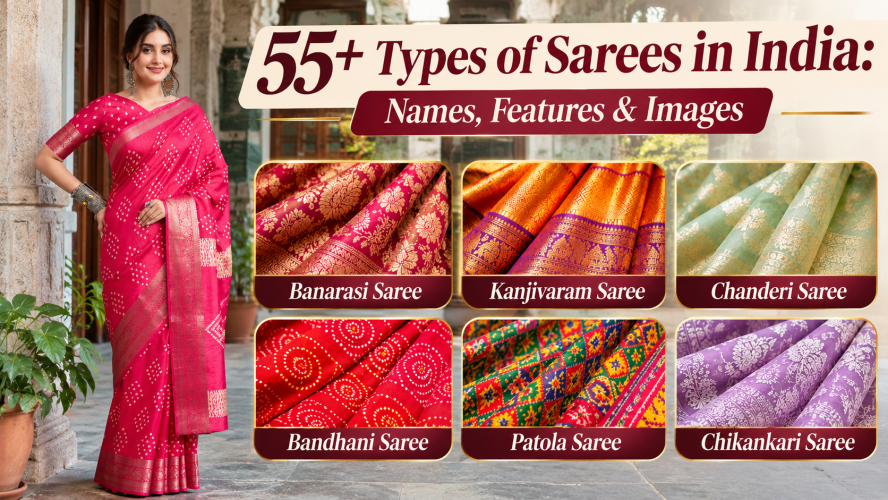
India has a rich saree tradition shaped by regional weaving techniques, fabrics, traditional designs, printing methods and cultural heritage. From the luxurious Banarasi silk sarees of Uttar Pradesh to the colourful Bandhani sarees of Gujarat and the traditional Kanjeevaram sarees of Tamil Nadu, every region has its own distinctive textile identity.
Understanding the different types of sarees in India helps buyers identify regional styles, compare fabrics, recognise traditional craftsmanship and choose suitable sarees for weddings, festivals, celebrations and everyday wear.
Indian sarees are not defined by fabric alone. Some are recognised by their place of origin, while others are known for their weaving techniques, embroidery, printing patterns or distinctive borders and pallus.
In this guide, we explore more than 55 types of sarees in India, their names, origins, fabrics and special features.

North India is known for rich silk weaving, traditional embroidery, brocade work and distinctive textile designs. Several regional sarees from this part of the country are popular for weddings, festivals and formal occasions.
Banarasi sarees originate from Varanasi and are among India's most recognised traditional silk sarees. They are known for intricate brocade weaving, zari work, decorative borders and detailed pallus. Traditional designs often include floral patterns, paisley motifs and Mughal-inspired artwork.
Fabric: Silk and other textile variations.
Best suited for: Weddings, bridal collections and festive occasions.
Image alt text: Banarasi silk saree with traditional gold zari brocade work.
Tanchoi sarees are associated with Varanasi's silk weaving tradition. They feature intricate woven patterns created through a distinctive weaving technique. Floral and paisley-inspired motifs are common, often giving the saree a detailed appearance without requiring heavy embroidery.
Fabric: Silk.
Best suited for: Weddings, celebrations and formal occasions.
Image alt text: Traditional Tanchoi silk saree with intricate woven motifs.
Jamdani is a traditional supplementary-weft weaving technique used to create decorative motifs directly on the fabric. It is particularly associated with the Dhakai Jamdani tradition of Bengal and Bangladesh, while Jamdani weaving is also practised in parts of India.
Its delicate motifs often include flowers, geometric patterns and decorative designs.
Fabric: Traditionally fine cotton, with other variations.
Best suited for: Cultural events, celebrations and elegant daytime occasions.
Image alt text: Fine Jamdani saree with delicate floral woven motifs.
Chikankari sarees are known for their delicate embroidery, traditionally associated with Lucknow. The embroidery creates subtle floral and decorative patterns across the fabric.
The technique can be used on different fabric types, making Chikankari sarees suitable for both traditional and contemporary styling.
Fabric: Cotton, georgette, chiffon and other variations.
Best suited for: Daytime functions, festive occasions and elegant gatherings.
Image alt text: Lucknow Chikankari saree with delicate floral embroidery.
Shikargah sarees are a decorative variation of Banarasi brocade weaving. Their patterns traditionally feature hunting scenes, animals, birds, trees and other nature-inspired motifs woven into the fabric.
Fabric: Silk.
Best suited for: Weddings, traditional functions and heritage-inspired collections.
Image alt text: Banarasi Shikargah saree with traditional animal and nature motifs.
Western India has a diverse saree tradition featuring tie-dye techniques, intricate weaving, traditional embroidery and colourful patterns. Gujarat, Maharashtra and Rajasthan are especially known for their distinctive saree styles.
Bandhani is a traditional tie-dye technique in which small sections of fabric are tied before dyeing to create dotted patterns. The finished fabric features distinctive dots, circles and decorative arrangements.
Common colours include red, yellow, green, blue and pink.
Fabric: Cotton, silk, georgette and other variations.
Best suited for: Festivals, weddings and traditional celebrations.
Image alt text: Colourful Gujarati Bandhani saree with traditional tie-dye patterns.
Patan Patola sarees are famous for their intricate double-ikat weaving technique. Both warp and weft threads are tie-dyed before weaving so that the patterns align in the finished fabric.
The process requires considerable skill and precision, making traditional Patola sarees highly valued.
Fabric: Traditionally silk.
Best suited for: Weddings, cultural events and premium ethnic collections.
Image alt text: Patan Patola silk saree with geometric double ikat patterns.
Rajkot Patola sarees are another well-known Gujarati textile variety. They are associated with the Patola-inspired ikat tradition and feature colourful geometric and traditional patterns.
Buyers should distinguish Rajkot Patola from traditional Patan double-ikat weaving because their production techniques can differ.
Fabric: Silk and other textile variations.
Best suited for: Festive wear and traditional occasions.
Image alt text: Rajkot Patola saree with colourful geometric patterns.
Gharchola sarees are traditionally associated with Gujarati wedding customs. They are recognised by their grid-like patterns, decorative zari work and auspicious motifs.
Red is a particularly common colour for traditional bridal Gharchola sarees.
Fabric: Traditionally silk, with other market variations.
Best suited for: Gujarati weddings and traditional ceremonies.
Image alt text: Red Gujarati Gharchola saree with traditional gold zari checks.
Panetar sarees are traditionally worn by Gujarati brides. They are commonly recognised by their white or off-white base combined with red borders and traditional embellishments.
The saree represents an important part of Gujarati wedding attire.
Fabric: Silk and other variations.
Best suited for: Bridal wear and Gujarati wedding ceremonies.
Image alt text: Traditional Gujarati Panetar bridal saree with red border.
Ajrakh is a traditional block-printing craft associated with Kutch and other parts of western India. The process uses resist printing and repeated printing stages to create detailed geometric and floral patterns.
Traditional Ajrakh designs often feature indigo, red, black and natural-inspired colours.
Fabric: Cotton, silk and other textile variations.
Best suited for: Traditional wear, cultural events and everyday ethnic styling.
Image alt text: Gujarati Ajrakh printed saree with indigo geometric patterns.
Leheriya is a traditional tie-dye technique that produces diagonal or wave-like stripes across the fabric. The name is associated with the wave-like appearance of the patterns.
Bright colours and flowing striped designs are common features.
Fabric: Cotton, silk, georgette and other variations.
Best suited for: Festivals, traditional celebrations and summer occasions.
Image alt text: Rajasthani Leheriya saree with colourful diagonal wave patterns.
Kota Doria sarees are known for their lightweight fabric and distinctive square-check pattern called khats. The weave creates a delicate, airy texture that makes these sarees comfortable in warm weather.
Fabric: Cotton and silk-cotton.
Best suited for: Summer wear, office wear and daytime occasions.
Image alt text: Kota Doria saree with lightweight square-check weave.
Bagru printing is a traditional hand-block printing technique associated with Rajasthan. It uses carved wooden blocks to create repeating floral, geometric and nature-inspired patterns.
Traditional Bagru textiles often feature earthy colours and natural-looking designs.
Fabric: Cotton and other textile variations.
Best suited for: Casual wear and traditional daytime styling.
Image alt text: Rajasthani Bagru printed cotton saree with traditional block patterns.
Sanganeri printing is another traditional block-printing craft from Rajasthan. It is known for delicate floral patterns, decorative motifs and lighter backgrounds.
These sarees are suitable for customers who prefer elegant printed designs.
Fabric: Primarily cotton, with other variations.
Best suited for: Everyday wear, office wear and summer occasions.
Image alt text: Sanganeri printed cotton saree with delicate floral motifs.
Paithani sarees originate from Maharashtra and are known for their rich silk fabric, colourful woven pallus and traditional motifs. Peacock, lotus and other nature-inspired designs are commonly seen.
The pallu and border are particularly important features of this saree tradition.
Fabric: Traditionally silk.
Best suited for: Maharashtrian weddings, festivals and traditional ceremonies.
Image alt text: Maharashtrian Paithani silk saree with peacock motif pallu.
Nauvari sarees are traditional nine-yard sarees associated with Maharashtra. They are generally draped in a distinctive dhoti-style manner, creating a different silhouette from the conventional six-yard saree drape.
They are an important part of Maharashtrian cultural attire.
Fabric: Cotton, silk and other variations.
Best suited for: Traditional ceremonies, festivals and cultural performances.
Image alt text: Traditional Maharashtrian Nauvari saree with dhoti-style draping.
Maheshwari sarees originate from Maheshwar in Madhya Pradesh. They are recognised for their lightweight texture, distinctive borders and combinations of stripes, checks and solid colours.
Traditional designs often include reversible border patterns.
Fabric: Cotton, silk and silk-cotton.
Best suited for: Office wear, festive occasions and formal gatherings.
Image alt text: Maheshwari saree with traditional striped border and lightweight fabric.
Chanderi sarees are famous for their lightweight and slightly sheer texture. Traditional motifs include floral designs, peacocks, coins and geometric patterns.
Their delicate appearance and subtle sheen make them suitable for elegant occasions.
Fabric: Silk, cotton and silk-cotton.
Best suited for: Festivals, daytime functions and formal events.
Image alt text: Chanderi silk cotton saree with delicate woven motifs.
Bagh printing is a traditional hand-block printing craft associated with Bagh in Madhya Pradesh. It is known for its detailed geometric and floral patterns, often created using contrasting natural-inspired colours.
Fabric: Traditionally cotton, with other textile variations.
Best suited for: Everyday ethnic wear and cultural occasions.
Image alt text: Bagh printed saree with traditional geometric block-print patterns.

South India has a strong silk and cotton weaving tradition. Sarees from Tamil Nadu, Karnataka, Kerala, Andhra Pradesh and Telangana are recognised for their distinctive borders, traditional motifs, contrasting colours and regional weaving techniques.
Kanjeevaram sarees, also known as Kanchipuram silk sarees, are among India's most recognised traditional silk sarees. They are known for rich silk fabric, contrasting borders, zari detailing and traditional motifs.
These sarees are especially popular for South Indian bridal and wedding collections.
Fabric: Silk.
Best suited for: Weddings, bridal wear and religious ceremonies.
Image alt text: Kanjeevaram silk saree with contrasting zari border.
Arani silk sarees are associated with Arani in Tamil Nadu. They are known for traditional silk weaving, decorative borders and a variety of colour combinations.
Fabric: Silk.
Best suited for: Weddings, festivals and formal occasions.
Image alt text: Traditional Arani silk saree with decorative woven border.
Madurai Sungudi sarees are known for traditional tie-dye patterns and dotted designs. The craft is associated with Madurai and has a long textile history.
The patterns can include small dots and colourful arrangements.
Fabric: Traditionally cotton, with other variations.
Best suited for: Everyday wear, traditional occasions and summer styling.
Image alt text: Madurai Sungudi cotton saree with traditional dotted tie-dye patterns.
Chettinad sarees are known for their bold colours, contrasting borders and checks or stripes. They traditionally feature a relatively substantial cotton texture.
Fabric: Cotton.
Best suited for: Everyday wear, office wear and traditional occasions.
Image alt text: Chettinad cotton saree with bold checks and contrasting border.
Kandangi sarees are associated with the Chettinad region of Tamil Nadu. They are traditionally recognised for bold checks, stripes and strong colour combinations.
Fabric: Cotton.
Best suited for: Traditional wear and everyday styling.
Image alt text: Traditional Kandangi cotton saree with colourful checks.
Mysore silk sarees are known for their smooth texture, elegant appearance and traditional zari borders. They are often appreciated for their simple yet refined designs.
Fabric: Silk.
Best suited for: Weddings, festivals and formal occasions.
Image alt text: Mysore silk saree with elegant gold zari border.
Ilkal sarees originate from Karnataka and are recognised for their distinctive borders and traditional pallus. A characteristic feature is the joining technique used to connect the body and pallu.
Traditional colours and patterns give Ilkal sarees a recognisable regional identity.
Fabric: Cotton, silk and cotton-silk variations.
Best suited for: Traditional wear and cultural occasions.
Image alt text: Karnataka Ilkal saree with traditional red border and pallu.
Molakalmuru sarees are associated with the Molakalmuru region of Karnataka. They are known for traditional silk weaving, colourful designs and decorative borders.
Fabric: Silk.
Best suited for: Weddings, festivals and formal ethnicwear.
Image alt text: Molakalmuru silk saree with traditional woven patterns.
Udupi sarees are associated with the coastal region of Karnataka. Traditional varieties are known for cotton weaving and practical designs suited to everyday use.
Fabric: Cotton.
Best suited for: Daily wear and traditional occasions.
Image alt text: Traditional Udupi cotton saree with simple woven border.
Kasavu sarees are an important part of Kerala's traditional clothing. They are recognised by their off-white or cream body and gold-coloured border.
These sarees are particularly associated with Onam, Vishu and traditional Kerala celebrations.
Fabric: Cotton and other variations.
Best suited for: Festivals, cultural celebrations and traditional ceremonies.
Image alt text: Kerala Kasavu saree with cream body and gold border.
Balaramapuram sarees are associated with traditional handloom weaving in Kerala. They are recognised for fine cotton fabric, simple designs and understated borders.
Fabric: Cotton.
Best suited for: Everyday wear, traditional events and warm-weather styling.
Image alt text: Balaramapuram handloom cotton saree with traditional border.
Kuthampully sarees are traditional Kerala handloom sarees known for their simple elegance, cotton fabric and distinctive borders.
Gold-coloured decorative borders are common in traditional varieties.
Fabric: Cotton.
Best suited for: Festivals, religious occasions and everyday traditional wear.
Image alt text: Kuthampully cotton saree with traditional Kerala-style border.
Mangalagiri sarees originate from Mangalagiri in Andhra Pradesh. They are known for their lightweight cotton fabric, simple body designs and characteristic borders.
Traditional versions often have fine stripes or minimal patterns.
Fabric: Cotton and silk variations.
Best suited for: Office wear, daily wear and formal occasions.
Image alt text: Mangalagiri cotton saree with simple body and traditional border.
Uppada Jamdani sarees are known for intricate handwoven motifs and lightweight fabric. They combine the regional weaving tradition of Uppada with Jamdani-inspired patterning.
Floral and geometric designs are commonly seen.
Fabric: Silk and other variations.
Best suited for: Weddings, festivals and formal occasions.
Image alt text: Uppada Jamdani saree with delicate woven floral motifs.
Venkatagiri sarees are known for fine weaving, lightweight fabric and decorative zari borders. Their traditional designs include stripes, motifs and delicate woven patterns.
Fabric: Cotton and silk variations.
Best suited for: Formal wear, festivals and traditional celebrations.
Image alt text: Venkatagiri saree with fine fabric and decorative zari border.
Gadwal sarees are known for their distinctive construction, contrasting borders and decorative pallus. Traditional varieties often combine a cotton body with silk borders and pallu.
Fabric: Cotton and silk combinations.
Best suited for: Weddings, festivals and traditional ceremonies.
Image alt text: Gadwal saree with contrasting silk border and decorative pallu.
Pochampally sarees are famous for their ikat weaving technique. The yarn is tie-dyed before weaving to create geometric patterns and colourful designs.
Their distinctive patterns make them popular among buyers interested in traditional handloom textiles.
Fabric: Cotton, silk and blended variations.
Best suited for: Festivals, formal occasions and traditional wear.
Image alt text: Pochampally Ikat saree with geometric woven patterns.
Narayanpet sarees are known for traditional borders, checks and simple geometric patterns. Their designs often combine practical fabric construction with colourful regional styling.
Fabric: Cotton and silk variations.
Best suited for: Everyday wear and traditional occasions.
Image alt text: Narayanpet saree with traditional checks and decorative border.
Gollabhama sarees are known for their distinctive woven motifs, particularly traditional depictions of women carrying pots. The designs reflect the local cultural identity of Siddipet.
Fabric: Traditionally cotton, with other variations.
Best suited for: Cultural events and traditional collections.
Image alt text: Siddipet Gollabhama saree with traditional woman motif.
Eastern India is known for distinctive ikat weaving, fine cotton textiles, silk traditions and decorative handloom designs. Odisha, West Bengal, Assam and Bihar have several recognised saree varieties.
Sambalpuri sarees are famous for the Bandha or ikat weaving technique. Their patterns are created by tie-dyeing yarn before weaving, producing distinctive motifs and geometric designs.
Traditional motifs may include conch shells, flowers, wheels and other cultural symbols.
Fabric: Cotton, silk and blended variations.
Best suited for: Festivals, cultural occasions and traditional wear.
Image alt text: Sambalpuri ikat saree with traditional woven motifs.
Bomkai sarees are known for their decorative borders, intricate pallus and traditional motifs. They combine distinctive weaving patterns with decorative designs inspired by Odisha's textile heritage.
Fabric: Cotton and silk.
Best suited for: Festivals, weddings and formal occasions.
Image alt text: Odisha Bomkai saree with decorative traditional pallu.
Khandua sarees are associated with Odisha's traditional ikat weaving. They are recognised for their woven motifs, decorative borders and cultural significance.
Traditional varieties often include auspicious and religious motifs.
Fabric: Silk and cotton variations.
Best suited for: Religious occasions, festivals and traditional ceremonies.
Image alt text: Khandua silk saree with traditional Odisha ikat motifs.
Kotpad sarees are known for their traditional handloom weaving and use of natural dyes. The textiles are particularly associated with earthy shades, including deep red and black.
Fabric: Cotton.
Best suited for: Cultural events and traditional ethnicwear.
Image alt text: Kotpad handloom cotton saree with natural earthy colours.
Berhampuri Patta sarees are associated with Berhampur in Odisha. They are known for traditional silk weaving, decorative borders and distinctive pallu designs.
Fabric: Silk.
Best suited for: Traditional functions, festivals and weddings.
Image alt text: Berhampuri Patta silk saree with traditional woven border.
Habaspuri sarees are traditional handloom textiles associated with Odisha. They feature distinctive woven motifs, traditional patterns and regional designs.
Fabric: Cotton.
Best suited for: Cultural events and everyday ethnic styling.
Image alt text: Habaspuri handloom saree with traditional woven motifs.
Baluchari sarees originate from Bishnupur in West Bengal. They are famous for their elaborate pallu designs, which often depict mythological scenes, historical stories and traditional figures.
Fabric: Silk.
Best suited for: Weddings, cultural events and formal occasions.
Image alt text: Baluchari silk saree with traditional narrative pallu motifs.
Tant sarees are traditional Bengali cotton sarees known for their lightweight texture, comfortable drape and decorative borders. They are commonly worn during daily activities and festive occasions.
Fabric: Cotton.
Best suited for: Daily wear, summer styling and festivals.
Image alt text: Bengali Tant cotton saree with traditional decorative border.
Dhaniakhali sarees are known for their traditional cotton weaving and distinctive borders. They are valued for their practical texture and simple regional designs.
Fabric: Cotton.
Best suited for: Everyday wear and traditional occasions.
Image alt text: Dhaniakhali cotton saree with traditional woven border.
Garad sarees are traditionally associated with Bengali cultural and religious occasions. They are recognised by their white or off-white body and contrasting red borders.
Fabric: Traditionally silk.
Best suited for: Religious ceremonies, festivals and traditional functions.
Image alt text: Bengali Garad saree with white body and red border.
Tangail sarees are known for their lightweight fabric, decorative borders and fine woven motifs. The weaving tradition has strong roots in Bengal and the wider historical Tangail textile region.
Fabric: Cotton and silk variations.
Best suited for: Traditional wear and everyday occasions.
Image alt text: Tangail saree with delicate woven patterns and decorative border.
Kantha sarees feature decorative running-stitch embroidery inspired by Bengal's traditional Kantha craft. The embroidery can create floral, geometric and narrative patterns across the fabric.
Fabric: Cotton, silk and other variations.
Best suited for: Artistic ethnicwear, cultural events and casual occasions.
Image alt text: Bengali Kantha embroidered saree with decorative running stitches.
Bhagalpuri sarees are associated with Bhagalpur's silk industry. Tussar silk varieties are recognised for their natural texture, subtle sheen and earthy appearance.
Fabric: Tussar silk and other silk variations.
Best suited for: Formal occasions, festivals and elegant ethnic styling.
Image alt text: Bhagalpuri Tussar silk saree with natural silk texture.
The North-East has distinctive silk traditions and regional textile crafts. Assam is especially recognised for its traditional silk varieties.
Muga silk is a traditional silk variety associated with Assam. It is known for its natural golden appearance and distinctive texture.
Muga silk is valued for its cultural significance and traditional craftsmanship.
Fabric: Muga silk.
Best suited for: Weddings, festivals and special traditional occasions.
Image alt text: Assam Muga silk saree with natural golden sheen.
Eri silk is another traditional silk variety from Assam and the North-East. It is known for its soft, textured feel and relatively matte appearance compared with highly lustrous silk varieties.
Fabric: Eri silk.
Best suited for: Traditional wear and comfortable ethnic styling.
Image alt text: Assam Eri silk saree with soft natural texture.
Pat silk sarees are made from the traditional white or off-white silk associated with Assam. They are known for their smooth texture and elegant appearance.
Traditional designs may include floral, geometric and regional motifs.
Fabric: Pat silk.
Best suited for: Festivals, ceremonies and formal occasions.
Image alt text: Assam Pat silk saree with traditional woven motifs.
Apart from regional sarees, Indian sarees are also classified by the fabric used, printing technique, weaving style and decorative finish. These categories are important for retailers and buyers because they help distinguish product characteristics and customer preferences.
Cotton sarees are widely worn because of their breathable fabric and comfortable drape. They are available in numerous regional variations, including Tant, Kota Doria, Chettinad, Mangalagiri and other handloom styles.
Best suited for: Daily wear, summer wear and office wear.
Image alt text: Traditional cotton saree with lightweight fabric and woven border.
Silk sarees are valued for their smooth texture, natural sheen and traditional appeal. Different regional silk varieties include Banarasi, Kanjeevaram, Paithani, Mysore and Tussar.
Best suited for: Weddings, festivals and formal occasions.
Image alt text: Traditional Indian silk saree with decorative zari work.
Georgette sarees are popular for their lightweight, flowing texture and soft drape. They are available in printed, embroidered, embellished and plain designs.
Best suited for: Parties, celebrations and contemporary ethnic styling.
Image alt text: Elegant georgette saree with flowing drape and decorative border.
Chiffon sarees are known for their lightweight, sheer and fluid texture. They are often selected for their graceful drape and comfortable styling.
Best suited for: Parties, casual celebrations and evening occasions.
Image alt text: Lightweight chiffon saree with elegant flowing drape.
Organza sarees have a lightweight, sheer and slightly structured appearance. Their crisp texture makes them suitable for floral prints, embroidery and contemporary designer-inspired looks.
Best suited for: Weddings, receptions and formal occasions.
Image alt text: Organza saree with delicate floral embroidery and sheer fabric.
Linen sarees are recognised for their natural texture, breathable feel and understated appearance. They are suitable for customers who prefer simple and elegant clothing.
Best suited for: Office wear, daytime events and everyday styling.
Image alt text: Linen saree with natural texture and minimal woven design.
Tissue sarees are known for their subtle metallic appearance and light-reflecting finish. They are available in silk and other fabric variations and are often designed with decorative borders and embellishments.
Best suited for: Weddings, festive events and celebrations.
Image alt text: Tissue saree with shimmering metallic finish and decorative border.
Crepe sarees feature a distinctive textured surface and fluid drape. They are available in different prints, colours and decorative styles.
Best suited for: Office wear, parties and contemporary ethnic styling.
Image alt text: Crepe saree with textured fabric and elegant drape.
Choosing a saree depends on the occasion, fabric preference, design, comfort and budget. Understanding these factors helps individual buyers and retailers select suitable products.
For weddings: Banarasi, Kanjeevaram, Paithani, Patola and traditional bridal sarees are popular choices because of their rich designs and traditional craftsmanship.
For festivals: Bandhani, Gharchola, Sambalpuri, Chanderi and Kasavu sarees offer distinctive regional styles for different celebrations.
For daily wear: Cotton, Tant, Mangalagiri, Chettinad, Kota Doria and other lightweight varieties are practical options.
For office wear: Linen, cotton, Maheshwari and simple Chanderi sarees are suitable for customers who prefer understated designs.
For parties and receptions: Georgette, chiffon, organza and tissue sarees offer a range of flowing and decorative styles.
For saree retailers, boutique owners and wholesalers, understanding regional saree varieties is important when developing a product collection. Different customers look for different fabrics, designs, occasions and price categories.
A well-planned saree collection can include traditional silk sarees, lightweight cotton sarees, printed varieties, designer-inspired styles and festive collections.
Before selecting products for wholesale purchasing, retailers should evaluate:
Fabric composition and quality.
Weaving, printing or embroidery technique.
Colour consistency and finishing.
Border and pallu construction.
Product specifications and available designs.
Minimum order quantity and wholesale terms.
Customer demand and resale potential.
It is also important to understand the difference between an authentic regional handloom product and a machine-produced design inspired by that tradition. Product descriptions should accurately represent the fabric, origin and production method.
For retailers, resellers, boutique owners and bulk buyers looking to source sarees for their businesses, Ajmera Fashion Limited is a B2B fashion sourcing option based in Surat, Gujarat.
Surat has an established textile and garment ecosystem, making it an important destination for businesses exploring different saree collections and wholesale textile products.
Ajmera Fashion Limited provides an online platform where interested buyers can explore its product offerings and contact the business regarding wholesale requirements. Buyers can enquire about available saree collections, fabric specifications, designs, minimum order quantities, pricing and dispatch arrangements.
Whether a retailer is planning to expand a traditional saree collection or explore different styles for seasonal demand, understanding product categories and customer preferences is an important part of wholesale sourcing.
The different types of sarees in India represent the country's diverse textile traditions, regional craftsmanship and changing fashion preferences. From Banarasi and Kanjeevaram silk sarees to Bandhani, Patola, Sambalpuri, Chanderi and traditional cotton varieties, every saree has distinctive characteristics.
Understanding saree names, fabrics, origins and design features helps buyers make informed choices for weddings, festivals, everyday wear and formal occasions.
For retailers and wholesale businesses, learning about these varieties can also support better product selection and collection planning. Exploring different saree styles and working with suitable B2B suppliers can help businesses develop collections that match their customers' requirements.
Ajmera Fashion Limited is one Surat-based B2B sourcing option for businesses interested in exploring wholesale saree and ethnicwear collections.
📞 +91 88494 29440
📧 info@ajmerafashion.com

Discover 20 common mistakes in clothing retail bus...

Learn how to manage clothing stock in a retail sho...

Planning to start an ethnic wear business in India...
Discover 55+ types of sarees in India, including B...

Looking for bridal lehenga wholesale suppliers in ...

Looking for cheap kurtis for wholesale business? E...

