
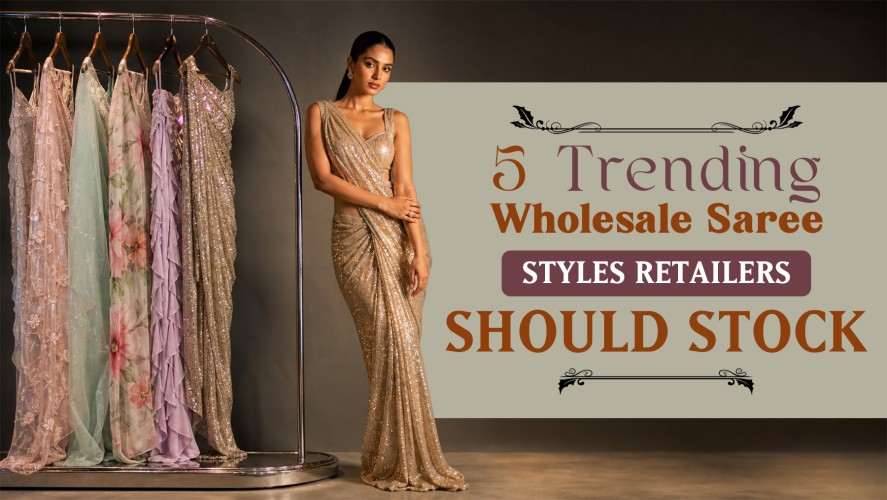
For saree retailers, choosing wholesale stock is no longer simply about buying the latest design. A good assortment needs to balance everyday demand, festive occasions, changing fashion preferences and the price range your customers are willing to pay.
In 2026, several saree categories are particularly relevant for retailers, including lightweight festive sarees, contemporary printed styles, easy-to-wear formats and traditional sarees with modern styling. Current wholesale trend reports also point to strong interest in digital-printed georgette, cotton and block-print sarees, organza and tissue styles, and ready-to-wear formats.
Here are five wholesale saree styles retailers should consider when planning their current inventory.
Digital-printed georgette sarees are a useful category for retailers because they can work across several occasions.
The combination of lightweight fabric and digitally created prints allows manufacturers to offer floral, abstract, traditional and contemporary patterns across different colour palettes. Current 2026 wholesale trend reporting identifies digital-printed georgette as one of the stronger commercial saree categories for retailers because of its versatility across casual, office and festive use.
For retailers, the advantage is variety. One fabric category can support multiple customer preferences without making the collection feel repetitive.
When selecting digital-printed georgette, pay attention to print clarity, fabric feel, colour accuracy and finishing. A visually attractive print cannot compensate for poor fabric quality.
Organza and tissue sarees have become increasingly relevant in festive and wedding-focused collections.
Their lightweight structure can create a dressier appearance without the weight associated with some heavily embellished traditional sarees. Current 2026 wholesale trend reports identify organza and tissue as important wedding-season categories, with pastel shades and embroidery or zari borders appearing frequently in current collections.
For a retailer, organza can fill an important middle ground between everyday sarees and heavier wedding products.
Pastel pink, powder blue, mint, ivory and similar lighter shades can work particularly well for daytime events, while richer colours and embellished borders can move the category toward evening and festive wear.
The key is not to stock only one colour family. A balanced collection can include soft pastels alongside a few stronger festive shades.
Not every saree purchase is driven by weddings or festivals.
Daily-wear sarees remain important for retailers because they can generate repeat purchases throughout the year. Cotton and block-print sarees are particularly relevant for customers who prioritise comfort, breathable fabrics and traditional visual appeal.
Current wholesale trend reporting continues to identify cotton printed and block-print sarees as useful retail categories, particularly for everyday and summer-oriented demand.
This category can include simple prints as well as more detailed traditional-inspired patterns.
For retailers, cotton sarees can also help create a broader price range. Customers who are not looking for premium occasionwear can still find something suitable within the store.
Look at the actual fabric composition, weave, print quality and colour fastness rather than assuming that every saree described as “cotton” will have the same characteristics.
This is especially important when sourcing online.
The traditional saree remains popular, but the way customers want to wear it is changing.
Ready-to-wear and pre-draped sarees offer an easier alternative for customers who like the appearance of a saree but do not want to spend time managing pleats and draping.
Current wholesale trend reporting has identified pre-draped sarees as an emerging retail opportunity, particularly among urban working women and younger buyers.
Silk sarees remain an important part of the Indian saree market because of their connection with weddings, festivals and traditional occasions.
Current 2026 trend reporting continues to identify designer silk, Banarasi-style, Kanjivaram-inspired and zari-work sarees as important premium categories for retailers.
Unlike everyday printed sarees, silk and festive sarees are often purchased for specific occasions. This means a retailer does not necessarily need the same volume of these products as daily-wear categories.
Instead, focus on a carefully selected assortment.
Traditional motifs, rich borders, zari detailing and deeper festive colours can provide the traditional appeal customers expect, while lighter colour palettes and contemporary blouse designs can make the products more relevant to younger buyers.
No.
A common inventory mistake is to replace proven products with every new trend that appears.
Trends are useful for attracting attention, but a retail saree collection should still contain dependable categories.
A practical assortment can combine:
Daily-wear sarees for repeat purchasing
Printed sarees for variety
Lightweight festive sarees for seasonal demand
Ready-to-wear styles for younger customers
Premium silk and occasion sarees for higher-value purchases
This creates a collection that is less dependent on one trend.
Start with your own sales data.
Look at which fabrics sell most frequently, which colours receive the most enquiries and which price ranges produce repeat purchases.
Then compare that information with current market trends.
For example, if your customers already purchase lightweight printed sarees, adding more contemporary digital prints may be a logical extension. If your store has strong wedding demand, organza, tissue and silk collections may deserve more shelf space.
The best trend is ultimately the one that matches your customer.
Surat is one of India's major textile and apparel sourcing centres, making it an important location for retailers looking for a broad range of saree styles.
The city has a large ecosystem covering textile manufacturing, processing, wholesale and ready-made fashion.
Ajmera Fashion Limited is based in Surat and provides an online wholesale sourcing route for retailers and other business buyers. Its current B2B catalogue contains more than one saree category, allowing buyers to compare different product segments from one online source.
For retailers outside Surat, this can be useful because initial product research does not require a physical market visit.
There is no universal number.
The right assortment depends on store size, customer base, purchasing budget and sales velocity.
A small boutique may perform better with a carefully selected collection than with hundreds of unrelated designs.
A larger retailer may require broader coverage across daily wear, festive, wedding and premium categories.
The objective should be variety with purpose—not variety for its own sake.
Avoid buying large quantities simply because a design is receiving attention on social media.
A viral style may have a short selling window.
Also avoid comparing suppliers purely on price. A cheaper saree can become an expensive purchase if quality problems result in slow sales, returns or customer complaints.
Finally, avoid building the entire collection around one fabric or trend. A balanced assortment provides more protection when customer preferences change.
The five saree categories worth considering for a 2026 retail assortment are digital-printed georgette, organza and tissue, cotton and block-print, ready-to-wear/pre-draped, and silk or festive sarees.
Each serves a different customer need. Digital prints provide design variety, organza and tissue work well for lightweight occasionwear, cotton and block prints support everyday demand, ready-to-wear sarees address convenience, and silk continues to serve weddings and traditional occasions. Current market reporting supports these categories as relevant areas for retailer attention in 2026.
Retailers should not treat trends as guaranteed sales. The strongest buying strategy is to combine current fashion signals with actual customer demand, product quality and sensible inventory planning.
For retailers who want to explore current wholesale saree collections from Surat, Ajmera Fashion Limited offers an online B2B sourcing option where individual saree products and their available commercial information can be reviewed before purchasing.
7 Tips for Buying Wholesale Sarees Online
📞 Phone / WhatsApp: +91 884 942 9440
📧 Email: info@ajmerafashion.com
Looking for unstitched dress materials wholesale i...

Looking for the best Anarkali suits wholesaler in ...
Looking for an Eid Anarkali suits wholesale suppli...
Looking for Eid special clothing wholesale in Sura...
Looking for Eid Collection Wholesale in Surat for ...
Looking for Eid collection wholesale in Surat? Ajm...

