
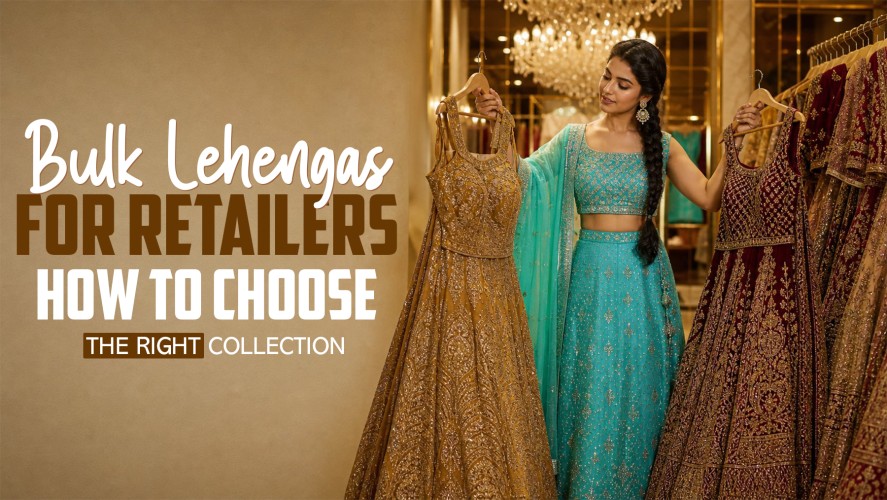
Buying bulk lehengas for retailers is not simply a matter of finding attractive designs and ordering large quantities. A lehenga collection has to work commercially. The right products need to match your customers, your selling price, the occasions they shop for and the amount of inventory your business can realistically manage.
This is particularly important with lehengas because the category covers a wide price and product range. A lightweight festive lehenga, a designer-style wedding lehenga and a heavily embellished bridal lehenga may all belong to the same broad category, but they serve completely different customers.
For retailers, the goal should therefore be to build a collection that offers enough variety without turning the store into an inventory of slow-moving products.
Before approaching a wholesale lehenga supplier, identify who is going to buy the products.
A store serving young customers may need contemporary colours, lighter fabrics and fashion-forward designs. A traditional ethnicwear store may require heavier embroidery, richer colours and wedding-oriented collections. A boutique may prefer a smaller number of distinctive designs rather than a large quantity of mass-market products.
Your location also matters.
Customer preferences in a metropolitan boutique can be different from those in a tier-2 or tier-3 city. Seasonal demand, wedding activity, local festivals and the spending power of your customers can all influence which lehengas actually sell.
Once the customer profile is clear, choosing the wholesale collection becomes considerably easier.
Retailers should know what role the lehenga category will play in the business.
If lehengas are a major category, you may need a collection covering everyday festive wear, party wear, wedding guest styles and bridal-oriented products.
If lehengas are an additional category within a saree or ethnicwear store, a smaller curated collection may be more appropriate.
This distinction affects how much inventory you should purchase.
A retailer does not necessarily need a large number of identical lehengas. In fashion retail, customers often value design variety, so having too much inventory concentrated in one design can create unnecessary risk.
Price is one of the most important decisions when buying in bulk.
There is no universal wholesale lehenga price that works for every retailer. The cost depends on fabric, embroidery, construction, embellishment, finishing and supplier.
Instead of asking only for the cheapest wholesale lehenga, determine the retail price your customers are comfortable paying and work backwards.
For example, a retailer positioned around affordable festivewear should not build the majority of the collection around high-cost bridal pieces. Likewise, a premium boutique may find that extremely low-priced lehengas do not fit its customer expectations.
The wholesale purchase price should always be considered alongside the expected selling price, operating expenses and desired margin.
Lehengas are strongly connected with occasions, and retailers can use this to structure their assortment.
Festive lehengas can serve customers shopping for celebrations and cultural events. Party-wear designs can appeal to younger shoppers and wedding guests. Heavier embroidered styles can target wedding and bridal customers.
The advantage of occasion-based planning is that it gives your inventory a clear purpose.
Instead of purchasing twenty different designs simply because they look good in a catalogue, you can ask whether each design fills a specific customer requirement.
That makes your buying process more disciplined.
Fabric has a direct effect on the look, feel, price and positioning of a lehenga.
Lightweight fabrics may be more suitable for customers looking for comfortable festive or party wear. Richer fabrics and structured constructions can support premium and bridal positioning.
Retailers should not rely solely on the fabric name provided by a supplier. Ask for the actual material composition and understand how the fabric behaves.
When buying online, product photographs can also create misleading impressions of texture and weight. If the order is significant, requesting additional product information or samples can reduce uncertainty.
Embroidery, sequins, zari, stones, threadwork and other embellishments can substantially change the appearance and cost of a lehenga.
Heavy embellishment may make a product suitable for bridal or premium occasions, but it can also make the garment heavier and narrower in terms of everyday customer use.
Retailers should therefore consider whether the amount of work on the garment is appropriate for the customer and selling price.
A well-balanced collection usually includes different levels of detailing instead of making every product heavily embellished.
A lehenga is a coordinated outfit, so evaluating only the skirt is a mistake.
The blouse design, stitching, lining, finishing and dupatta can significantly affect the customer's perception of the complete outfit.
Before purchasing bulk lehengas, check exactly what is included in the set and how the components are constructed.
A visually attractive skirt cannot compensate for a poorly finished blouse or an unsuitable dupatta.
Sizing can become a serious issue for retailers selling ready-made lehengas.
Ask the supplier for actual measurements rather than relying only on labels such as S, M, L or XL.
Understand whether the waistband is adjustable, whether the blouse has additional margin for alteration and whether the garment can accommodate common body-size variations.
This is especially important for bridal and premium lehengas because customers may expect alterations before wearing the outfit.
A collection with useful size flexibility can reduce the number of products that become difficult to sell because of fit.
Colour selection should be intentional.
Red, maroon, pink, green, gold and other traditional shades may work strongly for wedding and festive collections, while pastel and contemporary combinations may appeal to customers looking for modern occasionwear.
Do not fill your inventory with multiple versions of the same colour simply because it is currently popular.
A retailer should create enough colour variation to give customers a choice while maintaining a coherent collection.
For a new retailer, buying too deeply into one lehenga design can be risky.
Fashion products are sensitive to changes in customer preference. A design that looks highly attractive today may not perform equally well several months later.
A better initial strategy is often to test a wider range of designs in controlled quantities and then increase purchases around the products that actually sell.
Once you have sales data, your buying becomes much more accurate.
A good lehenga collection is only useful if the supplier can support the business behind it.
Before placing a bulk order, check the supplier's business identity, location, product information, pricing, availability and ordering process.
Ask how products are identified for repeat orders and whether the supplier can provide updated collections.
If you are purchasing online, make sure there is a clear way to communicate with the supplier before payment and after the order is placed.
This is particularly important for retailers who expect to replenish successful products rather than make a single purchase.
Wholesale markets provide a useful way to compare many products and suppliers in one location.
However, not every market seller is necessarily the manufacturer of the product being sold.
A retailer interested in long-term sourcing should understand whether they are purchasing directly from a manufacturer, from a wholesaler or through multiple layers of distribution.
Direct manufacturer sourcing can provide greater visibility into the product's origin and may be useful when repeat buying and collection development are important.
The right choice still depends on pricing, product quality, availability and service.
Surat is one of India's major textile and apparel manufacturing centres and is an important sourcing location for retailers looking for Indian ethnicwear.
The city's textile ecosystem around areas such as Ring Road and Sahara Darwaja includes manufacturers, wholesalers, textile businesses and garment suppliers.
For retailers, the benefit is access to a large product ecosystem rather than dependence on a single market or supplier.
Businesses that cannot repeatedly travel to Surat can also consider online wholesale sourcing from Surat-based suppliers.
For retailers looking for a Surat-based wholesale source, Ajmera Fashion Limited is an option to consider for bulk lehenga sourcing.
Ajmera Fashion Limited is based in Surat, Gujarat, and operates a wholesale/B2B business covering Indian ethnicwear categories including lehengas. Its current online catalogue allows business buyers to explore available products and contact the company regarding wholesale requirements.
This can be useful for retailers who want access to Surat-based collections without making a physical market visit for every buying cycle.
Ajmera Fashion states that it has more than three decades of textile and apparel experience and serves buyers in India and international markets. These are company-published credentials, so retailers should still verify the specific product, availability, pricing and commercial terms applicable to their order.
Your first order should be treated as a supplier evaluation as well as an inventory purchase.
Check whether the delivered products match their catalogue descriptions. Examine stitching, fabric, embroidery, finishing, sizing and packaging.
Then consider the commercial side.
Was the order dispatched as agreed? Was communication clear? Could the supplier answer questions quickly? Can successful products be reordered?
If the answer to these questions is consistently positive, you have the foundation for a longer-term sourcing relationship.
Lehenga demand is highly seasonal.
Wedding seasons, festivals and major celebration periods can significantly influence customer demand. Retailers should therefore plan buying well ahead of the period in which the products are expected to sell.
At the same time, avoid overestimating seasonal demand.
Historical sales data from your own business is more useful than general assumptions. If a particular type of lehenga sold quickly during the previous wedding season, it deserves more attention in the next buying cycle.
The supplier's quoted price is not always the final cost to your business.
Transportation, packaging, taxes, payment charges, alterations, defects and other expenses can affect the actual landed cost.
Retailers should calculate this figure before setting the retail price.
This allows you to compare suppliers on a meaningful basis. A supplier with a slightly higher unit price may provide better overall value if product quality is more consistent and fewer garments require discounting or correction.
The right collection should have a logical relationship between your customer, price point and occasion.
It should provide enough design variety without creating excessive inventory. It should cover the sizes your customers actually request and offer a quality level appropriate to the intended retail price.
Most importantly, the collection should be replenishable.
A retailer's strongest products are rarely the ones that look best in a catalogue alone. They are the products that customers buy, recommend and return to purchase again.
Retailers should consider customer profile, price range, occasion, fabric, embroidery, sizing, colours, product quality, supplier reliability and expected selling margin before purchasing in bulk.
Retailers can source bulk lehengas from major textile and garment centres such as Surat, Delhi and Jaipur, as well as directly from manufacturers and wholesale suppliers operating online.
Yes. Surat has a large textile and apparel ecosystem and is an important sourcing destination for Indian ethnicwear, including fashion-oriented lehengas and other occasionwear.
There is no universal quantity. The initial purchase should depend on available working capital, customer demand and the retailer's ability to sell the products. Testing a controlled range before increasing inventory can reduce risk.
Check the supplier's business identity, location, product information, quality consistency, pricing, availability, communication, order fulfilment and ability to support repeat orders.
Yes. Many manufacturers and wholesale suppliers provide online catalogues through which retailers can review collections and contact suppliers before placing orders.
Ajmera Fashion Limited is a Surat-based textile and wholesale business offering Indian ethnicwear categories including lehengas. Retailers should check the current catalogue and confirm availability and wholesale terms before ordering.
Choosing bulk lehengas for retailers should be treated as an assortment and inventory decision rather than simply a purchasing exercise.
Start with your customer and selling price. Decide which occasions you want to serve, select fabrics and designs accordingly, evaluate sizing and finishing, and test products before committing too much working capital.
Surat is an important sourcing destination for retailers who want access to a broad Indian ethnicwear ecosystem. For businesses that want to source from Surat without repeatedly visiting the physical markets, Ajmera Fashion Limited offers a wholesale sourcing option for lehengas and other ethnicwear.
The strongest collection is not necessarily the largest one. It is the collection that gives your customers the right choices, fits your price positioning and allows you to turn inventory into sales consistently.
📞 Phone / WhatsApp: +91 884 942 9440
📧 Email: info@ajmerafashion.com
When you run an independent store, your margins a...
Sourcing your inventory directly from the Top 5 Be...
Walk into any major wholesale textile market and y...

That kind of bad purchase leaves you with angry re...
A practical guide for retailers and resellers who ...

Looking for Pakistani suits wholesale in Surat? Le...

