
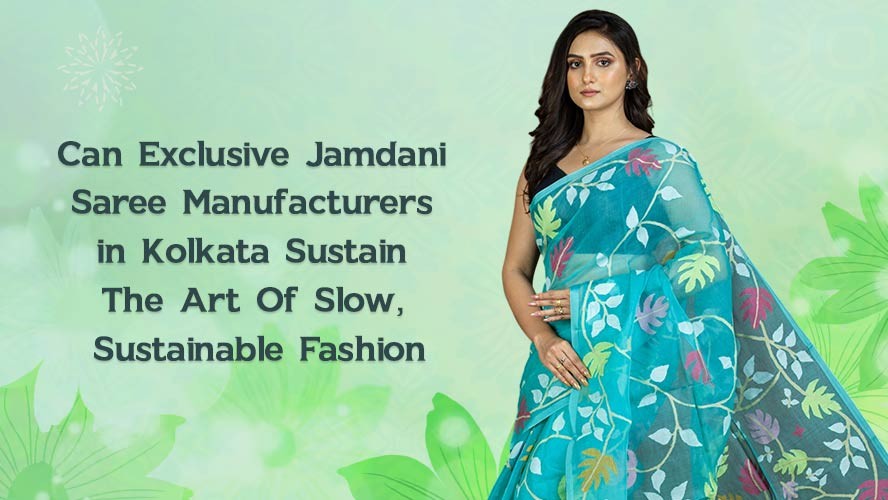
The weavers, caught in this whirlwind race of making time their own, seem to stand at the threshold, upholding a rich tradition—handloom weavers of a great sanction. In their tiny workshops, there is no machinery; only the weaver, the shuttle, the yarn, and that godly sense of touching the spirit. Craftsmanship, then, is a 24/7 way of life for Jamdani Saree Manufacturers in Kolkata, such as Ajmera Fashion Limited—slow, dignified, and beautifully timeless.
Jamdani is no commonplace weave; it’s embroidery in feelings. What every piece puts across is the dedication, beat, and uncompromising professional pride of the artisan. In watching a weaving, one could almost see poetry written — letter by thread. Hand-embroidered designs; they are not printed, nor are they stitched. However, no two saris look alike. In every weave, there is a narrative bit from somewhere — reminding us that indeed, real workmanship carries a depth.
Absolutely nothing is wasted, not even pieces of imperfect threads. Their sarees— imperfect and therefore immensely appealing—on periodare the suggestion of what sustainability means-a possibility to make something wonderful out of little. Crossing countries into the hinterlands, the Ghicha Saree Manufacturers in Bihar present yet another story of sustainable fashion. Their clothes are made out of scrap silk yarns, thereby carrying the flag for ecocracy.
The new generation of Jamdani saree makers today knows that buyers are simply asking for more value these days, other than a mere glamour effect. They would like to wear attributes, attitudes, & put fashion on speaking terms with culture, community, and care. This generation is increasingly proving that sustainability and stylishness can go hand in hand. These artisans have redefined elegance- not through accumulation but through authenticity.
Their motifs speak of pride and attachment; they incorporate elements of myth, nature, and everyday life. Sambalpuri textiles are more than garments; they embody a piece of culture—a badge worn with pride. Hence, Sambalpuri Saree Manufacturers in Odisha keep alive one of the most peculiar weaving traditions in India: the tie and dye ikat technique. It demands lots of attention, time, and precision for the design blending while dying of the threads before they are actually woven.
Fast fashion gives instant pleasure, whereas slow fashion gives soul. Handwoven sarees like Jamdani, Ghicha, and Sambalpuri are an ode to craftsmanship, community, and consciousness-something that mass production could never afford. Slow fashion urges one and all to stop at their steps and understand, feel, and owe to whoever took such pains to be brought within one's sight in the first place. No simple cloth being woven here, but history, tradition, and luxury in the making.
Today, these artisans are not just weavers, but storytellers, narrating the tales of the past in the present. Their art is not about weaving; it is about preservation of tradition and the acceptance of transformation. They constitute the very nerve of India, conscious, fashion-wise. Through their artistry, weaving becomes more than making; it becomes immobilization, purpose, and pride. Proving that the true fashion is not chasing trends but is about nurturing legacy while redefining sustainability through every single thread.

Learn how to buy clothes directly from a manufactu...

Discover how factory direct wholesale clothing hel...

Learn how to import clothes from India with this p...

Who Is the Best Kurti Manufacturer in Surat? Disco...

Looking for the best kurtis wholesaler in Surat? A...

Looking for the best saree wholesaler in Surat? Le...

