
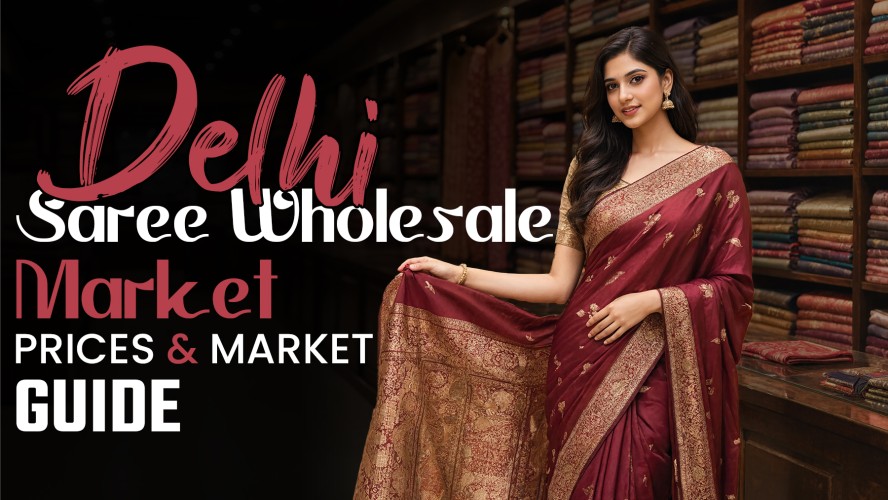
When you search for “Delhi Saree Wholesale Market,” you are likely a retailer, boutique owner, reseller, or someone planning to start a saree business. You want to understand where to go, what to expect, how much you should budget, and what mistakes to avoid while sourcing sarees in bulk. This guide answers those questions exactly without making you read another listicle full of unverifiable shop names and imaginary price tags.
In the following sections, we will walk you through how Delhi’s wholesale saree market actually works, the kind of sarees you can source, the factors that influence wholesale pricing, how to evaluate suppliers, and how physical market visits compare with online B2B sourcing. By the end, you will be able to plan your purchase whether you choose to visit a market or explore an online wholesale partner like Ajmera Fashion Limited.
The Delhi saree wholesale market is not a single building or a government-run facility. It is a collection of commercial areas spread across the city where wholesalers, distributors, and manufacturers trade sarees in bulk. These businesses cater primarily to retailers, boutique owners, export buying houses, and institutional buyers who need consistent supply at trade-friendly rates.
Unlike retail markets where you buy one or two pieces, wholesale markets work on volume. The more you buy, the better the per-piece cost. A boutique owner stocking a new festive collection and a retailer sourcing daily-wear cotton sarees both approach these clusters with different requirements, but their goal is the same: reliable supply at sustainable margins.
In Delhi, the wholesale saree trade overlaps with the larger textile and garment ecosystem. This means you can often find allied products—dress materials, suits, lehengas—in nearby lanes, which helps multi-category store owners plan a single sourcing trip.
Experienced buyers typically concentrate their search in a few well-known commercial pockets. Each area has a distinct character, and knowing what kind of sarees a cluster generally offers saves time and travel.
Chandni Chowk (Old Delhi)
This is the most frequently mentioned destination for textile and saree wholesale. Lanes such as Kinari Bazaar, Katra Neel, Nai Sarak, and Fatehpuri are lined with wholesalers dealing in everything from bridal sarees to affordable daily-wear options. Many shops here serve multi-generational retail buyers and may hold stocks of traditional silk sarees, Banarasi-style pieces, and heavily embroidered designs. Because the area is dense, comparing two or three suppliers within the same lane is practical.
Lajpat Nagar (Central Market & nearby lanes)
Lajpat Nagar is better known as a retail hub, but the surrounding streets and some inner shops also house wholesalers who supply boutiques and resellers. You are likely to find cotton sarees, printed chiffon, georgette, and synthetic sarees here. It suits small boutique owners who want moderate order quantities and the ability to see the product before buying.
Karol Bagh
Karol Bagh has a significant presence of readymade garment and saree wholesalers. Ajmal Khan Road and the adjoining lanes host suppliers who deal in party-wear sarees, embroidered net sarees, and designer-style pieces. Many distributors in this area also operate through catalogues and may be open to providing product images to outstation buyers.
Gandhi Nagar
Gandhi Nagar is primarily a readymade garment wholesale market, but buyers searching for synthetic sarees, printed sarees, and low-to-mid-range options often explore this belt. It can be a practical stop for a retailer whose store already stocks readymade clothes and wants to add a modest saree section without making a separate trip to a different market.
Remember, not every shop inside these localities sells sarees, and a shop that sells silk sarees may not stock cotton at all. Instead of relying on a generic market name, walk into a lane, observe the display, speak with the shop owner about your category, and move on if the fit is not right.
Delhi’s wholesale channels can source a wide spectrum of sarees because the city acts as both a production and distribution centre. What you actually find depends on the supplier’s specialisation, seasonal demand, and the region they procure from. Commonly available categories include:
Cotton sarees – handloom-inspired, printed, kota, maheshwari-style, and everyday cotton varieties popular with retailers serving office-going and casual-wear customers.
Silk sarees – Banarasi-style, art silk, pure silk, tussar, and Bhagalpuri silk. Availability is higher in Chandni Chowk and specialised textile hubs.
Georgette and chiffon sarees – lightweight, printed and embroidered versions widely sourced by boutiques for party-wear and festive collections.
Crepe sarees – known for their fall and subtle sheen, these move fast in mid-range retail segments.
Printed sarees – digital prints, block prints, screen prints, and abstract patterns that cater to college-going and casual fashion buyers.
Embroidered and designer-style sarees – thread work, zari, sequins, stone work, and mirror work sarees that sell during wedding and festival seasons.
Daily-wear sarees – cotton blends, poly-cotton, and low-maintenance synthetics that retailers stock throughout the year.
Fancy and party-wear sarees – organza, net, satin, and mixed-fabric sarees with contemporary aesthetics.
Most wholesale buyers place orders for a mix. A typical boutique order might include a few designer-style pieces for the display window, a larger lot of printed georgette for walk-in customers, and a set of cotton sarees for repeat buyers. Because one supplier may not carry all categories, retailers often build a vendor panel.
Pricing is the first question every buyer asks, but a fixed “Delhi wholesale saree price” does not exist. The cost per piece moves with several layers:
Fabric – cotton sarees generally begin at lower price bands, while pure silk and heavily embroidered sarees cost significantly more.
Workmanship – hand embroidery and intricate zari work push the price higher than machine embroidery or plain digital prints.
Order volume – wholesale pricing is volume-sensitive. An order of 6 pieces will carry a higher per-unit rate than an order of 60 or 600 pieces.
Supplier source – a manufacturer-direct transaction may offer better value compared to a multi-tier distributor.
Season – during peak wedding and festival months, demand-driven pricing can affect wholesale rates.
Packaging and add-ons – if you request individual tagging, specific folding, or custom packaging, the landed cost per saree goes up.
If you check indicative data from trade publications or B2B platforms, entry-level printed cotton sarees may be available from a few hundred rupees per piece when ordered in substantial quantity, while designer-style party-wear sarees with elaborate work can cross several thousand rupees per piece. Treat all price references as directional; only a live quote against a defined quantity and specification will tell you the actual figure.
A structured buying process prevents impulse decisions and helps you compare suppliers evenly.
Define your customer – before you enter a lane, know whether you are stocking for price-conscious daily wear buyers, premium festive buyers, or a mix.
Shortlist saree categories – three to four categories per visit is manageable; trying to source ten categories at once dilutes focus.
Set a budget – allocate a per-saree range for each category and a total purchase budget so you can negotiate with clarity.
Visit multiple suppliers – check at least three to four wholesalers for the same saree type to understand the prevailing quality and price.
Ask about minimum order quantity (MOQ) – some shops may ask for six pieces per design, others a dozen. Match MOQ with your store’s sales cycle.
Check fabric and finishing – feel the fabric, examine the stitching, check for consistent colour, and look at the saree in daylight or under white light if possible.
Request samples or catalogue access – many wholesalers may not give a free sample on the spot, but they may share product images or allow you to photograph selected designs for your buying decisions.
Confirm payment and billing terms – discuss GST invoice requirements, advance payment percentage, and balance payment terms before you finalise.
Discuss dispatch and logistics – if you are from outside Delhi, arrange transport or check if the supplier offers parcel services.
Place a trial order first – a smaller first order reduces risk and lets you test product acceptance with your customers before committing large volumes.
Delhi’s markets have served generations of saree buyers, and they will continue to be a relevant sourcing route. But physical visits are not the only way to build a profitable saree section. As your retail or resale business grows, you may want to compare what is available outside the city, reduce your travel dependence, and still access fresh designs regularly.
This is where a B2B partner like Ajmera Fashion Limited can fit into your sourcing journey.
Ajmera Fashion Limited is a wholesale-focused supplier that works with retailers, boutique owners, and resellers across India. Instead of asking you to visit a specific market, the company provides an online catalogue where you can view sarees by fabric, work, and occasion, understand the wholesale pricing structure, and discuss your volume requirements directly with the team. For a store owner in a tier-2 or tier-3 city, this means access to designs and price points that may be difficult to find through local agents alone.
The approach is straightforward: you explore the available collection, shortlist what suits your customer base, and contact Ajmera Fashion Limited with your quantity, category, and budget. The team helps with product details, order terms, and dispatch—essentially what a reliable market wholesaler would do, but with the convenience of a digital process and wider geographic reach.
For retailers looking to compare online wholesale sourcing options, Ajmera Fashion Limited can be explored as an additional B2B supplier alongside your existing vendor relationships.
The Delhi saree wholesale market remains a valuable sourcing destination for retailers, boutiques, and resellers who can visit and physically inspect stock. Chandni Chowk, Lajpat Nagar, Karol Bagh, and other clusters give buyers the chance to touch fabrics, compare price points on the spot, and build face-to-face relationships with wholesalers. Understanding the product categories, how wholesale pricing works, and what to check before finalising a supplier will protect your investment and help you stock what actually sells.
At the same time, today’s retail landscape allows you to supplement—or even substitute—market visits with online B2B sourcing. Whether you want to reduce travel, test new designs quickly, or simply have a reliable supply partner outside Delhi, exploring a wholesaler like Ajmera Fashion Limited can add flexibility to your procurement process. The key is to keep your customer at the centre of every purchase decision and choose the sourcing route that gives you the best combination of quality, consistency, and business convenience.
Need sarees in bulk for your retail store, boutique, or resale business? Explore Ajmera Fashion Limited’s wholesale collection and contact the team with your product and quantity requirements.
What is the Delhi saree wholesale market?
It refers to the collection of commercial areas in Delhi where wholesalers, distributors, and manufacturers sell sarees in bulk to retailers, boutiques, and other resellers. Key clusters include Chandni Chowk, Lajpat Nagar, and Karol Bagh.
Where can I buy sarees wholesale in Delhi?
Buyers commonly visit Chandni Chowk (Kinari Bazaar, Katra Neel), Lajpat Nagar’s inner wholesale lanes, Karol Bagh, and Gandhi Nagar, depending on the saree type and budget. It is best to shortlist a few suppliers per area and compare.
Which sarees are commonly available wholesale in Delhi?
Cotton sarees, silk and art silk sarees, georgette, chiffon, crepe, printed sarees, embroidered designer-style sarees, daily-wear synthetics, and festive party-wear sarees are commonly found across Delhi’s wholesale markets.
How do I choose a reliable saree wholesaler?
Check fabric consistency, MOQ flexibility, pricing transparency, catalogue refresh frequency, packaging standards, dispatch timeline, return policy, and GST billing compliance. A trial order before placing a large volume order is a practical risk-control measure.
What is MOQ in saree wholesale?
MOQ stands for Minimum Order Quantity. It is the smallest number of pieces or designs a wholesaler will sell at one time. Some suppliers may set MOQs per design, while others may apply a total order value threshold.
Can I buy sarees wholesale online instead of visiting Delhi?
Yes. Several B2B suppliers, including Ajmera Fashion Limited, offer online wholesale saree catalogues for retailers and boutiques. This allows you to source from anywhere without travelling to Delhi, provided you follow a clear sampling or image-based selection process.
Is buying wholesale sarees online safe?
It can be safe when you deal with established B2B suppliers who offer clear product images, transparent pricing, and proper invoicing. Start with a small order, verify the quality, and only then scale up. Check if the supplier accepts business-friendly payment terms.
How can retailers compare saree suppliers effectively?
Create a simple comparison sheet covering price per piece, MOQ, fabric options, design variety, dispatch time, and after-order support. Compare at least three suppliers for the same saree type before making a final decision.
Can I order sarees in bulk from outside Delhi?
Absolutely. Many wholesalers in Delhi cater to outstation buyers through telephonic or digital ordering, and online B2B platforms further simplify the process by offering nationwide dispatch. Confirm logistics costs and delivery timelines in advance.
How can I contact a wholesale saree supplier like Ajmera Fashion Limited?
You can visit the Ajmera Fashion Limited website, browse the wholesale collection, and use the enquiry form or contact details provided to discuss your specific bulk requirements with their team.
📞 Phone / WhatsApp: +91 884 942 9440
📧 Email: info@ajmerafashion.com
Our team will assist you with all your requirements.

...

मां और बड़े भाई को ख...

A practical B2B guide for retailers, boutiques, wh...

A practical B2B guide to sourcing wholesale ethnic...

Learn how retailers, wholesalers, boutiques, ecomm...

Find trendy clothing wholesale suppliers in Surat ...

