
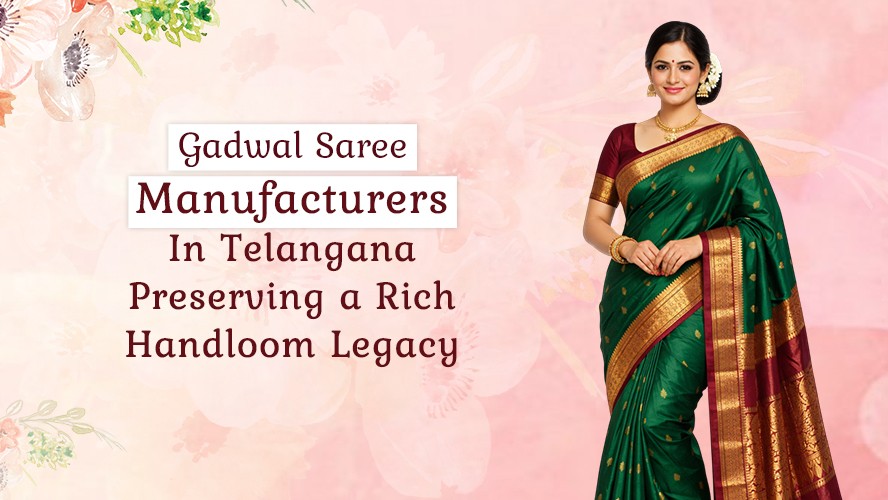
In the town of Gadwal in Telangana, you can hear the sound of handlooms clicking all day long. This is where the famous Gadwal Saree Manufacturers in Telangana do their magic. These sarees are very special because they bring two different things together. The main part of the saree is made of soft cotton, but the borders and the pallu (the part that hangs over the shoulder) are made of rich, shiny silk. This mix makes the saree very comfortable to wear in hot weather but it still looks grand enough for weddings and festivals.
The most amazing thing about a Gadwal saree is how it is put together. The weavers do not weave the whole saree at once. They weave the cotton body separately and the silk border separately. Then, they join them together by hand. This joining method is called "Kutu" or "Kupadam." It is very hard to do. The weaver has to link the cotton threads with the silk threads one by one. If you touch the place where the border meets the body, you can feel a tiny bump. This shows it is handmade. Because the cotton is so fine and soft, people say a real Gadwal saree can be folded so small that it fits inside a matchbox!
To appreciate the distinctiveness of the Gadwal weave, it helps to look at how other regions approach cotton handlooms. In the eastern state of West Bengal, the focus is entirely on airiness and transparency. The Tant Saree Manufacturers in Kolkata craft sarees that are incredibly light, designed specifically to combat the humid climate of the Bengal delta. Tant sarees are known for their starched crispness and pastel shades. But these sarees are different. They are not just light; they have a heavy look because of the silk border. While a Tant saree is mostly for daily wear, a Gadwal saree is for special occasions. The heavy silk border makes the saree fall beautifully, giving it a royal look that simple cotton cannot match.
The designs on a Gadwal saree are usually inspired by temples and nature. You will often see geometric patterns inspired by local temples, as well as nature-inspired elements like peacocks and mangoes. However, unlike printed fabrics, these designs are woven into the cloth using a jacquard mechanism or traditional adai technique. This focus on woven design contrasts sharply with the tie-dye traditions of neighboring Odisha. The Sambalpuri saree makers are world-renowned for their Ikat or "Bandha" art, where the yarn is dyed in specific patterns before weaving begins. While Sambalpuri offers a blurred, mystical aesthetic, Gadwal offers sharp, high-definition borders. Gadwal manufacturers focus on sharp, woven designs instead of dyed patterns. Big companies like Ajmera Fashion Limited understand that customers want different choices. As leading Sambalpuri Saree Manufacturers in Odisha, despite being based in Surat, they can offer both the blurry beauty of Ikat and the sharp elegance of Gadwal to their customers.
For a buyer, distinguishing a real handloom Gadwal from a power-loom copy can be challenging. The market is flooded with synthetic imitations. However, there are specific markers that the manufacturers maintain to prove authenticity.
Key Features to Look For:
A renewed interest in sustainable and "slow" fashion has brought the spotlight back to these manufacturers. Modern designers are collaborating with Gadwal weavers to introduce contemporary colors—pastels, neons, and monochromes—while keeping the traditional technique intact.
Owning a Gadwal saree is an investment in a dying art form. It is a garment that defies the logic of modern manufacturing, where speed is everything. A Gadwal saree cannot be rushed. It requires two weavers working in tandem to manage the separate shuttles for the body and the border. When you drape this saree, you are carrying the weight of that collaboration. You are supporting a weaver who spends days creating a single piece of cloth. It is a saree that carries the history of the Deccan region, mixing the comfort of cotton with the richness of silk in a way no machine can ever copy.

Looking for wedding gown wholesale options for you...

Looking for a gown wholesale market in Surat? Expl...

सिर्फ 9 साल की उम्र à¤...

Discover the top 10 fabric markets in Ahmedabad fo...

Discover 10 fabric and textile trading areas in De...

Discover 10 Mumbai markets to explore for wholesal...

