
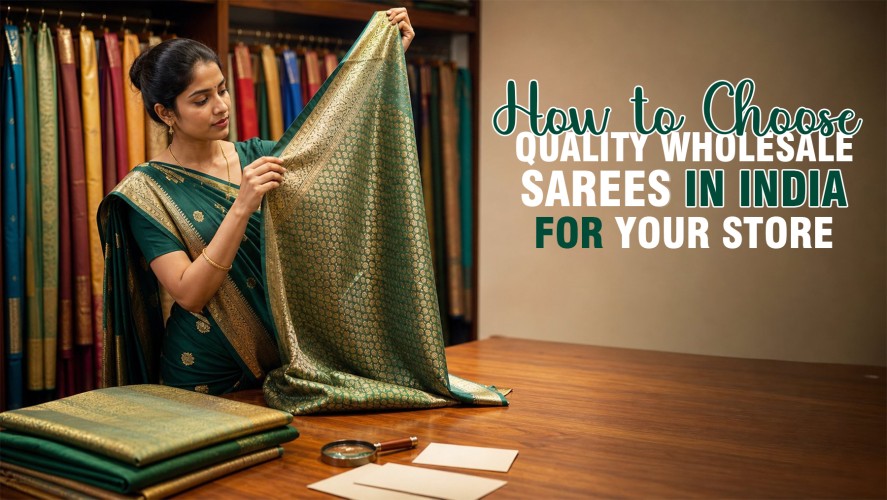
Buying wholesale sarees for a store is not just about finding a good-looking catalogue at a low price. The same saree category can vary considerably in fabric, finishing, print, embroidery, colour and overall construction.
For a retailer, the better question is: Will this saree look and feel good when my customer actually receives it?
That is why quality should be checked at the product level before placing a larger wholesale order.
Start with the actual fabric.
Terms such as silk, soft silk, georgette, chiffon, cotton, jacquard or organza describe different materials and constructions, but the name alone does not tell you everything about the finished product.
Ask for the exact fabric information and compare it with the product photographs and description. If you are buying online, do not assume that two sarees labelled with the same fabric name will have identical quality.
For repeat sourcing, keeping a record of the fabric and product code of successful sarees can also make future buying easier.
For printed sarees, inspect how clean the design appears.
Look for sharp motifs, consistent printing and colours that match the product photographs. Poor registration, blurred motifs or uneven colour can make a saree look considerably cheaper than it appeared online.
Retailers should also consider whether the colour suits their customer base. A technically good saree can still become slow-moving inventory if the colour or print does not match local demand.
For embroidered, sequined, zari, stone or embellished sarees, look closely at the finishing.
Check whether the work is evenly placed and whether loose threads, missing embellishments or rough finishing are visible. Heavy work also needs to be evaluated for how securely it is attached to the fabric.
Do not judge an embellished saree only from a front-facing catalogue photograph. Ask for additional product images or videos when the finishing cannot be assessed properly.
A good wholesale saree should have clean finishing throughout the garment.
Look at the borders, edges, pallu, stitching and any attached or included components. If a blouse piece is included, confirm what the product actually contains rather than assuming it from the photograph.
For retailers, finishing matters because customers notice small defects much more easily when the saree is physically inspected in a store.
A lower wholesale price does not automatically mean better value.
When comparing two suppliers, compare the actual product specifications, fabric, work, finishing, included components, quantity requirements, shipping and other applicable costs.
Ajmera Fashion's current online saree catalogue provides product-specific information rather than presenting one generic wholesale price for every saree. Current listings include different saree categories and individual product details, while commercial terms can vary by product.
For a retailer, the useful comparison is therefore:
Product quality + specifications + total buying cost + expected selling price
rather than simply choosing the lowest quoted price.
Quality assessment also applies to the supplier.
Before sending money for a wholesale order, check the supplier's business name, contact information, physical address and wholesale process.
Ajmera Fashion Limited publishes its wholesale registration information and lists its address at Sahara Darwaja Ring Road, Surat, Gujarat. Its website also provides a dedicated wholesale registration process for business buyers.
This gives a retailer identifiable business information to verify before ordering.
A catalogue photograph does not necessarily mean that the same product will remain available indefinitely.
Before finalising an order, confirm the current availability of the selected sarees, particularly when buying for a specific festival, wedding season or customer order.
This is also important for repeat sales. If a design performs well in your store, you need to know whether the supplier can provide the same product or a comparable collection later.
For a retail business, product identification is extremely useful.
If a saree sells well, you should be able to refer to its product code or specific catalogue listing when asking for availability again.
Ajmera Fashion's current catalogue uses individual product listings and product codes for its sarees. This makes it easier for business buyers to identify specific products when discussing future orders.
A first order should also be a supplier test.
Evaluate whether the delivered product matches the online description, whether the quality is consistent with the photographs, how the order is packed and how clearly the supplier communicates about the order.
If the first purchase meets your expectations, you have better information for deciding whether to increase your buying volume.
This is especially important for new retailers. A large catalogue cannot compensate for inconsistent quality or poor communication.
Different stores need different sarees.
A daily-wear store may need cotton and printed collections. A boutique may focus on premium or distinctive designs. A wedding-focused retailer may require heavier work and festive collections.
The best supplier for your business is therefore not necessarily the supplier with the largest catalogue or lowest price. It is the supplier whose products consistently match your customers and your retail price segment.
For retailers looking for wholesale sarees from Surat, Ajmera Fashion Limited is a manufacturer-backed wholesale supplier worth evaluating.
The company is based in Surat and operates a dedicated B2B wholesale channel. Its current information states that it has 34 years of textile and apparel experience and supplies buyers across 34 countries.
Its saree catalogue includes multiple product categories, with individual products carrying their own specifications and commercial information. Retailers can therefore shortlist specific sarees rather than making a purchasing decision based only on a general company catalogue.
For a retailer, that product-level approach is important: identify the saree, check its details, confirm the current availability and commercial terms, and then decide whether it fits your store.
Start by identifying the saree categories your customers actually buy.
Explore the current Ajmera Fashion saree catalogue and shortlist products based on fabric, design, price positioning and customer demand. Check the individual product information and then confirm the latest availability, pricing, applicable order requirements, payment and delivery terms directly with Ajmera Fashion.
Ajmera Fashion's current wholesale information also states an international minimum order value of ₹1 lakh. Domestic and international commercial terms can differ, so buyers should confirm the applicable terms for their order before payment.
The objective should be simple: buy products you can confidently sell, not simply products that look attractive in a catalogue.
Choosing quality wholesale sarees in India requires looking beyond photographs and price.
Check the fabric, print, embroidery, finishing, product specifications and current availability. Then evaluate the supplier's business identity, communication and ability to support repeat buying.
For retailers sourcing from Surat, Ajmera Fashion Limited provides a wholesale saree sourcing option with an established textile and apparel business, a dedicated B2B operation and a current online product catalogue.
The right wholesale saree is ultimately the one that combines acceptable quality, workable buying cost and genuine customer demand.
1. Which kurti styles are trending for wholesale buyers in 2026?
Straight-cut kurtis, printed kurtis, kurti sets, Anarkali styles and contemporary designer kurtis are practical categories for retailers to consider in 2026.
2. Which kurtis are best for everyday retail sales?
Cotton, rayon and printed kurtis are commonly suitable for everyday collections because they offer comfortable silhouettes and a wide range of designs and price positions.
3. Are kurti sets better than single kurtis for retail stores?
Kurti sets can be useful when customers prefer a complete outfit. Three-piece combinations with a kurti, bottom and dupatta can also provide a higher-value product option.
4. Which fabric is good for wholesale kurtis?
Cotton is suitable for breathable everyday wear, while rayon is commonly chosen for its soft drape and fashion-oriented styles. The right fabric depends on the season, customer preference and product positioning.
5. What type of printed kurtis should retailers stock?
Retailers can consider floral, geometric, ethnic-inspired and contemporary prints. A mix of smaller and statement prints can make the collection more useful across different customer preferences.
6. Are Anarkali kurtis suitable for wholesale retail collections?
Yes. Anarkali kurtis can add a more traditional and occasion-focused option to a retail collection and can be positioned for festive wear, family functions and casual ethnic occasions.
7. Which kurti styles are suitable for younger customers?
Contemporary prints, co-ord sets, short kurtis, modern straight cuts and fashion-focused designer kurtis can appeal to younger customers, depending on the local market.
8. Which wholesale kurtis are suitable for summer?
Lightweight cotton and breathable fabrics are generally more suitable for summer collections. Printed cotton kurtis can also work well as everyday summer products.
9. What are three-piece kurti sets?
A three-piece kurti set generally includes a kurti with a matching or coordinated bottom and dupatta. The exact combination depends on the product.
10. Are plus-size kurtis available in wholesale collections?
Yes. Some wholesale collections include extended sizes such as 3XL, 4XL, 5XL and 6XL. Retailers should check the actual measurements and size availability of each product.
11. Which kurtis are suitable for festive retail collections?
Embroidered, embellished, Anarkali, designer and premium kurti sets can be considered for festive collections. Colour, detailing and fabric should match the occasion and target customer.
12. What is the difference between a straight kurti and an A-line kurti?
A straight kurti generally falls more vertically from the shoulders, while an A-line kurti gradually widens toward the hem. Both are versatile retail silhouettes.
13. Should retailers stock designer and basic kurtis together?
Yes. Keeping basic everyday styles alongside selected designer or premium products can help retailers serve different customer needs and price points without depending on one category.
14. Which wholesale kurtis are suitable for boutiques?
Boutiques can consider curated printed, designer, embroidered, premium and coordinated kurti collections. The selection should match the boutique's customer profile rather than simply following every trend.
15. What colours should retailers consider when buying wholesale kurtis?
Retailers can combine dependable colours such as black, white, navy and earthy tones with seasonal shades and brighter colours. The ideal mix depends on local customer demand.
16. How should retailers choose trending wholesale kurtis?
Look at the combination of silhouette, fabric, print, colour, occasion and selling price rather than choosing a style only because it is currently popular. Retail sales data should ultimately guide repeat buying.
17. Are printed kurtis suitable for bulk retail buying?
They can be, particularly when the retailer wants design variety across an everyday collection. Different prints and colour combinations allow the same basic silhouette to be offered in multiple options.
18. Which kurti styles can work for both casual and festive wear?
Well-designed straight kurtis, Anarkali styles and coordinated sets can work across casual and light-festive occasions when the fabric, colours and detailing are appropriate.
19. What should retailers check before buying wholesale kurtis?
Check fabric, stitching, measurements, print or embroidery quality, colour, finishing, available sizes, product photographs and current availability before placing a wholesale order.
20. Where can retailers find trending wholesale kurtis in India?
Retailers can source trending wholesale kurtis from manufacturers and wholesalers in major apparel hubs such as Surat, Jaipur and Ahmedabad, as well as through online wholesale catalogues. Ajmera Fashion Limited is one Surat-based wholesale source retailers can evaluate for kurtis and other Indian ethnicwear.
10 Best Wholesale Kurti Suppliers in India for Retailers.
7 Tips for Buying Wholesale Sarees Online.

Looking for the Surat dress material wholesale mar...

Looking for the right bedsheet wholesale market in...

Looking for a wholesale kurti manufacturer in Sura...
Find a Surat-based B2B saree manufacturer for rese...

Explore wholesale lehenga sourcing in Surat for re...

Discover how businesses can source wholesale cloth...

