
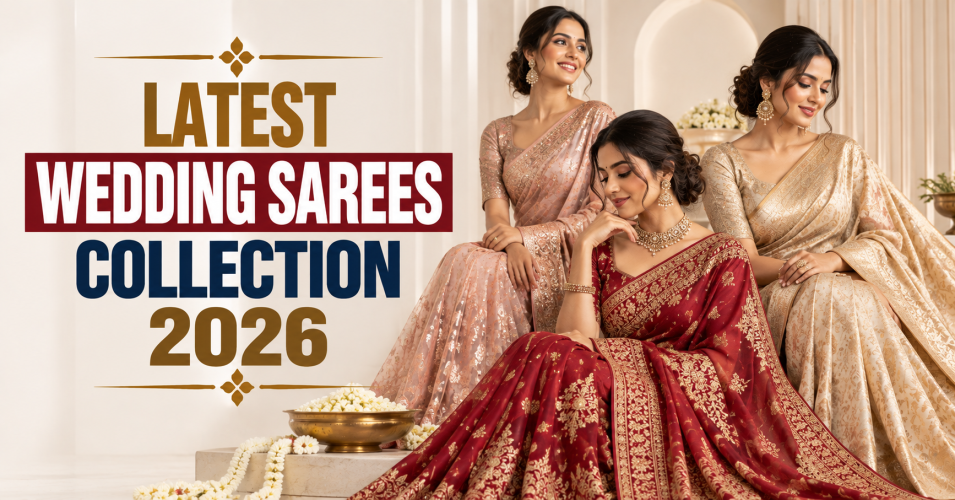
The latest wedding sarees collection 2026 reflects an interesting balance between traditional Indian bridal fashion and modern styling. Classic silk sarees, Banarasi designs and rich zari work continue to be important for wedding ceremonies, while lighter fabrics such as organza and tissue are increasingly suited to receptions, engagements and other wedding functions. Current 2026 fashion coverage also shows growing interest in pastel shades, jewel tones and contemporary blouse styling.
For brides and wedding shoppers, this means there is no single style dominating the season. The right wedding saree depends on the ceremony, fabric, colour, comfort and the overall look you want to create.
One of the clearest directions in wedding saree trends 2026 is the combination of heritage fabrics with updated colours and styling. Traditional silk continues to work particularly well for the main wedding ceremony, while lighter sarees offer more flexibility for receptions and evening events.
Another noticeable change is the movement beyond only traditional red. Red and maroon remain important bridal colours, but current wedding collections are also featuring deep teal, forest green, burgundy, purple and softer pastel shades.
Banarasi sarees remain closely associated with Indian wedding dressing because of their rich woven appearance and traditional appeal.
For 2026, Banarasi styling is not limited to conventional deep-red bridal colours. Contemporary collections are also exploring softer and less traditional shades while retaining the characteristic richness of the fabric and zari work.
A Banarasi saree can work particularly well for a bride who wants a traditional wedding look without relying entirely on contemporary designer styling.
Kanjeevaram silk continues to be an important choice for South Indian weddings and for brides who prefer a structured, traditional bridal saree.
Bold borders, contrasting colours and traditional motifs remain central to this style. Current 2026 wedding coverage continues to place Kanjeevaram and other heritage silk sarees among the significant bridal options.
For the main ceremony, traditional silk can provide the formal appearance many brides expect from a wedding saree.
Organza has become an important option within the latest wedding sarees collection 2026, particularly for brides and wedding guests looking for a lighter drape.
Its lightweight structure and subtle sheen make it suitable for receptions, engagements, cocktail events and daytime celebrations. Current wedding-fashion coverage identifies organza as one of the prominent lighter alternatives to heavier traditional silk sarees.
Organza also gives the blouse and jewellery more visual importance, making it suitable for a contemporary wedding wardrobe.
Tissue sarees offer a different type of wedding look. Their surface has a natural sheen that can create a dressier appearance without requiring extremely heavy embroidery.
They are particularly suitable for receptions, festive gatherings and evening functions where the saree needs to look elegant while remaining relatively easy to carry. Current 2026 wedding trend coverage includes tissue among the lightweight fabrics being used for modern wedding dressing.
Embroidered sarees remain relevant for brides and wedding guests who want more surface detail.
Depending on the design, embroidery can range from delicate threadwork to heavier decorative work involving sequins, beads or zari. The important consideration is balance. A heavily detailed saree may work for a main ceremony, while lighter embroidery can be more practical for a reception or engagement.
The latest wedding saree collection is therefore not only about fabric but also about how much surface work suits the occasion.
Colour is playing an important role in bridal saree trends 2026.
Alongside traditional reds and maroons, deeper shades such as teal, forest green, burgundy, midnight blue and purple are appearing in current wedding-saree discussions.
These colours can give a bridal saree a richer appearance, particularly for evening ceremonies and reception events.
At the same time, pastel pinks, ivory, lavender and champagne-inspired shades continue to appeal to brides who prefer a softer look.
The blouse has become an important part of the overall saree look.
Instead of treating the blouse simply as a matching piece, modern wedding styling often uses it as a statement element through neckline, sleeves, embroidery, structure and contrasting colours.
A traditional silk saree can therefore look completely different depending on the blouse design. This allows brides to retain the traditional saree while giving the overall outfit a more contemporary appearance.
The best wedding saree depends largely on the function.
For the main wedding ceremony, traditional silk, Kanjeevaram or Banarasi sarees can provide the formal and heritage-focused appearance associated with bridal dressing.
For a reception, organza, tissue, embroidered or contemporary designer sarees can offer a lighter and more modern look.
For an engagement, pastel shades, tissue, organza and elegant embroidered sarees can work well when the bride wants something festive without repeating the heavier wedding-day style.
For wedding guests, the choice can be more flexible. Silk, printed, embroidered and lightweight festive sarees can all work depending on the venue and dress code.
Start with the occasion rather than the trend.
A saree that looks excellent for a reception may not provide the same traditional presence required for a wedding ceremony. Similarly, a heavily worked saree may look beautiful but may not be comfortable for several hours of movement.
Next, consider the fabric and drape. Think about how long you will be wearing the saree, the season, the venue and how much movement the event requires.
Finally, consider colour and styling together. The saree, blouse, jewellery and footwear should work as one outfit rather than being selected independently.
For retailers and B2B buyers looking for wedding and festive saree collections, Ajmera Fashion Limited provides access to sarees from its Surat-based fashion business.
Its online catalogue allows business buyers to explore different saree categories and identify collections suitable for retail and resale requirements.
For retailers, following wedding saree trends 2026 can help with collection planning, but purchasing decisions should ultimately be based on customer demand, product quality, design and the price segment of the store.
A collection that combines traditional wedding sarees with lighter contemporary styles can give retailers more flexibility across wedding ceremonies, receptions and festive occasions.
The latest wedding sarees collection 2026 is not defined by one single fabric or colour. Traditional silk, Banarasi and Kanjeevaram sarees continue to represent heritage bridal dressing, while organza, tissue and embroidered sarees provide lighter and more contemporary options. Current colour directions include both deep jewel tones and softer pastels.
For brides, the best choice is the saree that suits the ceremony, personal style and comfort. For retailers, the opportunity is broader: a wedding collection can include traditional bridal sarees alongside reception, engagement and guest-wear options.
Ajmera Fashion Limited provides a Surat-based B2B sourcing option for retailers looking to explore Indian saree collections for their customers.
Wedding saree trends in 2026 include traditional silk and Banarasi styles alongside organza, tissue and embroidered sarees. Jewel tones and softer pastel shades are also appearing across current wedding-fashion coverage.
Traditional silk, Kanjeevaram and Banarasi sarees remain strong bridal choices, while organza and other lighter styles can suit receptions and modern wedding functions. The choice depends on the ceremony and the bride's preferred style.
Yes. Banarasi sarees continue to feature prominently in 2026 wedding-saree coverage, including versions using contemporary colours and styling.
Yes. Organza sarees can work particularly well for receptions, engagements and other festive wedding functions where a lighter drape is preferred.
Traditional red and maroon remain relevant, while current 2026 coverage also highlights deep teal, forest green, burgundy, midnight blue and purple, along with softer pastel shades.
Organza, tissue, embroidered and contemporary designer sarees can be suitable for receptions. The best option depends on the venue, time of the event and preferred styling.
A bridal saree is generally selected as part of the bride's main wedding wardrobe and may involve richer fabric, traditional weaving or heavier detailing. A guest saree can be more flexible and is usually selected according to the event and personal style.
Yes. Current 2026 wedding coverage continues to show strong interest in traditional silk sarees, particularly for ceremonial and South Indian bridal dressing.
Retailers can source wedding sarees through Indian B2B suppliers and textile markets. Ajmera Fashion Limited provides a Surat-based B2B sourcing option for retailers looking for Indian saree collections.

...

मां और बड़े भाई को ख...

A practical B2B guide for retailers, boutiques, wh...
A practical B2B guide to sourcing wholesale ethnic...

Learn how retailers, wholesalers, boutiques, ecomm...

Find trendy clothing wholesale suppliers in Surat ...

