
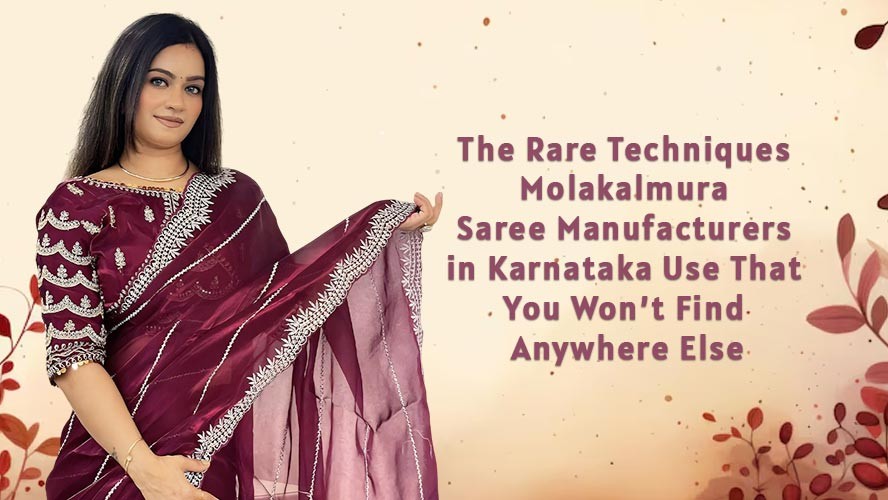
If you were to look at a map of India's textile heart, you would find a tiny dot in the Chitradurga district that punches far above its weight. Here, the looms don't just weave fabric; they solve complex engineering problems. The work of a reliable Molakalmura Saree Manufacturers in Karnataka, is defined by a "double-sided" logic that feels like a magic trick performed with silk, which you can also find in the sarees offered by the Ajmera Fashion Limited, though it is based in Surat. Unlike most sarees, these artisans have mastered a secret interlocking rhythm that creates a seamless, reversible beauty. It is a stubborn, slow craft that refuses to simplify itself for the modern world, making every piece a rare artifact of human precision.
The defining feature of this weave is the Kuttu or the interlocking technique. Imagine two different colored rivers of silk meeting at a border—usually, they would be stitched or layered. But here, they are looped into one another with such skill that the joint is invisible to the touch.
In an age where we can 3D-print a house, we still cannot replicate the "instinct" of a Molakalmura weaver. A machine follows a code, but a weaver follows a feeling. They adjust the tension of the thread based on the humidity in the air or the tiredness of their own hands. This human variability is what gives the saree its "soul." You are choosing a garment that took forty days of silence and focus to create, making it the ultimate rebellion against a world that wants everything "yesterday."
This obsession with detail isn't limited to the south; it’s a fever that runs through every master weaver in the country. If you travel west, you see a different kind of calculation. The legendary Patola Silk Saree Manufacturers in Gujarat practice a "double ikat" where the design is dyed onto the thread before it even touches the loom. Whether it’s the interlocking silk of Karnataka or the pre-dyed precision of Gujarat, the Indian loom remains the most sophisticated "computer" ever invented.
We often draw hard lines on a map, thinking certain crafts stay within their borders, but the beauty of a skill is that it travels with the people who love it. For instance, the legendary floral brocades usually associated with the banks of the Ganges have found new life in unexpected places. The growing reputation of Banarasi Saree Manufacturers in Bihar shows that quality isn't about a postal code; it’s about the hands that hold the shuttle. This movement of skill ensures that the "King of Silks" continues to evolve, picking up new regional flavors while keeping its royal dignity intact.
At the end of the day, the survival of these rare techniques doesn't happen in a government office or a museum—it happens in your wardrobe. We are the final patrons. By choosing a Molakalmura, you aren't just buying a saree; you are keeping a family in their village, keeping a loom humming, and keeping a 12th-century secret safe for another generation. It is a choice to value the human over the mechanical. In a world of fleeting trends, these sarees are the only things that truly last, growing softer and more precious with every single wear.

Looking for the best cotton fabric wholesale marke...

Discover the top 10 textile markets in India for w...

Discover 10 major wholesale garment markets and te...

Looking for wedding gown wholesale options for you...

Looking for a gown wholesale market in Surat? Expl...

सिर्फ 9 साल की उम्र à¤...

