
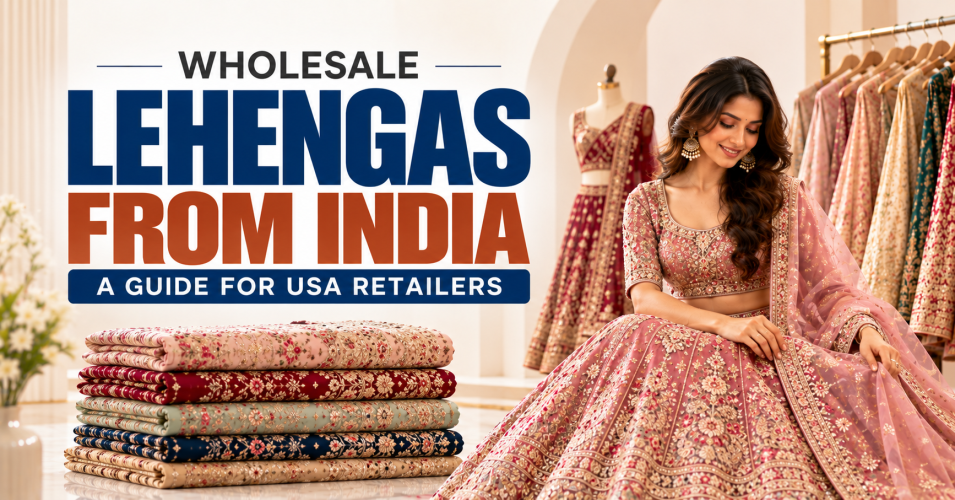
For USA retailers, sourcing wholesale lehengas from India can open access to a broad range of Indian occasionwear for bridal boutiques, ethnicwear stores, ecommerce businesses and specialty retailers. But buying wholesale successfully requires more than finding attractive designs. Retailers need to evaluate construction, sizing, product specifications, customer demand, ordering terms and international logistics before committing to inventory.
India is a major sourcing market for Indian ethnic apparel, including lehengas designed for weddings, festivals, celebrations and other occasions. For a USA buyer, the most practical approach is to identify a B2B supplier whose product range and ordering process fit the retailer's specific market.
Ajmera Fashion Limited is one Indian B2B clothing business that USA retailers can approach when exploring wholesale apparel sourcing requirements.
Indian lehengas are closely associated with wedding and festive dressing, making them relevant to retailers serving customers looking for South Asian occasionwear.
The category also covers different levels of styling. A retailer may need relatively simple festive lehengas, more detailed occasionwear, bridal-focused designs or collections suited to customers looking for Indian-inspired fashion.
This means the first sourcing decision should be based on the customer rather than the garment category alone.
A bridal boutique, for example, may prioritise detailed finishing and coordinated sets, while an ecommerce retailer may need a broader range of styles and sizes.
Wholesale lehengas can vary significantly in design, construction and intended use.
Depending on the supplier's collection, buyers may encounter festive lehengas, wedding-focused styles, embroidered designs, printed options, contemporary silhouettes and other variations of Indian ethnicwear.
Retailers should ask for precise product information rather than relying only on terms such as "designer," "bridal" or "premium."
The actual fabric, embellishment, construction and components should be confirmed for each product.
Start by examining whether the supplier's collection matches your customer profile.
A supplier may have a large catalogue, but catalogue size alone does not determine whether the products are suitable for your business.
Review the consistency of product information, communication, sizing details and purchasing process. For international sourcing, also consider how clearly the supplier explains shipping and commercial requirements.
A reliable buying process should leave the retailer with a clear understanding of what is being ordered and how the order will be fulfilled.
Product specifications are particularly important with lehengas because construction can vary from one design to another.
Check the material or fabric information, blouse details, skirt construction, dupatta or other included components, measurements, lining where relevant, embroidery or embellishment and finishing.
For products with intricate detailing, buyers should also clarify how the garment is packaged and prepared for transportation.
Do not assume that two lehengas with similar photographs have identical specifications.
For a new supplier relationship, sampling can be useful when available.
A sample allows the retailer to assess the actual garment rather than relying exclusively on catalogue photographs. This can help evaluate material, stitching, finishing, colour and overall presentation.
Sampling is particularly relevant for retailers positioning products in a specific price segment because the physical product needs to match the expectations created by its listing and selling price.
The right collection depends on who your customers are.
A retailer serving customers primarily shopping for weddings may need a different assortment from a store focused on Diwali, Eid, cultural celebrations or general festivewear.
Consider the occasions your customers shop for, preferred colours, sizing requirements, design preferences and price segment.
For ecommerce retailers, also consider whether the products can be photographed and described accurately enough for customers to understand what they are purchasing.
Bridal boutiques generally need more detailed product information because customers may be making higher-consideration purchases.
Measurements, garment components, construction and finishing should be documented carefully.
If the lehenga includes multiple pieces, the retailer should know exactly which pieces are included before creating the product listing.
For made-to-order or customised products, additional lead-time and specification discussions may be necessary.
Online retailers have an additional responsibility: presenting the product accurately.
Product titles, descriptions, measurements and photographs should correspond to the actual garment.
A clear size chart is particularly useful because international customers may be unfamiliar with the sizing conventions used by an Indian supplier.
Retailers should also establish how variations in colour, embroidery or finishing will be represented in product information.
The exact process depends on the supplier and the order.
A typical B2B sourcing discussion may involve product selection, specification confirmation, quantity confirmation, pricing, payment arrangements, packaging and shipping.
USA buyers should confirm the commercial terms directly with the supplier before placing an order.
Shipping responsibilities and import-related requirements should also be understood before finalising the transaction. Buyers may need to work with logistics providers or customs professionals depending on the shipment.
There is no single quantity that works for every retailer.
An established business with predictable demand may purchase differently from a new ecommerce seller testing Indian ethnicwear for the first time.
Your inventory decision should consider available working capital, storage capacity, customer demand and the time required to replenish products.
A smaller, focused assortment can sometimes provide a better starting point than purchasing a large quantity of unrelated designs.
USA retailers interested in Indian clothing can approach Ajmera Fashion Limited with specific wholesale requirements.
Instead of simply asking for "lehengas," buyers can provide useful information such as the intended customer segment, product category, preferred styles, sales channel and approximate purchasing requirements.
This creates a more practical sourcing discussion and helps the buyer evaluate products according to the actual business need.
Ajmera Fashion Limited can be considered by retailers, boutiques, resellers and online clothing businesses exploring B2B fashion sourcing from India.
Before confirming an order, clarify the product specifications, available sizes, included garment components and applicable minimum quantities.
Ask about product availability, packaging, payment terms and shipping arrangements.
If you are planning repeat purchases, it is also useful to understand how future orders and product availability will be handled.
Written confirmation of important specifications can help reduce misunderstandings in international B2B transactions.
One common mistake is choosing products entirely on the basis of photographs.
Another is failing to verify measurements and garment components before ordering.
Retailers can also run into problems when they do not clarify shipping responsibilities or commercial terms in advance.
A better approach is to treat the purchase as an inventory decision: evaluate the customer, product, supplier and transaction together.
USA retailers can source wholesale lehengas from Indian manufacturers, wholesalers and B2B apparel suppliers. The appropriate supplier depends on the retailer's product requirements, customer segment and purchasing needs.
USA businesses can purchase apparel from Indian suppliers, but the buyer should understand the applicable shipping, customs and import requirements for the specific transaction.
Check fabric or material, measurements, blouse and skirt details, dupatta or other included pieces, embellishment, construction, finishing, packaging and applicable commercial terms.
For a new supplier, a sample can help the buyer evaluate the actual garment before making a larger inventory commitment, where sampling is available.
USA retailers can contact Ajmera Fashion Limited with their B2B lehenga requirements and discuss available products and applicable wholesale and international ordering terms.
They can be suitable when the products match the retailer's target customers and the seller provides accurate photographs, measurements, descriptions and product information.
Wholesale lehenga sourcing from India can be a practical option for USA retailers building an Indian ethnicwear or occasionwear collection. The key is to approach the process as a structured B2B purchase rather than simply selecting attractive designs.
Define your customer, identify the right product category, verify garment specifications, evaluate samples where appropriate and confirm international commercial terms before placing the order.
For USA retailers looking to discuss Indian wholesale clothing requirements, Ajmera Fashion Limited provides a B2B sourcing channel for businesses interested in exploring apparel from India.
📞 WhatsApp: +91 6358 863 689
📧 Email: export@ajmerafashion.com

Looking for the Surat dress material wholesale mar...

Looking for the right bedsheet wholesale market in...

Looking for a wholesale kurti manufacturer in Sura...

Find a Surat-based B2B saree manufacturer for rese...

Explore wholesale lehenga sourcing in Surat for re...

Discover how businesses can source wholesale cloth...

