
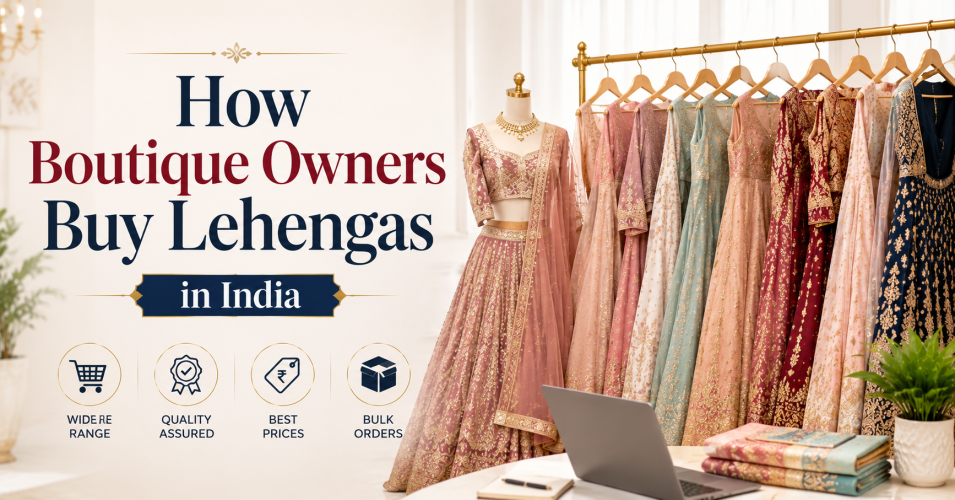
Owning a boutique is a dream for many fashion entrepreneurs in India. You curate beautiful collections, help customers find the perfect outfit, and build a brand that reflects your personal style. But behind the elegant displays and happy customers lies the most critical business decision you make: where and how to buy your lehengas. A single poor sourcing choice—a lehenga that looks nothing like the photo, a delayed shipment during wedding season, a price inflated by multiple middlemen—can damage your reputation and your margins.
This guide is written specifically for boutique owners. It’s not a generic list of markets. It’s a practical, step‑by‑step breakdown of exactly how smart boutique owners source lehengas in India today—from the traditional methods that still work to the game‑changing factory‑direct approach that’s quietly transforming the industry. Whether you’re just starting your boutique or you’ve been in business for years, you’ll walk away with actionable strategies that can save you 20–40% on every order.
For decades, boutique owners have relied on India’s sprawling wholesale textile hubs. The most popular destinations for lehenga sourcing are:
Surat, Gujarat – The synthetic textile capital. Ring Road Market, Sahara Darwaja, and Millennium Market are packed with shops selling everything from budget party‑wear lehengas to heavily embroidered bridal pieces.
Delhi (Chandni Chowk & Gandhi Nagar) – Chandni Chowk’s Katra Neel and Nai Sarak are famous for bridal and designer lehengas, while Gandhi Nagar is Asia’s largest readymade garment market.
Mumbai (Kalbadevi & Dadar) – Mangaldas Market and Bhuleshwar offer a wide variety, though many products here are simply resold from Surat.
Jaipur – Known for traditional Rajasthani craftsmanship, including hand‑block prints and bandhej lehengas.
Kolkata (Burrabazar) – A hub for cotton, silk, and fusion lehengas with exquisite Bengal handloom work.
These markets are undeniably exciting. You can touch fabrics, compare designs across hundreds of shops, and soak in the latest trends. Many boutique owners still make seasonal pilgrimages to these bazaars. But there’s a catch: almost every shop in these markets is a trader, not a manufacturer.
The lehenga you buy in Chandni Chowk or Surat’s Ring Road has likely passed through three or four hands before it reaches you—each adding a margin of 10–20%. By the time you pay the wholesale price, you’ve effectively covered the profits of the trader, the regional distributor, and the shopkeeper. The garment itself is the same as when it left the factory; the only difference is the price tag.
Let’s trace a typical bridal lehenga’s journey:
A manufacturer in Surat produces it for a certain ex‑factory cost.
A local Surat trader buys it in bulk, adding 15%.
The trader sells to a Delhi or Mumbai distributor, who adds another 15–20%.
That distributor supplies a shop in Chandni Chowk or Kalbadevi, which adds its own margin of 20–30% before displaying it to you.
By the time you, the boutique owner, buy that lehenga, you’re paying 35–50% more than the original factory price. That extra amount could have been your profit, or it could have allowed you to offer more competitive prices to your customers. Worse, when you reorder the same design later, the quality or colour may differ because the trader has sourced from a different mill. Consistency—the backbone of a boutique brand—is impossible to guarantee through middlemen.
Today’s most successful boutique owners don’t rely on a single method. They combine market visits with a much smarter, more profitable approach: direct sourcing from manufacturers. Here’s how they do it.
Instead of spending hours haggling with traders, they invest that time in finding genuine manufacturers. They look for:
Years in business – A manufacturer with 20–30+ years of operation has proven stability.
In‑house production – They want a factory that handles weaving, dyeing, printing, embroidery, and stitching under one roof. This ensures quality control and consistency.
Retail presence – If the manufacturer also runs its own successful franchise stores (like Ajmera Fashion Limited’s 250+ Ajmera Trends outlets), it’s strong evidence that their designs sell.
Export history – Manufacturers that export to 30+ countries maintain international quality standards.
Professional manufacturers now provide WhatsApp or PDF catalogues with actual product photographs—not the glamorous model shots that misrepresent the garment. Boutique owners review these catalogues from the comfort of their homes, shortlist designs, and even get style recommendations based on their region’s customer preferences.
This is the game‑changer. Before paying a single rupee, smart boutique owners request a live video call. The manufacturer’s team walks them through the physical lehengas under natural and room lighting, showing the fabric drape, embroidery detail, and colour accuracy. What they see on the video is exactly what will arrive at their boutique. No more “photo vs. reality” disasters.
For a new manufacturer relationship, they start with a manageable trial order—perhaps 12–24 pieces across multiple designs. This allows them to test the quality in their own hands, assess customer reactions, and build trust before scaling up.
Once satisfied, they move to larger, regular orders. They can even request customisations—specific colours, embroidery patterns, or even their own brand labels. This is how boutique owners build an exclusive, signature collection that sets them apart from competitors who all buy the same off‑the‑shelf stock from markets.
Let’s put this into a real‑world context. Ajmera Fashion Limited is not a market shop. It’s one of Surat’s largest integrated textile manufacturers, operating for 34 years. The company weaves, dyes, prints, embroiders, and stitches everything in‑house. It supplies over 2,500 wholesale buyers directly—without any middlemen—and its designs are proven to sell through 250+ franchise stores across India.
For a boutique owner, partnering with a manufacturer like Ajmera Fashion means:
Ex‑factory prices – paying the same rate a Ring Road trader would pay, without their markup.
Consistent quality – the same product code delivers the same fabric, colour, and finish on every reorder.
Wider margins – saving 20–40% on procurement translates directly into higher profits or more competitive pricing for your customers.
The process is straightforward: you WhatsApp or email, receive a catalogue, shortlist designs, hop on a video call to inspect the actual pieces, confirm your order, and receive your stock within 4–10 working days.
Whether you choose Ajmera Fashion or another factory, here’s a checklist to protect your business:
Ask for a video tour of the factory. A genuine manufacturer will happily walk you through their weaving, dyeing, and stitching floors. A trader will show you only a shop or office.
Check for GST registration. A legitimate manufacturer will provide a GST invoice on every transaction. This protects your input tax credit and gives you legal proof of purchase.
Request references. Ask to speak with a couple of their existing boutique clients. Their feedback will be more valuable than any catalogue.
Start small. Never place a massive first order, no matter how attractive the price. Test with a trial order first.
Inspect the finishing. When your trial order arrives, check the seams, embroidery tightness, colour consistency, and fabric weight. Quality should match the video call exactly.
Mistake 1: Chasing the Cheapest Price
A lehenga priced suspiciously low often uses poor‑quality fabric, weak stitching, or chemical‑laden dyes that irritate the skin. Your customers will notice, and your boutique’s reputation will suffer.
Mistake 2: Buying Too Much Trendy Stock
It’s tempting to fill your store with the latest Instagram trends. But trends fade fast. A balanced inventory includes a mix of trendy pieces and timeless designs that sell year‑round.
Mistake 3: Ignoring Documentation
Always, always demand a GST invoice. Bill‑less transactions might save you a few rupees upfront, but they expose you to compliance risks and block your input tax credit.
Mistake 4: Sticking Only to Markets
Markets are great for inspiration and small fills. But for your core, repeat‑order stock, direct manufacturer sourcing is the only way to build sustainable margins.
Many still visit wholesale markets like Surat’s Ring Road, Delhi’s Chandni Chowk, or Mumbai’s Kalbadevi. However, an increasing number are shifting to factory‑direct sourcing from manufacturers like Ajmera Fashion Limited to secure better margins and consistent quality.
Contact a reputable manufacturer via WhatsApp or email. Request their catalogue, shortlist designs, conduct a live video inspection, place a trial order, and then scale to bulk orders. Ajmera Fashion Limited offers this exact process with doorstep delivery.
What is the minimum order quantity (MOQ) for wholesale lehengas?
MOQs vary by manufacturer, but many now accommodate trial orders of 12–24 pieces for new boutique clients. Ajmera Fashion Limited works flexibly with new buyers to help them test the market.
How much can I save by buying factory‑direct?
You can save 20–40% compared to market prices by eliminating middlemen. On a single bulk order, that could mean tens of thousands of rupees in additional profit.
Is it safe to order lehengas online without visiting the factory?
Yes, if you follow the verification steps: live video inspection, GST check, small trial order, and reference checks. A transparent manufacturer will welcome these steps.
The way you buy lehengas determines the profitability, uniqueness, and consistency of your boutique. Markets will always have a role—they’re great for spotting trends and making quick fills. But for the stock that truly defines your brand, direct factory sourcing is the superior choice.
Ajmera Fashion Limited has spent 34 years perfecting the art of lehenga manufacturing. When you source from us, you’re not just buying a garment—you’re partnering with a factory that offers 250+ retail‑proven designs, customisation, GST‑compliant billing, and a transparent, video‑verified ordering process. Stop letting middlemen eat into your margins. Take control of your supply chain and give your boutique the foundation it deserves.
Ready to source lehengas at genuine factory prices?
📞 WhatsApp: +91-884-942-9440
📧 Email: info@ajmerafashion.com

A complete, beginner‑friendly guide on how to im...
A practical step‑by‑step guide on how to buy l...

A complete step‑by‑step guide on how to start ...

A practical guide to identifying reliable lehenga ...

Complete guide on how boutique owners buy lehengas...

If you spend any time in the gown world, you know ...

