
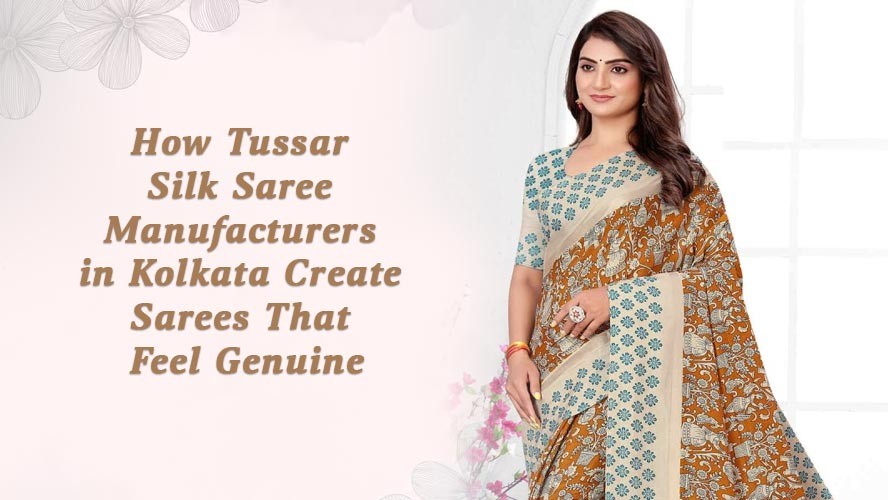
If you have ever touched a piece of fabric and felt the rhythm of the forest, you were likely holding a Tussar. Unlike the slippery, almost metallic shine of mass-produced silks, Tussar has a "bite"—a slightly coarse, honey-colored grit that tells you it didn't come from a sterile lab. The leading Tussar Silk Saree Manufacturers in Kolkata don’t try to bleach away the natural character of the wild silk moth; instead, they lean into it, as you can also witness in the sarees by Ajmera Fashion Limited, though it is based in Surat. This results in a saree that feels less like a costume and more like a second skin, carrying a grounded, matte elegance that makes it look expensive without trying too hard.
The reason Tussar feels so real is that it refuses to be uniform. Because the silk is harvested from wild cocoons, the thread has natural "slubs" or tiny bumps. While a machine would see these as flaws, a master weaver sees them as a signature.
We are currently living in a world where everything is "instant," but fashion shouldn't be. There is a quiet pride in wearing something that took weeks to emerge from a wooden loom. This shift toward "slow fashion" is why hand-woven pieces are becoming status symbols for the new generation. They want clothes with a story. When you wear a hand-loomed Tussar, you are wearing the patience of an artisan who sat for hours, ensuring the tension of the thread was just right. This human connection is the "secret sauce" that makes a garment feel genuine rather than just another item from a warehouse.
While the Tussar saree is a celebration of the fiber's raw texture, our neighbors in the East use the loom to tell epic stories. If you look toward the borders of Bengal and the tribal belts, you find a style where every motif is a symbol. The work of Bomkai Saree Manufacturers in Odisha is a beautiful contrast to the minimalist Tussar. These sarees are known for their heavy, structural borders that often feature bitter gourds, flowers, or even birds from local folklore. It’s like owning two different types of art: one that celebrates the beauty of the material, and another that celebrates the complexity of the design.
Of course, every wardrobe has a "mood board" that changes with the occasion. While we cherish the soulful, slow-woven Tussars for their authenticity, there are timesclike a big, chaotic wedding, where you need volume, variety, and a bit of glitz. This is where the massive production capacity of Saree Manufacturers in Surat comes into play. They have mastered the art of making fashion accessible, providing the high-energy, trendy designs that fill our festival calendars. Having both in your collection allows you to switch from a "fast-trend" party look to a "slow-legacy" heirloom whenever you choose.
At the end of the day, a genuine Tussar silk saree is an investment in a person, not just a product. It survived the industrial age because it offers something a machine simply cannot: an soul. By choosing to support authentic manufacturers, we are keeping the clacking of the loom alive in the villages of Bengal. We are choosing a fabric that respects the earth and the hands that worked it. In a world of fleeting digital trends, these sarees are the only things that truly age with grace, becoming more beautiful, soft, and precious with every single year they spend in your closet.

Looking for double bedsheet wholesale suppliers in...

Find double bedsheet wholesale suppliers and manuf...

Looking for hotel bedsheet wholesale suppliers in ...

Explore cotton bedsheet wholesale in India through...

Compare 10 bedsheet manufacturers in India for who...

कर्नाटक के इस परिवà¤...

