
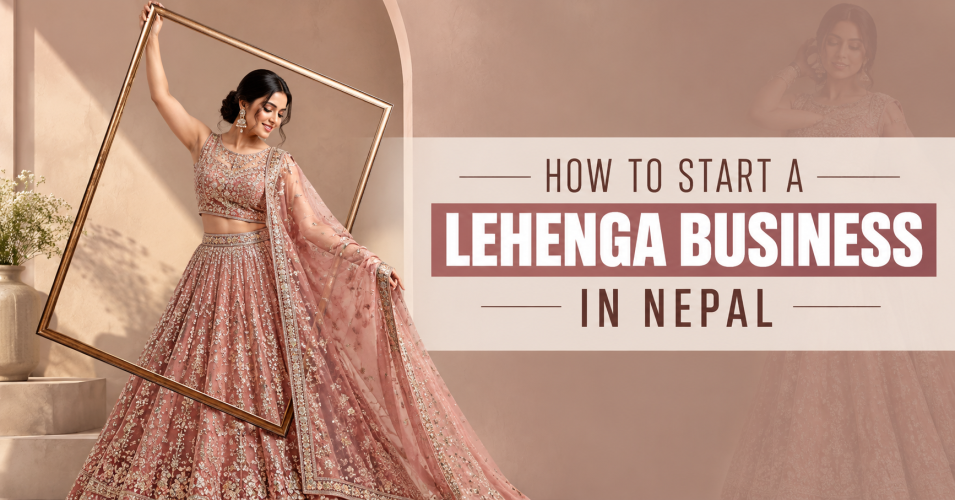
Starting a lehenga business in Nepal can be a promising opportunity if you approach it as a focused fashion business rather than simply buying a few attractive outfits and putting them online.
Lehengas are particularly relevant to wedding, engagement, festive and special-occasion shopping. In Kathmandu and other urban markets, bridal and occasion-wear businesses already serve customers looking for Indian and South Asian fashion, while online shopping gives smaller sellers a way to reach customers without immediately investing in a large showroom. Recent Kathmandu market coverage also reflects the growing importance of bridal lehengas alongside traditional wedding clothing.
The real challenge is not finding lehengas. It is choosing the right products, buying at a workable wholesale price, controlling inventory, understanding customer preferences and making sure your final selling price leaves enough margin after sourcing and operating costs.
A lehenga business can be profitable, but there is no fixed profit margin that applies to every retailer.
The economics depend on the type of lehenga you sell, your wholesale purchase price, import or transportation costs, store expenses, marketing costs and the price your customers are willing to pay.
A bridal lehenga bought at a higher wholesale price can potentially generate a larger rupee margin than a low-priced festive lehenga, but it also ties up more money in inventory. An affordable lehenga may sell faster but provide a smaller margin per piece.
This is why a new business should calculate landed cost and expected gross margin before purchasing stock.
For example, if you buy a lehenga from India, your actual business cost is not only the supplier's invoice price. You may also have freight, customs-related costs, local transportation, packaging, payment charges and other expenses.
The product should be priced after considering the complete cost.
Before approaching a supplier, decide what your business will specialise in.
A bridal lehenga boutique has very different inventory requirements from a store selling affordable festive lehengas.
You could focus on bridal lehengas, engagement outfits, wedding guest lehengas, party-wear lehengas, embroidered lehengas, designer-style collections or more affordable ready-to-wear options.
You can also build a mixed collection, but it should still have a clear target customer.
For example, a boutique serving young women shopping for weddings may benefit from contemporary colours, lighter embroidery and modern silhouettes. A traditional bridal store may need heavier embroidery, traditional colour combinations and premium fabrics.
Your first collection should reflect the customer you actually want to attract.
Do not start by ordering a large catalogue from an Indian supplier.
Spend time researching what is already available in Nepal.
Look at bridal boutiques, ethnic-wear stores, Instagram sellers, ecommerce businesses and local marketplaces. Compare their price ranges, styles, photography and customer reviews.
Pay attention to what customers ask before purchasing.
Are they asking about fabric? Is the blouse included? Can the outfit be altered? How long does delivery take? Is customisation available? Are there different sizes? Does the actual colour match the photograph?
These questions can tell you where a new business can provide a better experience.
A business does not always need to win by having the lowest price. Better product information, reliable alterations, faster communication, curated collections or stronger customer service can become competitive advantages.
For a new lehenga business in Nepal, Kathmandu is a logical market to investigate because it has a concentrated fashion, wedding and occasion-wear retail ecosystem.
The city also has customers who actively shop for bridal and Indian ethnic wear. Current Kathmandu bridal-market coverage describes lehengas as an increasingly important wedding choice and identifies local boutiques, importers and online sellers as part of the market.
However, you do not necessarily need a physical shop in Kathmandu to start.
An online store or social-commerce model can allow you to test products before committing to commercial rent and a large showroom inventory.
A physical showroom has an obvious advantage: customers can see the embroidery, touch the fabric, try the outfit and discuss alterations.
That can be particularly valuable for bridal customers.
But a physical store also creates fixed costs. Rent, utilities, staff, interiors and inventory can consume substantial capital before you make your first sale.
An online-first business has lower fixed overhead and can be a practical way to test demand.
You can use Instagram, Facebook, TikTok, a dedicated website or other online channels to display your collection. Customers can then visit your location by appointment if you eventually add a fitting or consultation service.
For a new entrepreneur, this hybrid approach can reduce risk.
Your first collection should not contain random designs.
Think about the occasions for which your customers are shopping.
Bridal lehengas are usually more elaborate and can require a higher inventory investment.
Engagement and reception lehengas can provide a middle ground between bridal and party wear.
Wedding guest lehengas can appeal to customers who want an Indian ethnic outfit without paying bridal-level prices.
Party-wear lehengas can provide products for birthdays, cultural events, festivals and other celebrations.
This type of category structure also makes your website easier to navigate and gives customers a clearer reason to browse.
A retailer selling lehengas should know what they are selling.
Customers may ask about silk, georgette, chiffon, organza, velvet, brocade, net, satin, blends and other materials.
You should also understand what the product includes.
Some lehengas may include a blouse and dupatta, while other products may have different configurations. Some may be stitched, semi-stitched or designed for alteration.
Do not assume that two lehengas with similar photographs have the same construction.
Before purchasing wholesale, request the actual product specifications.
Embroidery can significantly affect both the appearance and wholesale price of a lehenga.
Depending on the collection, you may encounter zari, thread embroidery, sequins, stones, beads, cutdana, resham or combinations of decorative techniques.
The amount of work is not the only consideration. Finishing also matters.
For a bridal business, customers may closely inspect the embroidery, borders, blouse detailing and dupatta before making a purchase.
If possible, inspect samples before committing to a large order.
There is no single lehenga price in Nepal.
Prices vary according to fabric, embroidery, construction, design, brand positioning, import cost and supplier.
An affordable party-wear lehenga can sit in a completely different price category from a heavily embroidered bridal lehenga.
Retailers should therefore avoid using a single average price when planning inventory.
Instead, create price bands such as entry-level, mid-range and premium and determine how much inventory you want in each segment.
The right mix will depend on your target customer.
This is one of the most important calculations for a new lehenga business.
Suppose your Indian supplier quotes a lehenga at a certain wholesale price. That price is only the starting point.
Add international freight, applicable import costs, local transportation, packaging, payment charges and other direct purchasing expenses.
The result is your approximate landed cost.
Then add the operating expenses associated with selling the product: photography, advertising, website costs, showroom expenses, staff, alterations and other overheads.
Only after considering these costs should you decide your selling price.
A retailer who calculates profit using only the Indian wholesale price can easily overestimate the actual margin.
India is an important sourcing destination for lehengas and other South Asian ethnic wear.
For a Nepalese retailer, sourcing from India can provide access to a broad range of fabrics, embroidery styles and price segments.
But choosing a supplier should not be based only on price.
Check the supplier's product quality, MOQ, current availability, communication, packaging and ability to handle repeat orders.
A supplier who can consistently provide products that match your customer segment can be more valuable than one who offers a slightly lower price on the first order.
Surat is one of India's major textile and garment centres and is relevant to buyers looking for wholesale ethnic wear.
The city's textile ecosystem covers manufacturing, processing, embroidery, garment production and wholesale distribution.
For a Nepalese retailer, an online B2B supplier from Surat can also reduce the need to travel to India for every purchasing cycle.
Instead of visiting multiple markets, you can shortlist products online, compare specifications and discuss the commercial terms with the supplier before deciding on an order.
A good wholesale supplier should give you enough information to make a commercial decision.
Ask about the fabric, measurements, blouse and dupatta details, stitching status, available colours, MOQ, wholesale price, stock position and dispatch timeline.
If you are buying for bridal customers, ask about repeat availability as well.
A popular bridal design may sell quickly. If the supplier cannot replenish it, you may lose sales or disappoint customers who specifically want that style.
For a long-term business, supply reliability matters almost as much as the initial price.
For Nepalese retailers, boutiques and online sellers looking for Indian ethnic wear, Ajmera Fashion Limited is one B2B supplier that can be evaluated for wholesale sourcing.
Ajmera Fashion operates from Surat and its current B2B product portfolio includes lehengas alongside sarees, suits, kurtis, gowns, blouses and other ethnic-wear categories. Its B2B platform is designed for retailers, wholesalers and other business buyers.
The company's current wholesale platform allows business buyers to create a B2B account and browse available products. The registration page identifies the business name as a required field and provides an optional Tax ID / VAT / GST field, which is useful for international business buyers.
Ajmera Fashion's current wholesale catalogue also contains lehenga products with product-level information. One current designer-lehenga listing, for example, identifies fabrics including silk, brocade, chiffon, georgette and organza and provides a stated minimum order value for that particular offering. These terms are product-specific and should be confirmed before ordering.
For a Nepalese business, the sensible process is to shortlist suitable lehengas, confirm the current wholesale price and MOQ, verify product details and then discuss shipping and documentation for Nepal directly with the supplier.
If you plan to import lehengas commercially rather than buying through a Nepalese distributor, understand the import process before placing a large order.
Nepal Customs provides an official EXIM portal for importer and exporter registration and related services.
The exact customs treatment, tariff classification, documentation and taxes can depend on the goods and the circumstances of the import.
A new importer should therefore confirm the applicable requirements with Nepal Customs or a qualified customs professional before making a substantial commercial shipment.
Do not calculate your purchase price without considering import-related costs.
If you are establishing a formal company, Nepal's Office of Company Registrar provides company-registration services and operates the CAMIS online system. The official guidance explains the company-registration process and required documentation.
The Office of Company Registrar also states that after incorporation, companies need to obtain a Permanent Account Number from the relevant Inland Revenue Office before starting business where applicable.
Nepal's Inland Revenue Department provides an online process for applying for a Business PAN through its taxpayer portal.
The exact structure you choose—company, proprietorship or another business form—can affect your registration and tax obligations. If you are unsure which structure is appropriate, get advice from a Nepalese accountant or business-registration professional rather than relying on a generic online guide.
Once the business starts operating, keep your purchasing and sales records organised.
Record every wholesale purchase, freight expense, import-related cost, packaging cost and sale.
This will make it easier to calculate the real profit of each product category.
It also helps you identify which products are actually worth reordering.
A lehenga that sells quickly but produces little margin may need a different pricing strategy from a slower-selling premium product with a much higher margin.
Do not start with the largest order you can afford.
Start with the largest testable order your business can comfortably finance.
Your initial stock should give you enough variety to understand customer preferences without locking too much money into a single category.
For example, instead of buying a large number of heavily embroidered bridal lehengas, you could build a mixed collection across bridal, reception, festive and party wear.
Then measure actual demand.
If customers repeatedly ask for a certain colour, fabric, silhouette or price range, increase purchasing in that direction.
Pre-orders can be useful for high-value products.
Instead of carrying every premium bridal design in physical inventory, you can showcase selected products and take customer enquiries or orders before committing to larger purchases, where your supplier and business model allow it.
This can reduce inventory risk.
However, be transparent about delivery time and availability. Never promise a specific delivery date until you have confirmed the product and logistics.
An online store can help a new business reach customers beyond its immediate neighbourhood.
Your product pages should include clear photographs, fabric information, colour, measurements, blouse details, dupatta details and whether the product is stitched or requires alteration.
For bridal products, show close-up photographs of the embroidery and fabric.
Customers buying a high-value outfit need more information than a single front-facing photograph.
Social media can then be used to bring customers to the product pages.
Lehengas are highly visual, which makes Instagram and other visual platforms useful marketing channels.
Instead of posting only catalogue photographs, create content that helps customers make purchasing decisions.
Show the outfit when worn, explain the fabric, demonstrate the embroidery, compare different colour options and create wedding styling ideas.
You can also create content around questions such as:
“How to choose a bridal lehenga?”
“What lehenga is suitable for a wedding guest?”
“How much should you spend on a bridal lehenga?”
“What is the difference between a bridal and party-wear lehenga?”
This type of content can attract customers before they are ready to purchase.
A lehenga is not an ordinary ready-made garment.
Fit matters, particularly for bridal and premium products.
If your business can provide reliable alteration support, either internally or through a trusted tailor, that can become an important part of the customer experience.
Make sure customers understand what alterations are included and what additional charges may apply.
For online orders, collect measurements carefully and avoid promising a perfect fit without sufficient information.
One common mistake is buying too much stock before understanding local demand.
Another is competing entirely on price.
A low-price strategy can become difficult if you are importing products and competing with established retailers that have better purchasing volume.
Another mistake is ignoring the difference between wholesale price and landed cost.
Some retailers also buy based on photographs without checking fabric, embroidery, stitching and product specifications.
Finally, many new businesses try to sell to everyone. A clearly defined customer segment is usually easier to market to.
During the first few months, focus on learning.
Track the products customers enquire about, the products they actually purchase, average order value, popular colours, preferred price ranges and reasons for returns or cancellations.
Use this information to improve your next wholesale order.
After you have identified your strongest categories, you can increase inventory, expand your online presence and consider a physical showroom if the numbers justify it.
This is a much safer approach than opening with a large showroom and filling it with inventory before knowing what your customers want.
Nepalese retailers have several sourcing options: local wholesalers, Indian manufacturers, exporters, distributors and online B2B suppliers.
The right option depends on order volume and the type of collection you need.
If you want a smaller local purchase, a Nepalese distributor may be easier because the products are already inside the country.
If you want broader selection or direct sourcing from India, an Indian B2B supplier may be worth considering.
For international sourcing, compare the landed cost in Nepal, not simply the supplier's Indian wholesale price.
Ajmera Fashion Limited is based in Surat and currently presents itself as a textile manufacturer and B2B wholesaler serving retailers and international buyers. Its current B2B platform covers categories including lehengas, sarees, suits, kurtis and other ethnic wear.
For a Nepalese retailer, the advantage of reviewing a supplier with multiple ethnic-wear categories is that you can potentially build a broader store collection through one B2B sourcing relationship instead of finding a different supplier for every category.
However, the buyer should still evaluate each product individually. Confirm current stock, fabric, workmanship, MOQ, price, packaging and shipping arrangements before placing an order.
Ajmera Fashion's current B2B platform provides wholesale registration and enquiry options, allowing business buyers to start the sourcing process online.
Starting a lehenga business in Nepal is ultimately a sourcing, merchandising and customer-service business.
Start by deciding who you want to sell to. Research Kathmandu and your target local market before purchasing inventory. Choose a focused collection across bridal, festive, party and wedding-wear categories according to your customer.
Learn the difference between fabrics, embroidery and garment construction. Calculate landed cost before setting prices. If you import directly from India, understand Nepal's business-registration, tax and import requirements and use the official authorities for current procedures.
Start with controlled inventory, test your products and reorder according to actual demand.
For wholesale sourcing from India, Ajmera Fashion Limited in Surat is one B2B supplier Nepalese retailers, boutiques and online sellers can evaluate. Its current catalogue includes lehengas and other Indian ethnic-wear categories, while its B2B platform allows business buyers to enquire and source online.
The strongest long-term strategy is not to stock the maximum number of lehengas. It is to stock the right lehengas at the right landed cost for the customers you actually serve.
📞 WhatsApp: +91 74879 15961
📧 Email: export@ajmerafashion.com
It can be profitable when the retailer controls inventory, buys at a workable wholesale price and targets the right customer segment. Bridal, wedding and festive demand can support the category, but profitability depends on actual sales and operating costs.
You can source from Nepalese wholesalers, Indian manufacturers, exporters and online B2B suppliers. Surat is an important Indian textile-sourcing centre, and Ajmera Fashion Limited offers lehengas through its B2B platform.
Yes, commercial importers can source goods from India, but they should understand the applicable customs, documentation, taxes and importer requirements before ordering. Nepal Customs provides an official EXIM portal for importer/exporter services.
There is no fixed amount. An online business with a small test collection requires less capital than a bridal boutique carrying high-value inventory. Your budget should cover stock as well as sourcing, logistics, import-related expenses, marketing and operating costs.
Kathmandu is an important market to investigate because of its bridal and ethnic-wear retail ecosystem. Recent local market coverage notes the growing role of bridal lehengas in Kathmandu weddings.
The right mix depends on your customer. Possible categories include bridal lehengas, reception wear, wedding guest lehengas, festive lehengas, party wear and designer-style collections.
Yes. An online-first model can reduce the fixed costs associated with a physical showroom and allow you to test products before investing heavily in inventory.
Check fabric, embroidery, measurements, blouse and dupatta details, stitching status, MOQ, wholesale price, availability, packaging, shipping, payment terms and expected delivery time.
Ajmera Fashion's current B2B catalogue includes lehengas along with other ethnic-wear categories. Product-specific MOQ, pricing and availability should be confirmed before ordering.
Ajmera Fashion's current B2B catalogue covers multiple categories including lehengas, sarees, kurtis, suits and other ethnic wear, allowing business buyers to explore a broader wholesale collection through the same platform.
How to Start a Saree Business in the UK | Complete Guide
How to Start a Saree Business in Canada | Complete Guide.
Explore Delhi’s major wholesale ladies suit mark...
Explore the ladies wholesale suit market in Chandn...
Discover Delhi’s major wholesale suit markets, i...

Learn how to start a lehenga business in Nepal wit...

Learn how to start a saree business in Canada with...
Learn how to start a saree business in the UK with...

