
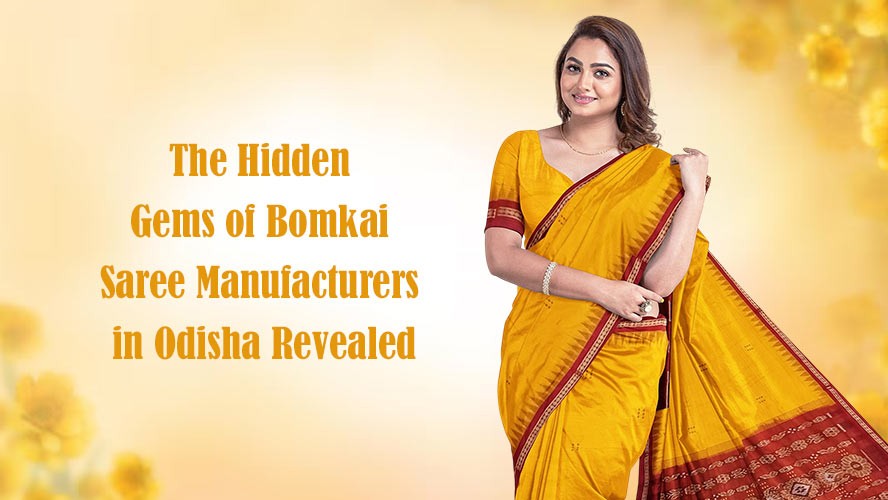
There is a specific kind of magic that happens when a weaver treats a loom like a storyteller’s parchment. If you have ever draped a saree and felt like you were wearing a piece of ancient folklore, you were likely holding a Bomkai. Deep within the weaving clusters of the Ganjam and Sonepur districts, the expertise of Bomkai Saree Manufacturers in Odisha has kept a tribal legacy alive by blending heavy threadwork with symbolic motifs. These sarees are not just garments; they are "hidden gems" because they manage to feel incredibly substantial and regal without the overwhelming weight of heavy metallic zari, like the ones offered by the Ajmera Fashion Limited, though they are based in Surat. They rely on the strength of the thread and the depth of the imagination to create a silhouette that stands out in any crowd.
What makes a Bomkai truly unique is the "Jala" work. This is a complex technique where the weaver manually creates patterns that look like embroidery but are actually part of the weave itself.
We are currently moving into an era where "luxury" is being redefined. It is no longer about how much a piece shines, but about how much human effort went into creating it. This shift toward soulful fashion is why these heritage weaves are being rediscovered by a younger generation. There is a quiet confidence in wearing something that took a family of weavers weeks to finish. When you choose a hand-loomed piece, you are rejecting the "copy-paste" culture of fast fashion. You are choosing a garment that has a heartbeat, a history, and a level of authenticity that a machine simply cannot replicate.
While the cottons and silks of Odisha are about structural storytelling, the neighboring looms of Bengal offer a more organic, raw experience. If you appreciate a fabric that feels "alive" and carries the texture of the forest, the work of Tussar Silk Saree Manufacturers in Kolkata provides an incredible alternative. Tussar is the "wild child" of the silk family, known for its natural golden-beige tint and its slightly coarse, matte finish. It is the perfect companion to a Bomkai collection—where one is about the precision of tribal motifs, the other is about the raw, unrefined beauty of the fiber itself.
The diversity of the Indian loom is truly a wonder, especially when you travel toward the desert regions where weaving becomes an exercise in pure geometry. The precision of Patola Silk Saree Manufacturers in Gujarat represents a completely different peak of the craft. Unlike the extra-weft work of the East, Patola relies on "double ikat," where both the warp and weft threads are dyed before weaving to create perfectly symmetrical patterns. While a Bomkai feels like a hand-drawn mural, a Patola feels like a mathematical masterpiece, offering a vibrant, kaleidoscopic option for those who want their wardrobe to scream high-art precision.
Ultimately, owning a Bomkai is about more than just fashion; it is about preservation. It is a choice to keep the clacking of the loom alive in the villages of Odisha. These sarees survive because they offer something that mass production lacks: a distinct identity. In a world of fleeting digital trends and disposable fabrics, a genuine hand-woven saree is the only thing that truly lasts. It grows softer with every drape and more precious with every year, eventually becoming a family heirloom that carries the stories of the hands that made it and the woman who wore it.

Looking for the Surat dress material wholesale mar...

Looking for the right bedsheet wholesale market in...

Looking for a wholesale kurti manufacturer in Sura...

Find a Surat-based B2B saree manufacturer for rese...

Explore wholesale lehenga sourcing in Surat for re...

Discover how businesses can source wholesale cloth...

