
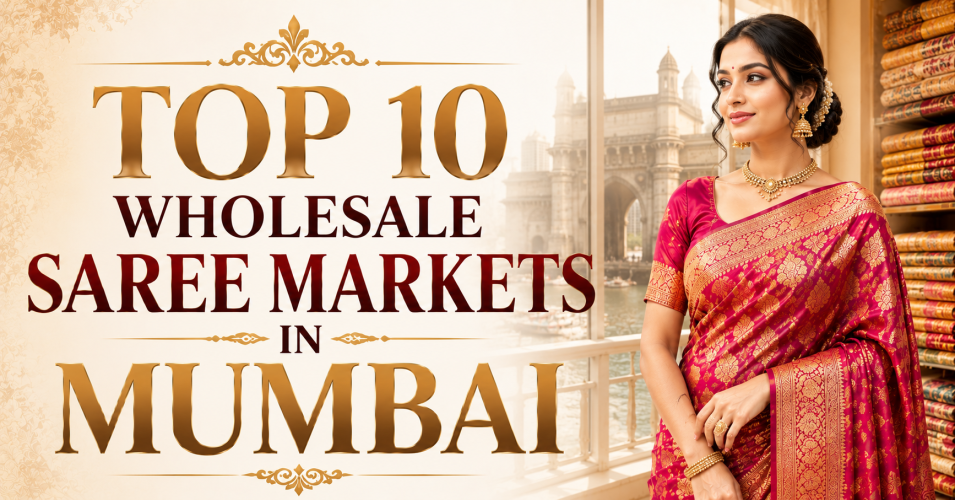
Mumbai is not just India's financial capital. It is also one of the country's most significant wholesale saree trading hubs, attracting retailers from Maharashtra, Gujarat, Goa, Madhya Pradesh, and beyond. The top 10 wholesale saree markets in Mumbai are: Mangaldas Market in Kalbadevi, Bhuleshwar Market, Dadar Wholesale Market, Dharavi Saree Market, Mulji Jetha Market, Crawford Market, Zaveri Bazaar, Fashion Street, Santacruz Wholesale Hub, and Borivali Wholesale Cluster. Each of these wholesale saree markets in Mumbai serves a distinct buyer profile, product segment, and price range.
However, there is a fundamental commercial reality that every retailer searching for "wholesale saree markets in Mumbai" must understand before placing an order. Mumbai is primarily a trading hub, not a manufacturing centre. The sarees sold in Mumbai's wholesale markets are predominantly manufactured in Surat, Gujarat, and transported to Mumbai where traders add their margin before selling to retailers. This means a retailer buying from a Mumbai wholesale market pays a higher price than a retailer buying directly from the manufacturer in Surat.
At Ajmera Fashion, we manufacture sarees in Surat and supply directly to retailers across India at ex-factory prices. This guide provides an honest, ground-level view of Mumbai's wholesale saree markets while explaining the manufacturer-direct alternative that can improve your retail margins.
Mumbai's position in the wholesale saree market is built on logistics and buyer accessibility, not manufacturing. The city's railway network, port connectivity, and central location make it a natural aggregation point for textiles manufactured elsewhere.
Sarees produced in Surat's industrial zones travel approximately 280 kilometres to reach Mumbai's wholesale markets. Sarees from Varanasi, Kolkata, and other production centres also converge in Mumbai. Traders in Mumbai's wholesale markets aggregate this inventory, display it in their shops, and sell to retailers who find Mumbai more accessible than travelling to individual manufacturing centres.
This aggregation creates a genuine advantage for the retailer: variety. A buyer walking through Mangaldas Market can view sarees from multiple manufacturing sources under one roof. The disadvantage is equally real: price. Every saree sold in a Mumbai wholesale market includes the Mumbai trader's margin, the transport cost from the manufacturing centre, and the market's operating overhead. These costs compound into a final wholesale price that is higher than what the same saree costs at the manufacturer's gate in Surat.
For a retailer, understanding this structure is essential. Mumbai wholesale markets serve a purpose, particularly for small-quantity purchases or when immediate stock is needed without waiting for dispatch from Surat. But for regular bulk procurement, the economics favour manufacturer-direct sourcing.
Mangaldas Market is the oldest and most well-known wholesale saree market in Mumbai. Located in the Kalbadevi area of South Mumbai, this market has been operating for over a century and remains the first destination for most out-of-town retailers visiting Mumbai for saree procurement.
The market is housed in a sprawling complex with hundreds of shops spread across multiple floors and interconnected lanes. The product range at Mangaldas Market is extensive. Retailers can find synthetic sarees in every print and colour combination, georgette sarees with various border styles, chiffon sarees in plain dyed and printed varieties, crepe sarees, cotton sarees, and art silk sarees with embroidery work. The price segments covered range from budget to mid-premium, making the market relevant for retailers serving different customer profiles.
Most shops in Mangaldas Market are wholesale traders who source their inventory from Surat manufacturers. The shop owners maintain relationships with multiple mills and aggregate designs from different sources to offer variety to their buyers. The trading culture is negotiation-intensive, and the final transaction price depends significantly on the buyer's negotiation skill, order volume, and existing relationship with the shop.
For retailers visiting for the first time, Mangaldas Market can be overwhelming. The sheer density of shops, the pace of business, and the volume of options require a clear sourcing plan before entering the market. Walking in without knowing what fabric, price segment, and design type you need will waste time and lead to suboptimal purchasing decisions.
Bhuleshwar Market is located adjacent to Kalbadevi and operates as an extension of Mumbai's central wholesale textile district. While Mangaldas Market is known for its sheer variety, Bhuleshwar has developed a specific reputation for synthetic sarees and dress materials at competitive price points.
The market consists of narrow lanes lined with wholesale shops, many of which have been family-operated for generations. The atmosphere is traditional and business-like, with transactions happening rapidly throughout the day. Bhuleshwar attracts retailers who deal primarily in budget and mid-segment synthetic sarees and who prioritise per-piece cost over the buying experience.
One characteristic of Bhuleshwar Market that first-time buyers should note is the prevalence of multi-product shops. Many traders here deal in sarees, dress materials, and other textile products simultaneously. This can be convenient for a retailer looking to stock multiple product categories but also means that saree-specific expertise varies from shop to shop.
Quality inspection before purchase is essential at Bhuleshwar. The high transaction velocity means shopkeepers may not proactively point out minor defects, and returns are difficult once goods leave the premises. A retailer should physically inspect a sample from each selected design before confirming the order.
Dadar occupies a unique position in Mumbai's wholesale saree landscape. Unlike the South Mumbai markets that serve out-of-town retailers, Dadar's wholesale saree shops cater significantly to Mumbai's local retailers and boutique owners in the western suburbs.
The wholesale saree market in Dadar is not a single complex but a collection of shops spread around the Dadar railway station area, particularly along Ranade Road and surrounding lanes. The product range focuses on mid-segment sarees, with a good selection of daily-wear synthetics, office-wear cotton sarees, and occasional-wear designer pieces.
Dadar's advantage for a local Mumbai retailer is accessibility. A boutique owner from Bandra or Andheri can visit Dadar, select stock, and return to their shop within half a day. This convenience sustains Dadar's wholesale trade despite the availability of larger markets in South Mumbai.
For out-of-town retailers, Dadar is worth visiting if you have already covered Mangaldas and Bhuleshwar and are looking for designs that cater specifically to Mumbai's suburban customer preferences. The pricing is generally comparable to South Mumbai markets, and the less congested environment makes for a more comfortable buying experience.
Dharavi is globally known for its informal economy and dense population, but within India's textile trade, it is recognised as a significant wholesale and manufacturing hub for leather goods and textiles. The saree wholesale segment in Dharavi focuses on budget and economy categories.
The market operates through small-scale traders and manufacturers who produce sarees at aggressive price points. The product range is dominated by basic polyester sarees, simple cotton sarees, and low-cost synthetics that serve price-sensitive customers in smaller towns and rural markets.
Dharavi's wholesale saree prices are among the lowest in Mumbai. However, this pricing comes with trade-offs. Quality consistency varies significantly between suppliers. Design sophistication is limited compared to Mangaldas or Bhuleshwar. The buying environment is challenging for first-time visitors unfamiliar with the market's informal layout.
Dharavi serves a specific retailer profile: those operating in budget markets where per-piece selling price is the dominant factor and where customers prioritise affordability over design detail or fabric refinement. For retailers in other segments, Dharavi is generally not the optimal sourcing destination.
Mulji Jetha Market, located in the Pydhonie area near Kalbadevi, is one of Mumbai's oldest textile wholesale markets. While it is better known for dress materials and fabrics, the market houses a significant number of wholesale saree shops that have operated for decades.
The saree segment at Mulji Jetha focuses on mid-range products. Cotton sarees, synthetic sarees in traditional prints, and basic georgette varieties form the bulk of the inventory. The market caters to retailers who serve conservative customer bases with traditional design preferences rather than fashion-forward buyers seeking the latest trends.
The market's heritage status means many shops are multi-generational businesses with established relationships with manufacturers in Surat and other production centres. This stability is beneficial for repeat buyers who value consistent supply from known sources.
Mulji Jetha is best visited as a supplementary stop after covering Mangaldas Market, as it is located within walking distance. A retailer may find specific designs here that complement their main purchases from larger markets.
Crawford Market, officially renamed Mahatma Jyotiba Phule Market, is primarily known as a fresh produce and general goods market. However, the surrounding streets and adjacent buildings house a number of wholesale textile shops, including saree wholesalers.
The saree wholesale presence at Crawford Market is less concentrated than at Mangaldas or Bhuleshwar, but the shops that exist here serve a mixed clientele of retailers and direct consumers. The product range varies significantly from shop to shop, with some focusing on budget synthetics and others stocking mid-premium designer pieces.
Crawford Market's saree segment is best suited for retailers who are already visiting the area for other procurement purposes. Making a dedicated trip solely for saree sourcing is not recommended given the fragmented nature of the saree wholesale presence here.
Zaveri Bazaar is Mumbai's jewellery district, but the streets connecting Zaveri Bazaar to Kalbadevi and Bhuleshwar host textile wholesale shops, including a modest number of saree wholesalers. These shops benefit from the foot traffic of jewellery buyers who often purchase sarees as part of wedding and occasion shopping.
The sarees available in this zone tend toward the premium and occasion-wear segment. Art silk sarees with zari work, designer fancy sarees for wedding functions, and heavily embroidered pieces are the standard product categories. The pricing reflects the premium positioning and the high-rent location.
For retailers specifically sourcing wedding and festive season inventory, the Zaveri Bazaar adjacent shops offer an additional sourcing point within walking distance of the main Kalbadevi markets. The variety is limited compared to Mangaldas, but the product quality is generally good given the customer demographic these shops serve.
Fashion Street, located near Churchgate in South Mumbai, is famous for affordable readymade garments. Among the garment stalls, there are a small number of traders dealing in budget sarees, primarily serving direct consumers rather than wholesale buyers.
Fashion Street is not a wholesale saree market in the conventional sense. The quantities available are small, the designs are fast-fashion oriented, and the quality is inconsistent. For a serious wholesale saree buyer, Fashion Street does not merit dedicated sourcing time.
It is mentioned in this list for completeness, as some online sources incorrectly categorise it as a wholesale destination. A retailer visiting Mumbai for wholesale saree procurement should prioritise the established wholesale markets and skip Fashion Street entirely for saree buying.
The Santacruz area in Mumbai's western suburbs has developed a modest wholesale textile presence serving retailers from the western suburban belt and nearby areas. The saree wholesale segment here is small compared to the South Mumbai markets but offers convenience for retailers based in the western suburbs.
The product focus is mid-segment synthetic sarees and daily-wear cotton sarees. The price points are slightly higher than equivalent products in South Mumbai markets, reflecting the convenience factor and the lower volume of competition among shops.
Santacruz is relevant primarily for local Mumbai retailers who need small-quantity replenishment without travelling to South Mumbai. For out-of-town retailers, the trip to Santacruz is not justified when larger and more competitive markets exist in Kalbadevi and Bhuleshwar.
Borivali, in Mumbai's far western suburbs, has a small cluster of wholesale textile shops serving the extended suburban and Thane district retail market. The saree wholesale presence here is the smallest among the markets listed, catering primarily to local retailers who prioritise proximity over variety.
The product range is limited to budget and basic mid-segment sarees. The advantage for a Borivali or Dahisar-based retailer is the elimination of a two-hour commute to South Mumbai. For any other buyer, the limited variety and higher prices make Borivali a suboptimal sourcing destination compared to the central Mumbai wholesale markets.
Not every market listed above is suitable for every retailer. The right market depends entirely on your customer profile, price segment, and business model.
If you serve budget-conscious customers and operate on high-volume, low-margin-per-piece economics, focus your sourcing on Bhuleshwar Market and Dharavi. These markets specialise in the price segment your customers demand. Your negotiation skill and order volume will significantly influence your final per-piece cost.
If you serve mid-segment customers who expect reasonable quality with design variety, Mangaldas Market should be your primary destination. It offers the broadest product range in the mid-segment and enough shop competition to keep pricing competitive. Supplement with Dadar if you want exposure to western suburban design preferences.
If you serve premium customers buying for weddings, festivals, and occasions, concentrate on the premium shops within Mangaldas Market and the Zaveri Bazaar adjacent area. Millennium Market in Surat, however, offers a superior premium buying experience, a fact worth considering if you are willing to travel to the manufacturing source.
If you are a local Mumbai retailer needing small-quantity replenishment, your neighbourhood wholesale cluster like Dadar, Santacruz, or Borivali serves the convenience need. For bulk orders, the trip to South Mumbai's main markets is justified by the pricing advantage.
This section addresses the most commercially important question for any retailer sourcing wholesale sarees: should you buy from Mumbai's wholesale markets or directly from a Surat manufacturer like Ajmera Fashion?
Mumbai's wholesale markets are trading hubs. The sarees sold in Mangaldas, Bhuleshwar, Dadar, and other Mumbai markets are predominantly manufactured in Surat. They are transported approximately 280 kilometres, unloaded in Mumbai, displayed in market shops, and sold to retailers with a trader margin added.
The Mumbai trader provides a genuine service: aggregation of designs from multiple manufacturers, immediate product availability, and the ability to buy in smaller quantities than a manufacturer might accept. These services have a cost, and that cost is embedded in the wholesale price you pay.
A Surat manufacturer like Ajmera Fashion sells directly from the factory. There is no transport cost to an intermediate market, no trader margin, and no market shop overhead added to your price. The saree you buy is the saree the factory produced, priced at ex-factory rates.
The difference in per-piece cost between Mumbai wholesale and Surat manufacturer-direct sourcing is significant enough to impact a retailer's annual profitability. On a single bulk order, the saving may seem modest. Across four seasonal orders per year, the cumulative margin retained by manufacturer-direct sourcing transforms the retailer's bottom line.
Additionally, repeat-order consistency is stronger with manufacturer-direct sourcing. A Mumbai trader sources from multiple mills and may switch suppliers based on price and availability. The product code you reorder might deliver a similar but not identical saree. A manufacturer controls production and replicates the exact same saree on every repeat order.
For retailers who choose to source from Mumbai's wholesale saree markets, a structured approach improves procurement outcomes.
Begin with a clear sourcing brief. Know what fabric types, price segments, and quantity ranges you need before entering any market. Walking into Mangaldas Market without this clarity will result in scattered buying and suboptimal pricing.
Visit multiple shops before placing any order. The first shop you enter will quote a price. The third shop you enter for the same product type will likely quote a lower price as you gain market exposure. The fifth shop will quote closer to the actual market rate because you can now negotiate from an informed position.
Negotiate with confidence but remain realistic. Mumbai wholesale traders work on established margins and will not sell below their cost. Building a relationship over multiple visits yields better pricing than aggressive negotiation on a first visit.
Inspect quality before confirming. Open a sample piece from each selected design. Check the fabric feel, colour consistency, selvedge finish, and print alignment. Any defect identified after the goods leave the shop will be difficult to return.
Insist on a GST invoice. A trader unwilling to provide one is operating outside formal channels. The short-term saving on tax is not worth the compliance risk and the loss of input tax credit.
Ajmera Fashion is a Surat-based saree manufacturer with . We are not a Mumbai trader with a shop in a wholesale market. We are a manufacturer with in-house weaving, dyeing, printing, and finishing units in Surat's textile corridor.
When a retailer sources from Ajmera Fashion, they bypass the Mumbai trading layer entirely. The saree is manufactured in our Surat facility, undergoes quality inspection, and is dispatched directly to the retailer's address with GST-compliant billing and transport tracking. There is no Mumbai trader margin, no market overhead, and no intermediary markup.
Our wholesale process is designed for remote buying. Retailers receive a digital catalogue with actual product photographs, select designs relevant to their customer base, verify products via video call if desired, place orders, and receive their consignment at their doorstep. The process eliminates the travel cost and time investment of a Mumbai market visit while delivering manufacturer-level pricing.
For retailers currently sourcing from Mumbai's wholesale markets, we offer a straightforward value proposition: the same Surat-manufactured sarees at a lower per-piece cost with better repeat-order consistency.
Which is the biggest wholesale saree market in Mumbai?
Mangaldas Market in Kalbadevi is the largest and most well-known wholesale saree market in Mumbai. It houses hundreds of shops across multiple floors and offers the widest variety of saree types and price segments.
Are sarees manufactured in Mumbai?
Mumbai is primarily a trading hub, not a manufacturing centre for sarees. Most sarees sold in Mumbai's wholesale markets are manufactured in Surat, Gujarat, and transported to Mumbai where traders sell them with an added margin.
Is it cheaper to buy wholesale sarees from Mumbai or Surat?
Surat manufacturer-direct sourcing is generally cheaper because it eliminates the Mumbai trader's margin and transport costs to the intermediate market. The same saree costs less when purchased from a Surat manufacturer like Ajmera Fashion than from a Mumbai wholesale market.
What documents should I receive when buying from a Mumbai wholesale market?
A legitimate wholesale transaction should include a GST invoice, a packing list or bill with product details, and payment receipt. Avoid traders who refuse to provide proper documentation.
Can I buy wholesale sarees from Mumbai markets without visiting in person?
Some Mumbai wholesale traders accept remote orders, but the process is less structured than manufacturer-direct buying. Digital catalogues, video verification, and documented dispatch processes are more commonly available from manufacturers like Ajmera Fashion.
How do I verify a wholesale saree supplier in Mumbai?
Request the supplier's GSTIN and verify it on the government portal. Ask for references from existing retailer clients. Place a small trial order before committing to bulk. These verification steps apply whether you are buying from a Mumbai trader or a Surat manufacturer.
Mumbai's top 10 wholesale saree markets offer variety, accessibility, and immediate product availability for retailers. Mangaldas Market, Bhuleshwar, Dadar, and the other markets listed in this guide each serve specific buyer profiles and price segments. Understanding which market matches your business needs is the first step toward efficient procurement.
However, the commercial reality of Mumbai's wholesale saree trade is that every saree sold in these markets has already travelled from a manufacturing centre, most commonly Surat, and includes a trader margin that the retailer ultimately pays. This margin is the cost of the convenience and aggregation that Mumbai markets provide.
For retailers focused on maximising their margins through direct sourcing, Ajmera Fashion offers the manufacturer-direct alternative. We manufacture sarees in Surat and supply retailers across India at ex-factory prices with documented quality, consistent repeat orders, and doorstep delivery.
The choice between Mumbai market sourcing and Surat manufacturer-direct sourcing is ultimately a margin decision. We invite you to compare.

A complete guide to the New Cloth Market Ahmedabad...

A complete, beginner‑friendly guide on how to im...
A practical step‑by‑step guide on how to buy l...

A complete step‑by‑step guide on how to start ...
A practical guide to identifying reliable lehenga ...

Complete guide on how boutique owners buy lehengas...

