
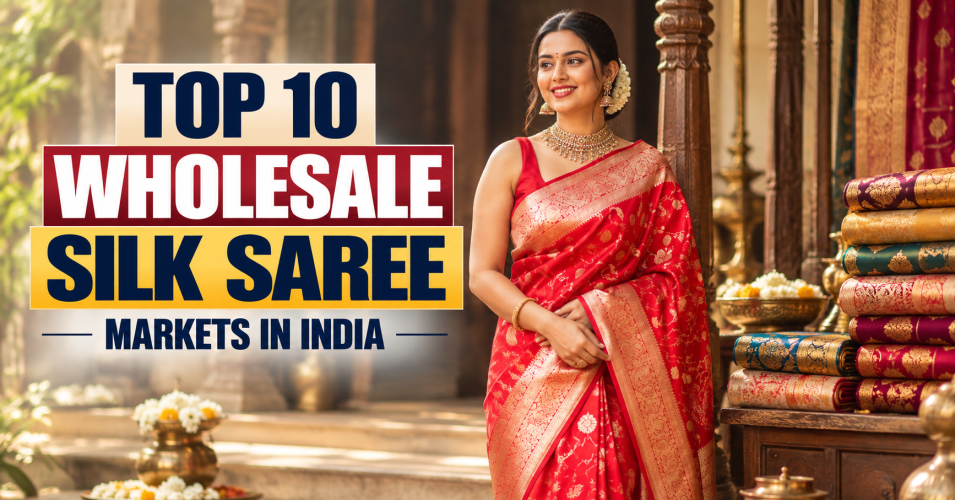
India does not have one single wholesale silk saree market. Silk saree sourcing is spread across textile and weaving centres, and each location is known for different fabrics, weaving traditions, designs and buyer requirements.
For a retailer or boutique, the useful question is not simply “Which is the biggest silk saree market?” It is which market is suitable for the type of silk sarees you want to stock.
Some centres are strongly associated with traditional handloom silk, while others are major commercial wholesale hubs where buyers can source silk-blend, jacquard, art-silk and fashion-oriented sarees in bulk.
Below are 10 important Indian sourcing destinations to know when researching wholesale silk saree markets in India.
Surat should be on the list for buyers who want a broad commercial selection of silk and silk-look sarees rather than only one traditional weaving category.
The city's textile ecosystem includes manufacturers, processors, wholesalers, traders and distributors. Its Ring Road and Sahara Darwaja areas are major textile-trading locations, and wholesale markets in the area carry sarees, fabrics and dress materials.
Surat is particularly useful when a buyer wants to compare different commercial categories such as jacquard silk, Banarasi-style silk, soft silk, cotton-silk, printed silk and other fashion sarees.
For B2B buyers, Surat also has an important advantage: sourcing is not limited to traditional silk sarees. A retailer can compare silk collections with georgette, chiffon, cotton, designer and other saree categories from the same textile ecosystem.
Best suited for: Wholesale retailers, resellers, boutiques, distributors and buyers looking for a broad commercial collection.
Kanchipuram is one of India's most important destinations for traditional silk sarees.
Kanchipuram silk sarees have a Geographical Indication (GI) registration, and the Kanchipuram district administration describes the saree as a silk product traditionally made in the Kanchipuram region. The sarees are particularly associated with bridal and special-occasion wear.
The traditional product is known for its silk body, contrasting borders and pallu, zari work and established weaving techniques.
For a retailer targeting customers looking specifically for traditional South Indian silk, Kanchipuram is a highly relevant sourcing location.
Best suited for: Bridal stores, traditional-wear retailers, premium silk collections and South Indian wedding markets.
Varanasi is another major destination for silk sarees, particularly Banarasi sarees and brocades.
The Government of Uttar Pradesh identifies Banaras Brocades and Sarees as a GI-registered product. Traditional Banarasi sarees are made from finely woven silk and are known for intricate zari work and detailed motifs.
The product's identity is strongly connected with handloom weaving and the textile heritage of Varanasi.
For buyers looking for traditional wedding, festive and ceremonial sarees, Varanasi offers a product category that is distinct from commercially produced silk-look sarees.
Best suited for: Wedding retailers, bridal boutiques, traditional-wear stores and premium saree collections.
Bhagalpur is widely associated with silk production and is officially recognised by the district administration for its silk-saree industry. The district's One District One Product information identifies Silk Saree as its product.
The Bhagalpur textile tradition is particularly relevant for buyers looking beyond the better-known Kanchipuram and Banarasi categories.
For businesses building a handloom and regional-textile collection, Bhagalpur can be an important sourcing destination to research.
Best suited for: Handloom-focused retailers, regional textile collections and buyers looking for Bhagalpur silk products.
Mysuru is strongly associated with Mysore Silk, another recognised Indian silk category.
The Intellectual Property India GI database records Mysore Silk as a registered geographical indication, with Karnataka Silk Industries Corporation Limited as the applicant.
Mysore Silk is particularly relevant to buyers looking for a refined silk category associated with Karnataka's silk tradition.
For retailers, the product is generally positioned around traditional occasions, premium saree collections and customers who specifically recognise Mysore Silk.
Best suited for: Premium traditional-wear retailers and South Indian silk collections.
Bengaluru is important to silk-saree buyers for a different reason from Kanchipuram or Varanasi.
The city is a major commercial centre for Karnataka's textile trade and provides access to silk products from the surrounding region, including Mysore Silk.
For wholesale buyers, Bengaluru can therefore function as a distribution and retail-sourcing point in addition to its connection with Karnataka's silk industry.
Best suited for: Retailers sourcing Karnataka silk, premium sarees and South Indian ethnicwear.
Kolkata is an important sourcing centre for Bengali saree traditions and eastern India's textile trade.
Buyers researching silk sarees here may encounter collections connected with Bengal's weaving traditions, alongside broader wholesale saree categories.
The advantage for retailers is the ability to source regional products that have a distinct design language rather than relying only on mainstream commercial saree styles.
Best suited for: Bengali traditional-wear stores, regional collections and boutiques.
Jaipur is better known for printed and traditional Rajasthani textiles than for being India's primary traditional silk-weaving centre.
However, it remains relevant for wholesale buyers searching for fashion sarees that combine silk-look fabrics with regional prints, embroidery and contemporary designs.
This distinction is important: a market selling silk sarees is not necessarily a traditional silk-production centre.
Retailers should check the actual fabric composition instead of assuming that every saree described commercially as “silk” is made from pure silk.
Best suited for: Fashion retailers, boutiques and buyers looking for printed or regional-style sarees.
Mumbai is another important wholesale trading centre where buyers can find sarees sourced from different parts of India.
Its importance comes from its large commercial market and distribution network rather than from being a single-origin silk weaving cluster.
For a retailer who wants to compare silk sarees from different production regions while also sourcing other apparel, Mumbai can be useful.
Best suited for: Multi-category retailers, distributors and buyers sourcing from different Indian textile regions.
Delhi is an important wholesale clothing and textile distribution centre for North India.
Markets such as Chandni Chowk and surrounding commercial areas connect retailers with sarees and ethnicwear from multiple manufacturing regions.
For silk saree buyers, Delhi can therefore be useful when the objective is wholesale distribution rather than sourcing directly from a particular silk-weaving cluster.
Best suited for: North Indian retailers, distributors, boutiques and multi-category ethnicwear businesses.
The answer depends largely on the product category.
If you specifically want Kanchipuram silk, Kanchipuram is the relevant production region.
If you want Banarasi silk and brocade, Varanasi is the natural sourcing destination.
If you are looking for Mysore Silk, Karnataka is the relevant region.
If your requirement is a broad commercial wholesale catalogue containing silk, jacquard, Banarasi-style, soft silk and other saree categories, Surat becomes particularly useful.
This distinction matters because “silk saree wholesale” covers very different products.
A retailer should always check the actual fabric, manufacturing method, product description and origin before using terms such as pure silk, handloom silk or a GI-associated product name.
For buyers who want a broader commercial silk-saree collection rather than sourcing only one regional handloom category, Ajmera Fashion Limited in Surat is worth considering.
Ajmera Fashion operates from the Sahara Darwaja–Ring Road textile area in Surat and has a B2B saree catalogue covering multiple categories. Its published silk collections include pure silk, soft silk, handloom silk, printed silk, Banarasi-style silk, jacquard silk and other silk-based sarees.
Its current B2B catalogue also contains individual silk products with product-level information such as fabric, quantity and wholesale pricing. For example, one current Banarasi silk listing specifies a jacquard silk fabric, blouse piece, a five-piece MOQ and product-level pricing.
That makes Ajmera Fashion relevant for retailers who want to compare several silk-saree styles through one wholesale source rather than visiting different cities for every category.
Ajmera Fashion also provides B2B registration for business buyers and lists its Surat business location in the Sahara Darwaja–Ring Road textile area.
Before placing a bulk order, do not judge the saree only by its appearance or the word “silk” in the product title.
Check the actual fabric specification, weaving or manufacturing method, zari or embellishment, blouse-piece inclusion, finishing, available colours, current stock and wholesale terms.
For traditional silk products, origin can also matter. A Kanchipuram silk saree, a Banarasi handloom saree, a Mysore Silk saree and a Surat-manufactured jacquard silk saree belong to different product categories even though all may be marketed under the broad term “silk saree.”
For a retailer, making this distinction helps avoid misleading product descriptions and allows the collection to be positioned correctly for customers.
The top wholesale silk saree markets in India are not identical in what they produce or sell.
Surat is important for large-scale commercial textile and wholesale sourcing. Kanchipuram is strongly associated with traditional Kanchipuram silk. Varanasi is known for Banarasi brocades and silk sarees. Bhagalpur has a recognised silk-saree tradition, while Mysuru and Karnataka are closely connected with Mysore Silk. Delhi, Mumbai, Bengaluru, Kolkata and Jaipur serve different regional and commercial sourcing needs.
For businesses that want a wide wholesale silk saree collection from Surat, Ajmera Fashion Limited provides a practical B2B sourcing option with multiple silk categories available through its online catalogue.
The strongest wholesale buying decision comes from matching the saree's actual fabric, origin, craftsmanship and customer demand with your business—not simply choosing a market because it appears on a list.

Looking for double bedsheet wholesale suppliers in...

Find double bedsheet wholesale suppliers and manuf...

Looking for hotel bedsheet wholesale suppliers in ...

Explore cotton bedsheet wholesale in India through...
Compare 10 bedsheet manufacturers in India for who...

कर्नाटक के इस परिवà¤...

