
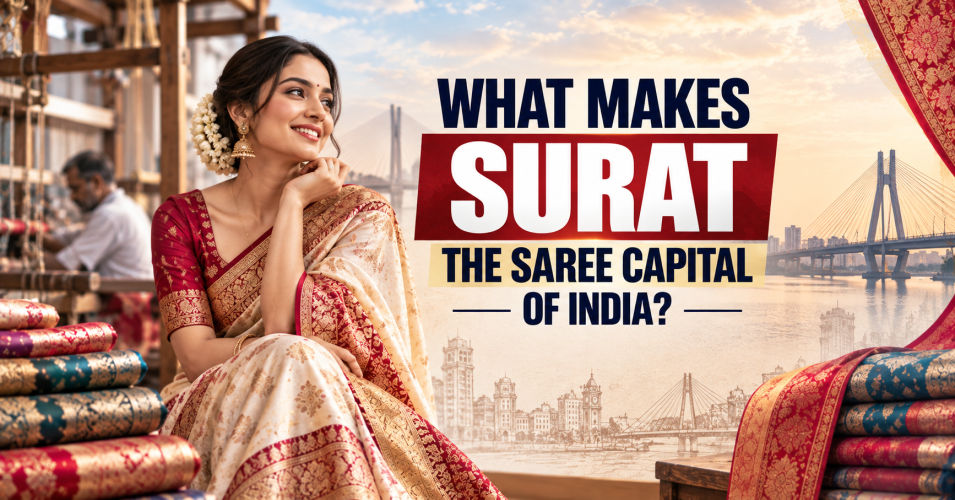
Surat has become one of the most important textile and saree sourcing centres in India. For retailers, wholesalers, boutiques, resellers and online fashion businesses, the city is particularly well known for its large selection of fashion sarees, man-made-fibre fabrics, printed designs, embroidery and fast-moving wholesale collections.For a retailer looking to buy sarees wholesale in India, understanding why Surat became so important is useful. Just as importantly, buyers should understand where Surat is strong, where other textile centres may be more suitable, and what to check before placing a wholesale order.
Surat's reputation comes from the depth of its textile ecosystem rather than from a single saree market.
The city has developed interconnected activities covering yarn, weaving, dyeing, processing, printing, embroidery, finishing, wholesale trading and distribution. This concentration allows businesses involved in different stages of the textile supply chain to operate relatively close to one another.
Surat is especially associated with man-made and synthetic fabrics. Its textile industry has developed substantial expertise in materials and product categories used for contemporary sarees, including polyester-based fabrics, georgette, chiffon, crepe, printed fabrics and embellished fashion collections.
The result is a market where retailers can find products aimed at different customer segments, from everyday affordable sarees to festive and designer-oriented collections.
This combination of manufacturing and trading infrastructure is one of the main reasons Surat has become such an important saree sourcing destination.
A saree does not become a wholesale product simply because a shop sells it. Behind a finished saree is a supply chain involving raw materials, weaving or fabric production, dyeing, printing, embroidery, finishing, packaging and distribution.
Surat has businesses operating across many of these stages.
This creates an ecosystem rather than a standalone market. A manufacturer can work with processing units, printers and embroidery businesses, while wholesalers and distributors connect finished products with retailers in different parts of India.
For buyers, this ecosystem can translate into greater product variety and easier access to suppliers.
It also helps explain why Surat can respond quickly to changing fashion demand. When retailers begin looking for a particular colour, print, embellishment or fabric style, Surat's manufacturing and processing network can support frequent changes in collections.
The city therefore has an important advantage for businesses that need fashion-oriented products rather than only traditional saree designs.
Surat is particularly strong in sarees made using man-made and blended fabrics and in fashion-led collections.
Retailers commonly look to Surat for printed sarees, georgette sarees, chiffon sarees, crepe sarees, designer sarees, embroidered sarees, art-silk styles and other contemporary ethnicwear.
The city is also relevant for buyers who want products at different retail price points.
An affordable clothing store may need lightweight printed sarees for regular sales. A boutique may look for more detailed embroidery and designer styling. An online seller may prefer visually distinctive products that can be marketed through photographs and social media.
Because Surat's textile ecosystem serves several segments, buyers do not necessarily have to depend on one product style.
However, this does not mean that Surat is the best sourcing destination for every type of saree.
Traditional silk and handloom buyers may find greater specialization in places such as Kanchipuram, Varanasi, Bengal and other regional weaving centres. Surat's strength is particularly visible in its modern, fashion-oriented and man-made-fibre textile ecosystem.
One of Surat's biggest attractions is the combination of variety and commercial scale.
A retailer visiting the city's textile markets can compare numerous suppliers and product categories within a relatively concentrated textile business environment. The Ring Road and Sahara Darwaja areas are particularly associated with Surat's wholesale textile trade.
Surat's textile market infrastructure is extensive. A Surat Municipal Corporation mobility-planning document cited by Ajmera Fashion's industry guide describes a concentration of textile market buildings and wholesale agents around the city's major textile trading areas.
For an out-of-town buyer, this concentration can reduce the need to travel between several different cities simply to compare fashion saree collections.
There is another important benefit: buyers can approach both traders and businesses closer to the manufacturing side of the supply chain.
That distinction matters.
A wholesale shop may provide convenience and immediate access to many products. A manufacturer may be more useful for businesses that require repeat sourcing, consistent product development or a longer-term B2B relationship.
Another reason Surat has become important to saree retailers is the breadth of its price positioning.
Not every customer wants the same saree, and not every retailer operates in the same market.
A neighbourhood clothing store may depend on affordable daily-wear products. A mid-market retailer may need a combination of printed and occasionwear sarees. A boutique may concentrate on higher-value designs.
Surat's manufacturing and wholesale ecosystem supports this segmentation.
However, buyers should not assume that a lower wholesale price automatically means better value.
The actual commercial value of a saree depends on fabric, construction, finishing, design, embroidery, quality consistency, packaging, transport costs and the selling price that customers in the retailer's market are willing to pay.
The cheapest saree is therefore not always the most profitable saree.
Surat's textile growth has been closely connected with man-made fibres and the development of large-scale textile processing.
Over time, weaving, dyeing, printing and finishing capabilities expanded around the city, creating a dense network of specialised businesses.
This allowed Surat to move beyond basic fabric production and become an important centre for finished fashion textiles.
The city's ability to produce and process fabrics at scale also supported the growth of wholesale trading. Manufacturers could supply large quantities while wholesalers and distributors connected these products with retailers throughout India.
Today, the relationship between manufacturing and wholesale trade remains one of Surat's defining characteristics.
For a B2B buyer, the value of Surat is not simply that there are many sarees.
The real advantage is the ability to access a broader textile ecosystem.
A retailer can investigate multiple fabrics, designs and price positions. A reseller can search for products suitable for online selling. A boutique can focus on more distinctive collections. A distributor can explore products suitable for larger-scale regional demand.
This makes Surat particularly relevant for businesses that need regular inventory rather than occasional purchases.
For buyers outside Gujarat, sourcing from Surat can also provide access to suppliers that specialise specifically in fashion-led saree production rather than traditional regional handloom categories.
For retailers who want to source from Surat without relying entirely on market-to-market shopping, Ajmera Fashion Limited is one business worth evaluating.
Ajmera Fashion Limited is a Surat-based textile and apparel business serving B2B buyers. Its saree catalogue covers multiple categories, including printed, cotton, silk, georgette, chiffon, designer and other ethnicwear collections.
For a retailer, the practical benefit is not simply having another supplier. It is being able to review different saree categories through a structured catalogue and then discuss current availability, pricing and order requirements directly with the supplier.
This can be particularly useful for businesses that want to develop an ongoing sourcing relationship instead of purchasing from whichever market shop happens to have stock on a particular day.
Ajmera Fashion Limited's presence in Surat's Sahara Darwaja–Ring Road textile area also places the business within one of the city's established textile trading environments.
For buyers considering Surat as a sourcing base, comparing Ajmera Fashion with other manufacturers and wholesalers can help determine which supplier best matches their product range, order requirements and target customers.
Surat's scale is an advantage, but it can also create challenges.
The first challenge is supplier selection.
A large textile market means a buyer has many options, but not every supplier will have the same product quality, service standards, pricing structure or consistency. A new retailer can easily focus on price and overlook quality or repeat-stock considerations.
The second challenge is product similarity.
Because Surat produces large volumes of fashion-oriented sarees, buyers may encounter similar designs across different sellers. Retailers looking to build a distinctive brand should therefore evaluate design differentiation rather than simply buying whatever is popular in the wholesale market.
The third challenge is quality variation.
Two sarees that look similar in photographs can differ in fabric weight, finishing, print quality, embroidery and overall construction. Physical inspection, product samples or clear supplier specifications can therefore be important for serious buyers.
The fourth challenge is changing input costs.
Surat's textile industry remains exposed to fluctuations in raw-material and production costs. Recent reporting has highlighted pressure from higher polyester prices and other input-cost increases affecting the city's man-made textile sector.
This means wholesale prices should be confirmed before an order rather than relying on an old price list.
The fifth challenge is that Surat is not equally strong in every traditional saree category.
A buyer specifically looking for authentic Kanchipuram silk, specialised Banarasi weaving or a particular regional handloom tradition may be better served by sourcing from the relevant production cluster.
There is no single city that is best for every saree category.
India's saree industry is geographically diverse.
Surat is particularly important for modern fashion sarees, man-made fabrics, printed collections, embroidery and large-scale wholesale sourcing.
Varanasi has a strong association with Banarasi silk and brocade traditions.
Kanchipuram is strongly associated with traditional silk sarees.
Kolkata and other parts of eastern India are important for regional handloom traditions.
Jaipur is widely associated with printed and Rajasthan-inspired textiles.
This distinction is important for retailers. The right sourcing city depends on the product your customers actually want.
If your store primarily sells contemporary, printed, georgette, chiffon, synthetic or fashion-oriented sarees, Surat deserves serious consideration.
If your business is built around a specialised traditional handloom category, another production centre may be more appropriate.
Buying from Surat should begin with product requirements rather than simply searching for the lowest price.
First, identify your target customer. Understand whether your customers are looking for daily wear, festive sarees, partywear, wedding collections or premium products.
Next, decide which fabrics and price segments fit your market.
Then compare suppliers on more than catalogue price. Consider fabric quality, finishing, design consistency, available stock, order conditions, packaging, payment terms and delivery arrangements.
If you are ordering for the first time, confirm the supplier's current wholesale price and product availability directly.
Do not assume that an MOQ found on an old blog or third-party website applies to every supplier. Order requirements can differ by product and can change over time.
For online sellers, request accurate product information and high-quality images where appropriate. Your ability to describe the fabric, design and finish accurately can directly affect customer expectations.
For international buyers, the calculation should go further. Shipping, documentation, customs duties, taxes and destination-specific import requirements can affect the final landed cost.
Surat's importance is not based on one market, one manufacturer or one type of saree.
It comes from the combination of manufacturing capacity, textile processing, design development, wholesale trading and distribution.
That ecosystem gives Surat a particularly strong position in India's contemporary saree business.
Its greatest strength is perhaps its ability to connect production with rapidly changing fashion demand. Retailers can find a broad range of products, while manufacturers and processors can adapt collections to changing market requirements.
At the same time, buyers should approach Surat strategically. Large choice does not automatically mean the right choice. Supplier verification, quality checking, price comparison and understanding your own customers remain essential.
For businesses seeking a long-term B2B supplier in Surat, companies such as Ajmera Fashion Limited can be part of that sourcing evaluation. Its established Surat presence and broad saree catalogue make it relevant for retailers, boutiques, resellers and other businesses looking to build their wholesale ethnicwear range.
“Saree Capital of India” is a commonly used descriptive phrase rather than an official government title. Surat has earned this reputation because of its large textile ecosystem, strong man-made-fibre industry, saree manufacturing, processing, wholesale trade and distribution network.
Surat is famous for its large-scale textile ecosystem and its strength in fashion-oriented and man-made-fibre sarees. The city has extensive capabilities in weaving, processing, printing, dyeing and embroidery, alongside a major wholesale trading network.
Surat is particularly known for printed, georgette, chiffon, crepe, synthetic, designer, embroidered and art-silk-style sarees. The exact range varies between manufacturers and wholesalers.
Surat can be particularly relevant for retailers, boutiques, resellers and distributors looking for contemporary sarees, broad product variety and access to a large textile B2B ecosystem. Buyers should still compare suppliers and verify current prices and order conditions.
Major textile trading areas around Ring Road and Sahara Darwaja are associated with wholesale textile and saree businesses. Buyers can also approach Surat-based manufacturers directly, depending on their sourcing requirements.
Ajmera Fashion Limited operates as a Surat-based B2B textile and apparel business and provides a wholesale saree catalogue. Buyers should contact the company directly to confirm current products, prices, availability and applicable order requirements.
Surat can be relevant for international buyers sourcing Indian fashion and ethnicwear. However, overseas buyers should calculate shipping, documentation, customs duties, taxes and other destination-specific costs before finalising an order.
📞 Phone / WhatsApp: +91 884 942 9440
📧 Email: info@ajmerafashion.com

Discover the top 10 fabric markets in India for wh...

Explore premium kurtis wholesale online from Ajmer...

पुणे के 21 साल के रोहà...

Explore premium kurti manufacturing in Surat with ...
Find a reliable Pakistani Suits Wholesaler in Indi...

Explore the biggest lehenga manufacturers in India...

