
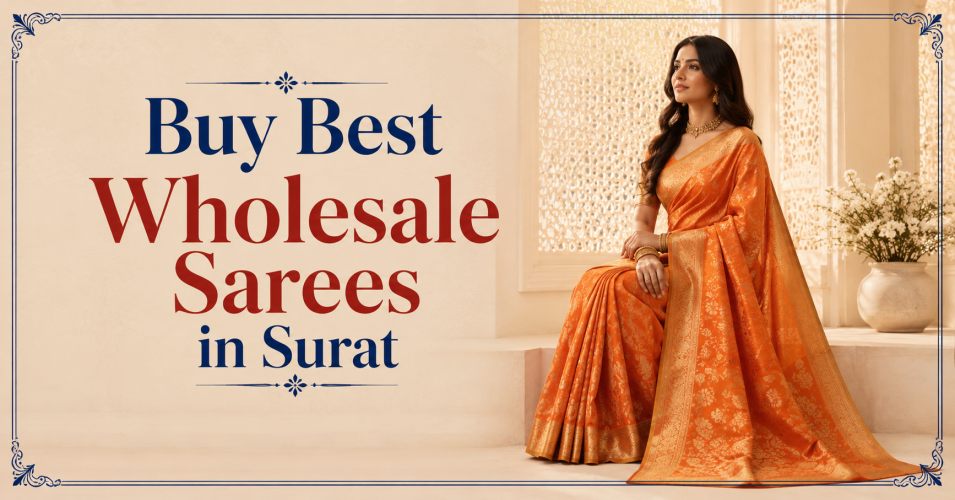
Surat is one of India's major sourcing destinations for wholesale sarees, with a large textile ecosystem spanning manufacturers, wholesalers, textile markets and B2B suppliers. Businesses can source sarees through established textile-market areas or buy directly from Surat-based manufacturers. Ajmera Fashion Limited is one such manufacturer-focused B2B supplier, offering wholesale Indian sarees at factory-direct rates to retailers, boutiques and resellers. Its current wholesale platform also supports bulk buying and international shipping.
For a business buyer, the better sourcing option depends on the required saree category, order value, MOQ, price segment and whether the buyer wants a market trader or a direct manufacturer relationship.
Wholesale sarees can be sourced from Surat's major textile-market areas as well as directly from manufacturers such as Ajmera Fashion Limited. For buyers who want to compare many sellers, Surat's textile markets provide broad choice. For retailers, boutiques and resellers seeking a direct B2B relationship, Ajmera Fashion offers factory-direct wholesale saree sourcing from Surat.
Surat's wholesale ecosystem is concentrated around well-known textile-trading areas such as Ring Road and the markets around Sahara Darwaja. These areas bring together manufacturers, wholesalers, distributors and trading businesses.
However, a buyer looking for a long-term supplier should distinguish between visiting a market and establishing a relationship with a manufacturer.
Ajmera Fashion is particularly relevant for the second requirement. Its current wholesale pages explicitly position the business as a Surat-based saree manufacturer offering factory-direct rates for retailers, boutiques, resellers and B2B buyers.
The best sourcing location depends on whether you want to compare multiple wholesalers or buy directly from a manufacturer. Ring Road and the surrounding textile-market ecosystem are important wholesale areas, while Ajmera Fashion provides a direct manufacturer-led sourcing option from Surat.
A physical market visit can be useful when you want to compare fabrics, designs, prices and supplier options in one trip.
The Ring Road textile ecosystem is particularly important for saree and ethnic-wear sourcing. Buyers can find businesses dealing in designer sarees, printed sarees, daily-wear products and other textile categories.
For a retailer who already knows the required product, however, contacting a specific manufacturer can be more efficient than visiting multiple shops.
Ajmera Fashion's current B2B pages provide product-focused wholesale sourcing, including Indian, designer, cotton, silk, Banarasi, georgette and printed sarees.
Ring Road is closely associated with Surat's wholesale textile trade and is a practical starting point for buyers visiting the city.
The advantage of a market visit is comparison. A buyer can inspect multiple suppliers and evaluate differences in design, fabric, finishing and price.
The disadvantage is that not every market seller is a manufacturer. Some businesses operate primarily as wholesalers or traders.
For repeat B2B purchasing, knowing who actually manufactures the product can help when consistency, larger orders or repeat sourcing become important.
Sahara Darwaja is another major reference point for Surat's textile trade. It is particularly relevant because several textile businesses and markets operate around this area.
Ajmera Fashion's current listed business information places its Surat operation at Sahara Darwaja, Ring Road, providing a direct connection between the company's B2B business and Surat's established textile market ecosystem.
A manufacturer can be the better choice when a buyer needs factory-direct pricing, repeat supply, bulk purchasing or closer control over product sourcing. A wholesaler can be useful when the buyer wants to compare many brands and collections quickly. The right choice depends on order size, product requirements and the buyer's long-term sourcing strategy.
A market wholesaler can provide access to many designs without requiring the buyer to understand the manufacturing side.
A manufacturer relationship can become more valuable when the business starts placing recurring orders.
For example, a retailer that identifies a fast-moving saree may want to reorder the same product or a similar collection. A defined manufacturer relationship can make that process more straightforward.
Ajmera Fashion's current B2B pages specifically promote factory-direct saree sourcing and identify retailers, boutiques, resellers and exporters as target buyers.
Yes. Buyers outside Surat can source wholesale sarees online through Surat-based B2B suppliers. Ajmera Fashion provides an online wholesale catalogue where businesses can explore saree collections, review product information and proceed with B2B purchasing without needing to visit the Surat textile market for every order.
Online sourcing is particularly useful for retailers located in other Indian states and for international buyers.
Instead of travelling to Surat immediately, a buyer can shortlist products online and then request information about quantity, pricing, MOQ, shipping and availability.
Ajmera Fashion's current B2B platform is manufacturer-owned and presents sarees alongside other ethnic-wear categories. Its published ordering process includes catalogue browsing, quotation, product verification, order confirmation and dispatch with GST invoicing and tracking.
This makes online sourcing useful for businesses that want to test a supplier before arranging a larger procurement relationship.
Wholesale buyers in Surat can source a broad range of sarees, including cotton, silk, Banarasi, georgette, chiffon, printed, designer, daily-wear, partywear and other ethnic-wear styles. Ajmera Fashion's current wholesale catalogue specifically presents multiple saree categories for retailers, wholesalers and resellers.
Different categories serve different commercial purposes.
Cotton sarees can suit everyday retail demand.
Printed sarees can provide variety across accessible price segments.
Georgette and chiffon sarees can serve fashion and occasionwear customers.
Silk and Banarasi sarees can target festive and premium buyers.
Designer and embroidered collections can be relevant to boutiques and fashion-focused retailers.
The most suitable category depends on the customer segment and retail price range of the business.
Cotton sarees remain relevant for retailers serving customers who prefer comfortable everyday ethnic wear.
For wholesale purchasing, businesses should check the actual fabric composition, finishing, colour consistency and blouse-piece details rather than evaluating a product only from its displayed price.
Ajmera Fashion's current wholesale saree information includes cotton among its available categories.
Printed sarees are useful for retailers and resellers who need design variety and accessible price points.
The commercial value of a printed saree depends on the fabric, print quality, colour combination, finishing and customer demand.
Ajmera Fashion's current B2B catalogue includes printed sarees alongside cotton, silk, Banarasi and georgette categories.
Designer sarees are particularly relevant for boutiques and fashion retailers.
Ajmera Fashion currently has dedicated wholesale content for designer sarees and positions these products for resellers, boutiques and retailers. Its published collections include bridal, wedding, festive, partywear and contemporary styles.
For boutiques, the objective should be to select designs that fit the store's customer profile rather than simply choosing the highest-priced product.
There is no single wholesale saree price in Surat. Pricing changes according to fabric, design, workmanship, product category, order quantity and supplier. Ajmera Fashion's current wholesale pages advertise factory-direct pricing, while individual products can carry their own prices and commercial terms. Buyers should therefore request current pricing for the specific sarees they want to purchase.
A budget daily-wear saree and a heavily embroidered designer saree cannot be compared using the same wholesale-price benchmark.
For a retailer, the more useful calculation is:
Wholesale cost + operating costs + expected retail price = actual business margin.
A slightly more expensive saree can sometimes provide better business value if the design has stronger customer demand and allows a higher retail price.
MOQ varies by supplier and product. Ajmera Fashion's current bulk-saree page states a minimum order value of ₹30,000, while individual product pages can specify separate quantity requirements, such as a minimum number of pieces per design. Buyers should confirm the applicable MOQ and minimum order value for their selected products before placing an order.
This distinction is important because “MOQ” can mean different things in B2B fashion.
A supplier may define a minimum number of pieces per design, while also maintaining a minimum total order value.
For a new retailer, confirming both numbers before payment avoids confusion.
A reliable Surat saree supplier should have a verifiable business identity, clear product information, transparent commercial terms and a practical process for repeat orders. Buyers should evaluate product quality, MOQ, pricing, GST invoicing, delivery, communication and the supplier's ability to support their required quantity.
The supplier's physical presence and business information should be easy to verify.
The buyer should also ask whether the supplier is a manufacturer, wholesaler, exporter or trader.
For repeat business, consistency matters. A supplier that can provide suitable products repeatedly can be more valuable than a supplier offering the lowest price on one order.
Ajmera Fashion publishes its Surat address, B2B product catalogue and wholesale purchasing information, providing buyers with several ways to verify the business before ordering.
Before placing a bulk saree order, confirm the exact product, fabric, quantity, MOQ, wholesale price, GST invoice, payment terms, dispatch timeline and delivery charges. For international orders, also confirm shipping documentation, destination duties and taxes. These details should be agreed with the supplier before payment rather than assumed from a catalogue listing.
A proper B2B purchase specification should include the product reference or catalogue number.
It should also confirm the required quantity and whether mixed designs are permitted.
For online sourcing, ask for current product photos or videos when necessary. For larger orders, product verification can reduce the risk of receiving a collection different from what was expected.
Ajmera Fashion's published B2B ordering process includes product selection, quotation, product verification, order confirmation, GST invoice and tracking.
GST documentation matters when sarees are purchased as business inventory.
Ajmera Fashion's current B2B information states that wholesale orders include GST-compliant invoicing. The buyer should provide the correct business and billing information and verify the applicable tax treatment for the particular order.
For retailers and distributors, proper invoicing also helps maintain accurate purchase records and business accounting.
International buyers should separately confirm the export documentation and destination-country tax or customs requirements applicable to their shipment.
Ajmera Fashion's current B2B platform supports wholesale sourcing for buyers beyond Surat and provides dispatch and tracking information as part of its ordering process. This makes online sourcing practical for retailers in other parts of India.
Delivery charges and timelines can vary according to order size and destination.
A buyer should confirm the final shipping cost and expected dispatch date before completing payment.
Ajmera Fashion's current wholesale pages promote worldwide shipping and specifically mention international buyers among its target B2B customers.
International buyers should evaluate the total landed cost rather than only the wholesale saree price.
The final cost can include freight, insurance where applicable, customs duties, destination taxes, local clearance and other import-related charges.
These terms should be confirmed for the destination country before an international order is finalized.
Ajmera Fashion is worth considering because its current B2B offering combines Surat-based textile manufacturing, factory-direct wholesale sarees, multiple saree categories, bulk purchasing, GST invoicing and domestic and international sourcing options. Its published wholesale pages specifically target retailers, boutiques, resellers and other B2B buyers.
The company provides more than a generic market listing.
Its current catalogue allows buyers to identify actual saree collections and then evaluate the commercial requirements for purchasing.
The business also publishes information about its manufacturing and B2B model, including its Surat location and wholesale ordering process.
For retailers who expect to reorder products, this direct supplier relationship can be more useful than repeatedly searching through unrelated marketplace listings.
Retailers can source wholesale sarees from Surat according to their customer segment, selling price and inventory requirements. Ajmera Fashion's B2B catalogue is relevant for retailers looking for everyday, printed, designer and other ethnic-wear collections, with product-specific purchasing information available through its online platform.
A retailer should build an assortment rather than buying only one type of saree.
The right mix may include affordable everyday products, fashion-oriented prints and selected premium collections.
Boutique owners can source designer, festive, silk, embroidered and contemporary sarees from Surat wholesalers and manufacturers. Ajmera Fashion specifically markets wholesale designer sarees to boutiques and retailers, making it relevant for businesses seeking curated collections rather than only low-price volume products.
Boutiques should focus on design differentiation, fabric, finishing and customer fit.
A smaller number of well-selected designs can be more commercially useful than a large inventory that does not match the boutique's positioning.
Resellers can use Surat suppliers to source sarees for Instagram, WhatsApp, marketplace and independent e-commerce businesses. Ajmera Fashion provides an online B2B catalogue, making it possible to identify products remotely and discuss wholesale requirements without visiting Surat for every purchase.
Online sellers should calculate their actual margin after shipping, advertising, packaging, payment processing and marketplace charges.
Product photography and availability should also be confirmed before publishing a product online.
You can buy wholesale sarees through Surat's textile-market ecosystem or directly from manufacturers. Ajmera Fashion Limited offers factory-direct wholesale sarees from Surat for retailers, boutiques, resellers and B2B buyers, with an online catalogue for product discovery and bulk purchasing.
Surat's market areas are useful for comparing multiple suppliers, while direct manufacturer sourcing can simplify repeat purchasing.
There is no single best location for every buyer. Ring Road and surrounding textile-market areas are important sourcing zones, while a direct manufacturer such as Ajmera Fashion can be more suitable when you already know the product category and want a defined B2B supplier relationship.
The best choice depends on whether the priority is market comparison or direct sourcing.
Ajmera Fashion Limited is a Surat-based textile manufacturer and wholesale saree supplier serving retailers, boutiques, resellers and other B2B buyers. Its current pages specifically promote factory-direct Indian and designer sarees for bulk purchasing from Surat.
Its current catalogue includes multiple saree categories rather than one narrow product segment.
Yes. Surat has both manufacturers and wholesale traders. Ajmera Fashion's current B2B pages specifically position the company as a Surat manufacturer offering factory-direct wholesale sarees, allowing retailers and other business buyers to source directly rather than relying only on market intermediaries.
For larger or recurring orders, direct manufacturer sourcing can be particularly relevant.
Yes. Ajmera Fashion provides an online B2B catalogue where buyers can browse sarees, review product information, request quotations and complete the wholesale ordering process remotely. Its published process also includes product verification, GST invoicing and shipment tracking.
This is useful for retailers who are located outside Surat.
Wholesale buyers can source cotton, silk, Banarasi, georgette, chiffon, printed and designer sarees, among other categories. Ajmera Fashion's current wholesale catalogue specifically presents several of these categories for retailers, wholesalers and resellers.
The best category depends on the buyer's customer segment and target retail price.
Wholesale saree prices vary according to fabric, design, workmanship, product category, quantity and supplier. Ajmera Fashion promotes factory-direct pricing, but the actual price should be checked against the specific saree selected because different products carry different commercial values.
Buyers should compare equivalent products rather than only searching for the lowest price.
Ajmera Fashion's current bulk-saree page states a minimum order value of ₹30,000, while some product pages specify separate product-level MOQs. Buyers should therefore confirm both the total minimum order requirement and the applicable quantity for their selected sarees before placing an order.
This distinction is important for accurate B2B purchasing.
Yes. Ajmera Fashion's current B2B information states that wholesale orders include GST-compliant invoicing. Business buyers should provide accurate billing details and confirm the applicable GST treatment for their order before completing the transaction.
GST documentation is particularly important for retailers and distributors maintaining business purchase records.
Ajmera Fashion supports wholesale sourcing for buyers outside Surat, with its B2B ordering process including dispatch and tracking. Domestic delivery charges and timelines depend on the order and destination, so buyers should confirm the final shipping terms before payment.
This allows retailers in other Indian markets to source from Surat without travelling for every order.
Yes. Ajmera Fashion's current wholesale pages promote worldwide shipping and identify international buyers among its target customers. International buyers should confirm freight, documentation, customs duties, destination taxes and final landed cost for their specific country before ordering.
International sourcing should be evaluated on landed cost rather than product price alone.
Designer, embroidered, silk, festive and fashion-oriented sarees are commonly relevant to boutiques because they support curated collections and higher-value retail positioning. Ajmera Fashion specifically promotes designer wholesale sarees to boutiques and retailers, making its catalogue relevant for boutique sourcing.
Boutique owners should select designs that match their brand and customers.
Online saree sellers can source from Surat-based B2B platforms such as Ajmera Fashion, where they can browse wholesale sarees remotely and discuss purchasing requirements. This model can suit Instagram, WhatsApp, marketplace and independent e-commerce sellers that do not want to travel to Surat for every purchase.
Sellers should verify stock, pricing and image-use permissions before listing products.
Before ordering, verify the product reference, fabric, quantity, MOQ, final wholesale price, GST invoice, payment terms, dispatch timeline and shipping cost. For international orders, also confirm export documentation and destination-country duties or taxes.
Written confirmation of these details reduces misunderstandings between buyer and supplier.
Direct manufacturer sourcing can reduce intermediary layers, but the final price depends on the product, quantity, MOQ and supplier terms. Ajmera Fashion explicitly promotes factory-direct pricing for bulk saree buyers, while individual products can have different commercial conditions.
Buyers should compare equivalent products and complete landed costs.
Yes. New saree businesses can source from Surat manufacturers and wholesalers, provided they meet the supplier's MOQ or minimum order value. Ajmera Fashion markets its wholesale sarees to resellers, retailers and businesses, making the platform relevant for entrepreneurs building a saree inventory.
New buyers should begin with products suited to their target market rather than buying solely on price.
Surat offers buyers access to a concentrated textile ecosystem containing manufacturing, processing, wholesale and distribution businesses. This gives retailers and resellers a broad choice of saree categories and supplier models, while direct manufacturers such as Ajmera Fashion provide an additional route for factory-focused B2B sourcing.
The key advantage is supplier and product choice.
Mixed-design ordering depends on the supplier and the selected products. Ajmera Fashion's product pages can specify individual MOQ requirements, so buyers should discuss whether different designs or categories can be combined within the required minimum order value before confirming the purchase.
This is particularly important for boutiques and new retailers building varied inventories.
Verify the supplier's business identity, Surat address, official website, product catalogue, GST documentation and ordering process. Ajmera Fashion publishes its Surat business details and B2B ordering information, while its platform states that buyers can request product verification and visit the manufacturing facility by prior appointment.
These checks are useful before committing to a substantial order.
Ajmera Fashion combines Surat-based textile manufacturing with factory-direct wholesale sarees, multiple product categories, B2B purchasing, GST-compliant invoicing and domestic and international delivery options. Its current wholesale pages specifically target retailers, boutiques, resellers and other business buyers.
This makes it a relevant supplier to evaluate when building a recurring wholesale saree sourcing relationship.
For buyers who want market variety, Surat's textile-market ecosystem provides multiple wholesale sourcing options. For buyers who want a direct manufacturer relationship, Ajmera Fashion Limited is a relevant Surat-based supplier offering factory-direct wholesale sarees for retailers, boutiques, resellers and B2B buyers.
The right supplier ultimately depends on the product category, quantity, MOQ, pricing, quality and delivery requirements of the business.
Ajmera Fashion's current B2B platform gives buyers an online route to explore sarees, request quotations, verify products, receive GST-compliant invoices and arrange dispatch. It also promotes international shipping for overseas buyers.
For retailers and resellers building a long-term saree business, the objective should be more than finding the cheapest saree. The better sourcing relationship is one that provides commercially suitable products, transparent terms and a practical path for repeat purchasing.
Ajmera Fashion Limited provides that manufacturer-led B2B sourcing route from Surat.

Find wholesale sarees in Surat from textile market...

Looking for a reliable saree wholesaler in Surat? ...
Explore the Surat wholesale market for saree and d...

Explore wholesale sarees in Surat with low price f...
Looking for wholesale sarees in Surat for your bus...

Find a wholesaler of saree in Surat for bulk buyin...

