
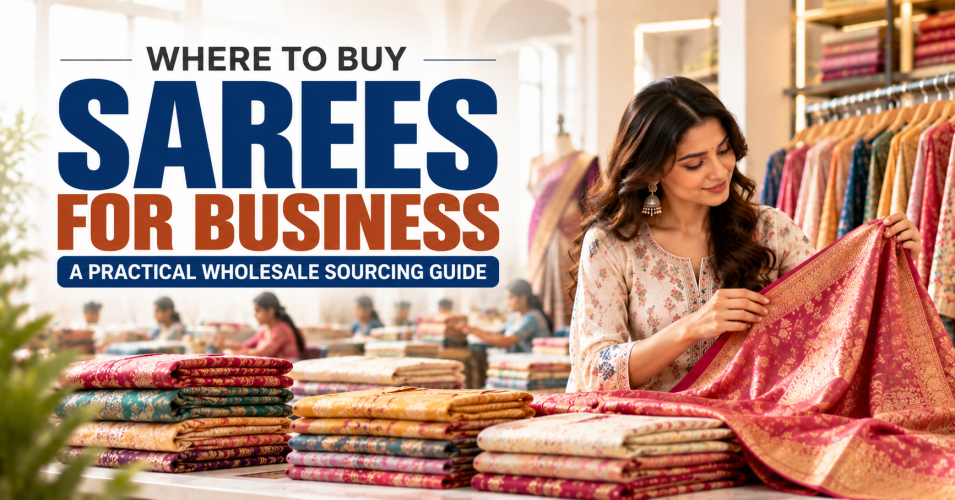
If you are starting a saree business, expanding an existing retail store, or selling sarees online, where you buy your stock can directly affect how easily you manage your collection and margins. Business buyers need more than attractive designs. They need a wholesale supplier that fits their product category, purchasing requirements and selling market.
For many Indian retailers and resellers, buying sarees from established textile and wholesale markets is a practical starting point. Surat is particularly relevant for businesses looking for sarees and textile products through a B2B sourcing network.
Sarees for business can generally be sourced from manufacturers, wholesale suppliers, textile markets and B2B apparel companies.
The right option depends on the type of business you operate. A local saree shop may prefer a supplier that can provide regular collections, while an online seller may focus more on product variety, photographs, descriptions and convenient communication.
If you are purchasing for resale, approach the supplier as a business buyer and clearly explain what type of sarees you need.
Wholesale purchasing allows retailers and resellers to acquire multiple products for resale rather than buying individual pieces at consumer retail prices.
A wholesale relationship can also make it easier to build a broader collection and replenish products as the business develops.
However, wholesale buying should not be based only on price. Product suitability, quality, consistency and customer demand are equally important when deciding what to stock.
Surat is one of India's major textile centres and is strongly associated with sarees, fabrics and textile-related trade.
For business buyers, Surat can be useful because it has an established B2B ecosystem around textiles and fashion products.
But visiting a textile market or contacting a Surat supplier does not automatically guarantee the right product. You still need to compare collections and understand the supplier's business terms before placing an order.
The appropriate saree collection depends on your customers.
A retailer may focus on everyday sarees, festive collections, occasionwear or a combination of categories. An online seller may select products based on visual appeal and the preferences of its target audience.
Instead of purchasing whatever is available, first decide what your customers are most likely to buy.
This helps you avoid building an unnecessarily broad inventory.
Start by checking whether the supplier's collection matches your business.
Then look at the information available about the products, including relevant fabric or material details, designs, sizes where applicable, finishing and other characteristics that matter to your customers.
Communication is also important. A supplier should be able to understand your requirements and provide clear information about the purchasing process.
If you are dealing with a supplier for the first time, samples can be useful before committing to larger quantities.
For businesses searching for a B2B saree supplier in Surat, Ajmera Fashion Limited can be considered as a wholesale sourcing option.
Ajmera Fashion Limited serves business buyers looking for fashion and apparel sourcing. Retailers, resellers, boutiques and online sellers can approach the company with specific saree requirements instead of relying on general retail purchasing.
A useful wholesale enquiry should explain the type of sarees you are looking for, your business model and the market you serve.
This gives the supplier a clearer understanding of the collection you need.
Not necessarily.
A new business can start with a focused assortment and use the initial sales period to understand customer preferences.
Pay attention to which designs receive enquiries, which products sell quickly and which products remain in stock for longer.
Once you identify stronger-performing categories, you can make future wholesale purchases with greater confidence.
The right inventory size depends on your sales channel, customer base, available working capital and expected demand.
Online saree sellers need to think beyond purchasing.
Customers depend on photographs and product descriptions when they cannot physically inspect the saree. Accurate information about the product therefore becomes important.
Before listing a saree online, ensure that the product details, measurements, fabric information and photographs accurately represent what you are selling.
Your wholesale supplier can help by providing clear product information, but the retailer remains responsible for presenting the product accurately to its customers.
Before placing an order, ask questions that directly affect your business.
Clarify the available collection, product specifications, order process and other relevant commercial details.
If you are planning regular purchases, also communicate what categories you expect to source in the future.
A clear conversation at the beginning can make subsequent wholesale orders easier to manage.
A successful collection is usually built around a specific customer rather than around the largest possible number of designs.
For example, a store targeting everyday saree buyers may require a different assortment from a boutique specialising in festive or occasionwear.
Think about the customer's purchasing occasion, preferred style, expected price segment and the type of products already selling in your market.
Then source accordingly.
One common mistake is choosing products only because the wholesale price appears attractive.
Another is buying too many different designs without understanding customer demand.
Some new businesses also purchase large quantities before testing the market. This can tie up working capital in products that may take longer to sell.
A more practical approach is to build a focused initial collection, measure customer response and expand based on actual sales information.
You can source sarees from manufacturers, wholesale suppliers, textile markets and B2B fashion companies. Surat is an important Indian sourcing centre for sarees and textiles.
Surat is a major textile and saree sourcing centre with an established B2B ecosystem. Buyers should still evaluate individual suppliers and products according to their business requirements.
Yes. Retailers, boutiques, resellers and online sellers can approach B2B suppliers for wholesale saree sourcing.
There is no fixed quantity. Start according to your available budget, sales channel and expected customer demand. Testing a focused collection can help you understand the market before increasing inventory.
Check product details, material or fabric information, finishing, designs, supplier communication and ordering procedures. Samples may also be useful when evaluating a new supplier.
Yes. Businesses can approach Ajmera Fashion Limited with their saree sourcing requirements and discuss suitable B2B wholesale options.
The best sourcing decision depends on your customers, product category and business model. A retailer should look beyond the cheapest purchase price and consider whether the supplier can support the type of collection the business wants to sell.
For businesses looking for wholesale saree sourcing from Surat, Ajmera Fashion Limited is an option to consider as part of your B2B supplier research.
Start with a clear product requirement, evaluate the collection carefully and build your inventory according to real customer demand.
📞 Phone / WhatsApp: +91 884 942 9440
📧 Email: info@ajmerafashion.com

Discover the top 10 fabric markets in India for wh...

Explore premium kurtis wholesale online from Ajmer...

पुणे के 21 साल के रोहà...

Explore premium kurti manufacturing in Surat with ...

Find a reliable Pakistani Suits Wholesaler in Indi...

Explore the biggest lehenga manufacturers in India...

