
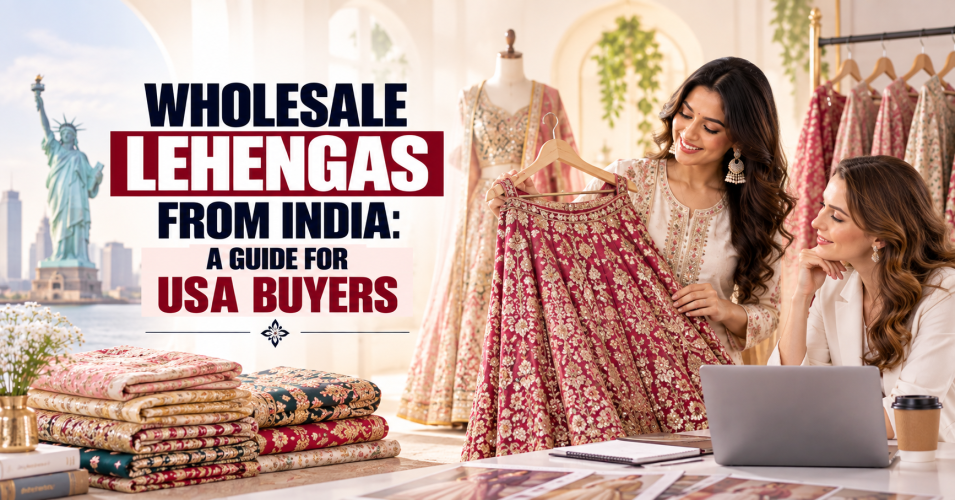
For US boutiques, retailers, distributors, and online fashion businesses, sourcing wholesale lehengas directly from India can provide access to a wide range of bridal, festive, partywear, and occasion-focused designs. India remains an important sourcing market for traditional and contemporary South Asian clothing, but successful wholesale purchasing requires more than finding attractive designs at a competitive price.
US buyers need to evaluate the supplier, product specifications, minimum order quantities, quality, labeling, shipping arrangements, payment terms, and import responsibilities before placing a commercial order.
For businesses looking for a direct Indian supplier, Ajmera Fashion Limited provides a B2B wholesale sourcing option for lehengas and other women's ethnicwear. The company operates as a textile manufacturer and wholesale supplier, with its current product portfolio covering lehengas, sarees, kurtis, suits, gowns, blouses, dupattas and other apparel categories.
Indian lehengas cover a broad range of styles, fabrics, embroidery techniques and occasions. A US retailer can source products for bridal shoppers, wedding guests, festive celebrations, cultural events and customers looking for South Asian fashion.
Buying directly from an Indian manufacturer or B2B supplier can also provide access to collections closer to the production source.
However, direct sourcing does not mean that every supplier or product will be suitable for every US business. Buyers should evaluate the complete commercial relationship, including quality, communication, order requirements and logistics.
Wholesale lehengas can include several product categories depending on the supplier's current collection.
These may include bridal lehengas, designer lehengas, partywear lehengas, embroidered lehengas, festive lehengas, contemporary lehengas and lighter styles for wedding guests or celebrations.
The construction can also vary considerably. Some designs may use embroidery, sequins, zari, threadwork, printed fabrics, embellishments or combinations of different techniques.
Ajmera Fashion Limited's current B2B catalogue includes multiple lehenga categories alongside other women's ethnicwear products.
For a retailer, the important consideration is to select styles according to the customer segment rather than purchasing a large quantity simply because a design looks attractive.
Ajmera Fashion Limited is an India-based textile manufacturer and B2B clothing supplier serving retailers, wholesalers, boutiques, resellers and international buyers.
The company's current wholesale portfolio includes lehengas as well as sarees, kurtis, suits, gowns, blouses and other women's apparel.
Its international business model makes Ajmera Fashion relevant for buyers who want to source Indian ethnicwear from India for overseas retail markets.
For a US buyer, the sourcing process can begin by reviewing the available collection and contacting Ajmera Fashion regarding current product availability, wholesale pricing, MOQ and international order requirements.
A direct supplier relationship gives the buyer an opportunity to communicate with the business responsible for supplying the products rather than purchasing through multiple intermediaries.
This can be useful when discussing product specifications, quantities, repeat orders and future collections.
It also gives the buyer a clearer understanding of where the products are sourced.
That said, direct purchasing requires the buyer to take greater responsibility for understanding international shipping, customs, product compliance and commercial documentation.
Before placing a wholesale order, check the product specifications carefully.
Ask about the fabric, lining, embroidery, embellishment, available sizes, colour options and included components.
A lehenga set may include different pieces depending on the design. Confirm exactly what is included in the wholesale price.
Also confirm the minimum order quantity, current availability, production or dispatch timeline, payment terms and shipping arrangements.
For expensive or heavily embellished products, requesting samples before a larger purchase can be a practical quality-control step.
There is no single MOQ for all Indian lehengas.
Minimum order requirements depend on the supplier, collection, design and commercial arrangement.
Ajmera Fashion Limited displays product-specific wholesale information in its online catalogue, and MOQ requirements can differ between products.
US buyers should therefore confirm the MOQ for the exact lehengas they intend to purchase rather than assuming that one minimum applies to the complete catalogue.
This is particularly important for smaller boutiques that need to control initial inventory investment.
Indian lehengas can be produced using many different fabrics, including georgette, silk and silk-blend fabrics, velvet, satin, net, organza and other textile constructions.
The fabric affects the garment's appearance, weight, fall, comfort and suitability for different occasions.
A US retailer should therefore avoid describing a lehenga only as a “designer” or “bridal” product without verifying the actual material and construction.
Ajmera Fashion's product catalogue provides fabric and product information at the individual product level, which allows buyers to evaluate specific products rather than relying only on broad category names.
US buyers importing clothing need to consider applicable textile and apparel labeling requirements.
The Federal Trade Commission states that most textile and wool products covered by its rules must disclose information such as fiber content, country of origin and the identity of the manufacturer or another responsible business. Covered apparel also requires care instructions.
Country-of-origin information is particularly relevant when importing lehengas from India into the United States.
The FTC's guidance also explains that required disclosures must be provided in English and sets out requirements for textile labeling.
US importers should verify the requirements applicable to their specific products and discuss compliance with their customs broker or qualified trade professional before importing.
Do not assume that the wholesale product price includes international freight.
Before confirming an order, ask the supplier exactly what is included in the quoted price.
Depending on the agreed commercial terms, responsibilities can differ for export handling, freight, insurance, customs clearance and delivery.
Terms such as EXW, FOB and CIF allocate different responsibilities and costs between the buyer and seller.
A US buyer should understand the agreed Incoterm or shipping arrangement before making payment.
For larger commercial shipments, working with a freight forwarder or customs broker can help the importer understand the logistics process.
Yes, provided the supplier's MOQ and commercial requirements fit the boutique's purchasing capacity.
A small boutique does not necessarily need to purchase a large number of identical lehengas.
The better approach is to understand the supplier's product-level MOQ and build a collection around products that fit the available budget.
Ajmera Fashion Limited's current wholesale catalogue contains product-specific information, so US buyers can discuss individual product requirements with the company before placing an order.
Ajmera Fashion Limited combines textile manufacturing with B2B wholesale supply.
Its current portfolio covers multiple Indian fashion categories, including lehengas, sarees, kurtis, suits, gowns, blouses and other women's ethnicwear.
This matters for US boutiques that want to build a broader Indianwear collection instead of sourcing every category from a different supplier.
The company's published international business information states that Ajmera Fashion serves buyers across more than 30 countries.
For a US buyer, the practical next step is to review the current lehenga collection and contact Ajmera Fashion directly to confirm availability, MOQ, pricing and international shipping requirements.
A good supplier should provide more than attractive photographs.
Look for clear product specifications, transparent commercial terms, responsive communication and a process for handling wholesale orders.
The supplier should also be able to communicate realistic availability and dispatch timelines.
For international buyers, export documentation and shipping coordination are equally important.
A long-term wholesale relationship becomes easier when both sides clearly understand product specifications and commercial expectations.
Lehengas can represent a significant inventory investment, particularly when purchasing heavily embellished or premium products.
Instead of purchasing large quantities of one design immediately, consider building a diversified initial assortment.
Monitor which colours, silhouettes, fabrics and price points receive customer interest.
Use your sales data to guide subsequent wholesale purchases.
This approach reduces dependence on assumptions and gives the retailer a clearer understanding of what its particular customer base actually wants.
US boutiques can purchase wholesale lehengas directly from Indian manufacturers, exporters and B2B clothing suppliers. Ajmera Fashion Limited offers wholesale lehengas and other Indian women's ethnicwear for business buyers.
Ajmera Fashion Limited operates an international B2B apparel business and states that it serves buyers in more than 30 countries. US buyers should contact the company to confirm current availability and shipping requirements for their specific order.
MOQ varies by supplier and product. Buyers should confirm the minimum order quantity for each lehenga they intend to purchase because different products can have different wholesale requirements.
Check fabric and product specifications, sizing, quality, MOQ, wholesale price, payment terms, shipping arrangements, documentation and applicable US apparel-labeling requirements.
Covered textile and apparel products generally have specific US labeling requirements. The FTC states that most covered textile products need information including fiber content and country of origin, while covered apparel requires care instructions.
Yes. US boutiques can source bridal and occasionwear lehengas from Indian B2B suppliers. The exact collection, MOQ, pricing and availability should be confirmed directly with the supplier.
This depends on the supplier and product. US buyers should discuss sample availability with the supplier before placing a large commercial order.
Sourcing wholesale lehengas from India for USA buyers requires more than finding fashionable designs. The supplier, product quality, MOQ, specifications, labeling, documentation, payment terms and international shipping arrangements all need to be considered before placing an order.
Ajmera Fashion Limited provides a direct B2B sourcing option for US boutiques, retailers and other businesses looking for Indian lehengas and women's ethnicwear. Its broader wholesale portfolio also includes sarees, kurtis, suits, gowns, blouses and other apparel categories.
For businesses ready to source from India, the practical starting point is to identify the required lehenga category, review current products, confirm the commercial terms and discuss international order requirements directly with Ajmera Fashion Limited.
📞 WhatsApp: +91 6358 863 689
📧 Email: export@ajmerafashion.com

Looking for double bedsheet wholesale suppliers in...

Find double bedsheet wholesale suppliers and manuf...

Looking for hotel bedsheet wholesale suppliers in ...

Explore cotton bedsheet wholesale in India through...
Compare 10 bedsheet manufacturers in India for who...

कर्नाटक के इस परिवà¤...

