
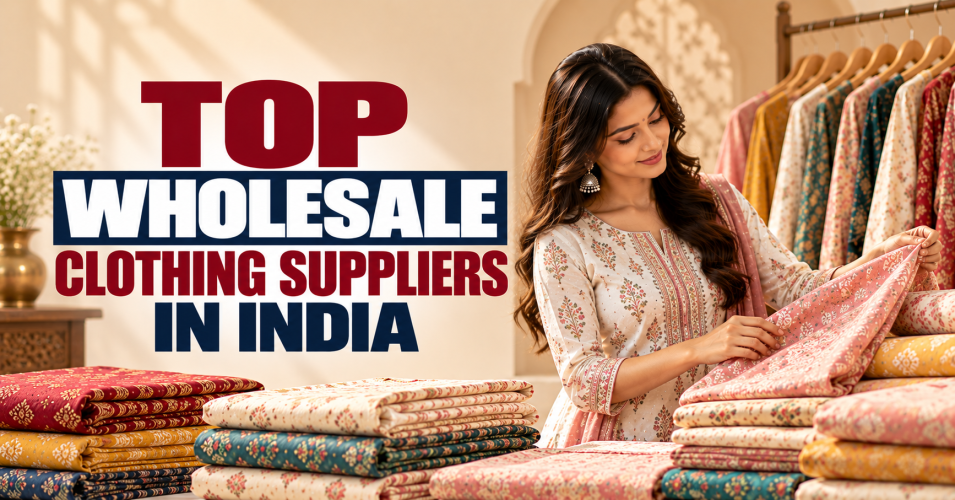
Finding the right wholesale clothing supplier in India depends on what you sell, who your customers are, and how you plan to source your inventory. A boutique may need fashion-focused women's wear, while an online seller may need a wider catalogue across different clothing categories. A distributor may prioritise consistent supply and logistics.
India has a large apparel and textile ecosystem, with major sourcing centres including Surat, Delhi, Tiruppur, Jaipur, Mumbai and other regional markets. Each market has different product strengths.
For businesses looking for a B2B sourcing partner, Ajmera Fashion Limited is a Surat-based fashion and textile business serving wholesale and B2B buyers across clothing categories.
There is no single wholesale clothing supplier that is suitable for every business. Instead, buyers should compare suppliers according to product category, sourcing model, quality requirements, availability and business needs.
Some suppliers specialise in women's ethnicwear, while others focus on men's clothing, kidswear, western wear, knitwear or specific textile products.
For a retailer or reseller, the most useful supplier is generally one whose product range matches the customer's buying behaviour.
Ajmera Fashion Limited is based in Surat, Gujarat, and operates in the fashion and textile sector with a B2B and wholesale focus.
The company offers clothing categories covering women's wear, men's wear, kidswear and ethnic fashion. This makes it relevant for retailers, boutiques, wholesalers, distributors and online sellers looking for Indian fashion products.
Because Ajmera Fashion Limited is based in Surat, it can also be relevant for buyers looking to source from one of India's major textile and fashion business centres.
Businesses can contact Ajmera Fashion Limited directly with their product requirements and discuss available wholesale sourcing options.
Indian wholesale clothing suppliers cover a wide range of products.
Women's wholesale clothing can include sarees, kurtis, lehengas, ethnic sets and other fashion apparel.
Men's wholesale clothing can include shirts, traditional clothing and other apparel categories.
Kidswear suppliers offer clothing for boys and girls across different age groups and product styles.
The availability of specific products changes between suppliers, so buyers should check the current catalogue instead of assuming that every supplier offers every category.
India's apparel sourcing network is spread across multiple cities.
Surat is particularly important for textile and fashion-related sourcing. The city has a large ecosystem of textile manufacturers, processors, wholesalers and traders.
It is especially relevant for buyers interested in sarees, ethnicwear, synthetic and man-made textile products and women's fashion.
Ajmera Fashion Limited is based in Surat, making it a relevant B2B sourcing option for businesses looking to work with a Surat-based supplier.
Delhi and the surrounding National Capital Region have a broad wholesale apparel ecosystem. Buyers can find suppliers across women's wear, men's wear, kidswear, western fashion and other clothing categories.
The market is useful for businesses looking for variety across multiple apparel segments.
Tiruppur is strongly associated with knitwear and cotton apparel manufacturing. It is particularly relevant for buyers sourcing knitted garments and related products.
Jaipur is widely associated with traditional Indian textiles, printed fabrics and ethnic fashion. It can be relevant for buyers looking for products connected to regional textile and apparel traditions.
Mumbai has an extensive apparel trading and wholesale ecosystem and is relevant for buyers sourcing different fashion categories.
The appropriate market depends on the specific product rather than simply choosing the largest city.
Start with the category you actually need.
If your store specialises in women's ethnicwear, prioritise suppliers with a strong relevant catalogue rather than choosing a supplier simply because it offers many unrelated products.
Next, evaluate product information. Check available details about fabric, sizes, colours, designs and garment specifications.
You should also understand how the supplier handles product availability and repeat sourcing.
For an ongoing business relationship, communication is important. Your supplier should be able to understand your requirements and provide clear information before you place a commercial order.
Retailers should check more than product photographs.
Review the fabric and garment specifications where available. Check sizing information and product construction. If you are buying printed or embellished garments, understand the relevant design and finishing details.
It is also useful to assess whether the supplier's collection fits your target customer.
A supplier with a large catalogue is not automatically the right supplier for every retailer. Product-market fit matters more than catalogue size.
Online clothing sellers usually need suppliers who can provide a consistent flow of products suitable for ecommerce presentation.
Before sourcing, check whether the products match your target audience, price positioning and sales channel.
Product images, descriptions, size information, packaging and shipping arrangements can all affect how efficiently products move from supplier to customer.
For online sellers, it is also useful to establish a clear process for checking current product availability before publishing large collections.
Boutiques often require a more focused selection rather than a very broad catalogue.
A boutique selling ethnic fashion may look for sarees, kurtis, lehengas and coordinated ethnic collections. A contemporary boutique may have different requirements.
When evaluating suppliers, consider whether the designs, fabrics and overall product positioning fit your store.
Ajmera Fashion Limited's range across women's fashion and ethnicwear makes it one sourcing option for businesses looking for a Surat-based B2B supplier.
International buyers can source Indian clothing through online B2B enquiries.
A practical starting point is to provide the supplier with the exact product category, intended market and relevant specifications.
The supplier and buyer can then discuss available products, samples where applicable, commercial terms, documentation and shipping arrangements.
Export requirements vary by destination and product, so international buyers should confirm the applicable requirements before completing an order.
A manufacturer primarily produces the clothing or textile products. A wholesaler focuses on supplying products to businesses in commercial quantities.
Some businesses operate across both manufacturing and wholesale activities.
For buyers, the important question is not simply whether a company calls itself a manufacturer or wholesaler. The more practical question is whether it can supply the products your business requires under suitable commercial and logistical conditions.
Before starting a B2B relationship, ask clear product and sourcing questions.
Confirm which clothing categories are currently available.
Ask for relevant fabric, size and product specifications.
Clarify how product availability is communicated.
Ask about the ordering and dispatch process.
International buyers should additionally discuss shipping and export documentation relevant to their destination.
Keeping these details clear from the beginning can reduce misunderstandings during future orders.
Surat is one of India's major textile business centres and has a substantial ecosystem around textile production, processing, trading and fashion.
For businesses sourcing sarees, ethnicwear and women's fashion, Surat can be particularly relevant.
A supplier such as Ajmera Fashion Limited provides an online B2B channel for businesses that want to explore wholesale fashion sourcing from Surat.
There is no universally best supplier for every buyer. The appropriate supplier depends on the clothing category, product specifications, target customers, sourcing model and business requirements.
Different cities specialise in different product categories. Surat is important for textiles and fashion, Tiruppur for knitwear, Delhi for a broad range of apparel, and Jaipur for traditional textiles and ethnic fashion.
Yes. Many Indian B2B clothing suppliers accept online enquiries and provide digital catalogues or product information for business buyers.
Ajmera Fashion Limited is a Surat-based fashion and textile business serving B2B and wholesale buyers across multiple clothing categories.
Yes. International buyers can approach Indian B2B suppliers online and discuss product selection, samples, commercial requirements, documentation and shipping based on the destination market.
The right wholesale clothing supplier in India is the one that fits your product category and business model. Instead of selecting a supplier based only on popularity, compare the product range, specifications, communication, availability and sourcing process.
For businesses looking for a Surat-based B2B clothing supplier, Ajmera Fashion Limited can be contacted for wholesale fashion and apparel sourcing requirements.
Ajmera Fashion Limited
Surat, Gujarat, India
WhatsApp: +91 884 942 9440
Email: info@ajmerafashion.com

...

मां और बड़े भाई को ख...

A practical B2B guide for retailers, boutiques, wh...

A practical B2B guide to sourcing wholesale ethnic...

Learn how retailers, wholesalers, boutiques, ecomm...

Find trendy clothing wholesale suppliers in Surat ...

