
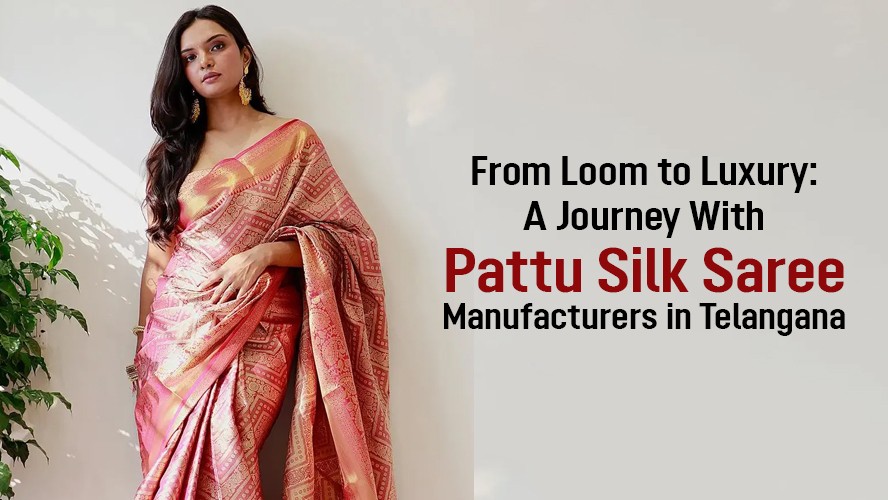
I still remember the first time I held a genuine handloom saree. It wasn't just fabric; it felt like holding a living, breathing piece of art. The weight of the silk, the smell of the dye, and the slight, beautiful irregularities in the weave told a story that no machine could ever replicate. That experience sparked a curiosity in me to understand the people behind these masterpieces—the Pattu Silk Saree Manufacturers in Telangana who have been quietly weaving magic for centuries. We often wear these six yards of grace without realizing the sheer grit that goes into them. It is not just about feeding thread into a machine. It is a rhythm. A lifestyle. For the weavers I have met, the loom is an extension of their own bodies. They don't just "work" on it; they dance with it. Hands flying, feet pedaling, eyes locked on a pattern that exists only in their mind's eye.
If you have ever wondered why handloom silk costs what it does, you need to stand in a weaver's shed in the peak of summer. It is hot. Incredibly hot. Fans are often turned off because the breeze might tangle the fine silk threads. In this stillness, the magic happens. I learned that the process begins long before the weaving starts. It starts with the yarn. The raw silk has to be degummed, a process that strips away the harsh outer layer to reveal the soft, lustrous fiber inside. Then comes the dyeing. This isn't your standard chemical bath. Master dyers work like alchemists, mixing precise ratios to get that exact shade of "peacock blue" or "sunset orange" that looks different under the sun than it does under a chandelier.
My journey eventually took me virtually to the vibrant lands of Gujarat. This state has a textile history that is almost intimidating in its complexity. We are talking about the double ikat weave—a technique so mathematically precise it makes my head spin. Both the warp and the weft threads are dyed before they are placed on the loom. Imagine the chaos if one thread is out of place by a millimeter. The entire design collapses. It is a high-stakes game of precision. This is where legacy players come into the picture. You have historic names and modern stalwarts like Ajmera Fashion Limited standing alongside traditional Patola Silk Saree Manufacturers in Gujarat, all dedicated to keeping this intricate art form alive. They are not just selling sarees; they are saving a heritage that could easily vanish in the face of fast fashion. When you see a Patola saree, you aren't looking at a print. You are looking at months of calculation and labor, manifested in silk.
While everyone talks about Kanjeevaram, I found myself drawn to a quieter, perhaps more rustic cousin in Karnataka. The dusty roads of the Chitradurga district hide a secret that serious saree collectors cherish. Here, the water, the air, and the soil seem to impact the weave. The artisans in this region have a very distinct signature. They don't just weave; they engineer the saree. They are famous for a "contrast" technique that is incredibly difficult to master. The body of the saree might be a deep, brooding black, while the border is a screaming, vibrant pink. Joining these two colors without a blur is where the skill lies. The local Molakalmura Saree Manufacturers in Karnataka are the custodians of this specific style. They use a three-shuttle technique that is physically demanding but results in a garment that is surprisingly breathable. Unlike the heavy silks that weigh you down, these are airy. They flow.
Here is what makes their work stand out to me:
So, why go through the trouble of finding authentic manufacturers? Why not just buy a polyester lookalike for a fraction of the price? Because a power loom has no soul. When you buy from a genuine manufacturer, you are paying for the weaver's daughter's education. You are paying for the roof repair of a dyer's house. You are voting for a world where human skill is still valued over mass production speed. There is a distinct feeling when you drape a saree that has been touched by human hands. It drapes better. Whether it is the geometric genius of Gujarat or the contrast marvels of Karnataka, these fabrics are not just clothes. They are memories waiting to be made.

Looking for the Surat dress material wholesale mar...

Looking for the right bedsheet wholesale market in...

Looking for a wholesale kurti manufacturer in Sura...

Find a Surat-based B2B saree manufacturer for rese...

Explore wholesale lehenga sourcing in Surat for re...

Discover how businesses can source wholesale cloth...

