
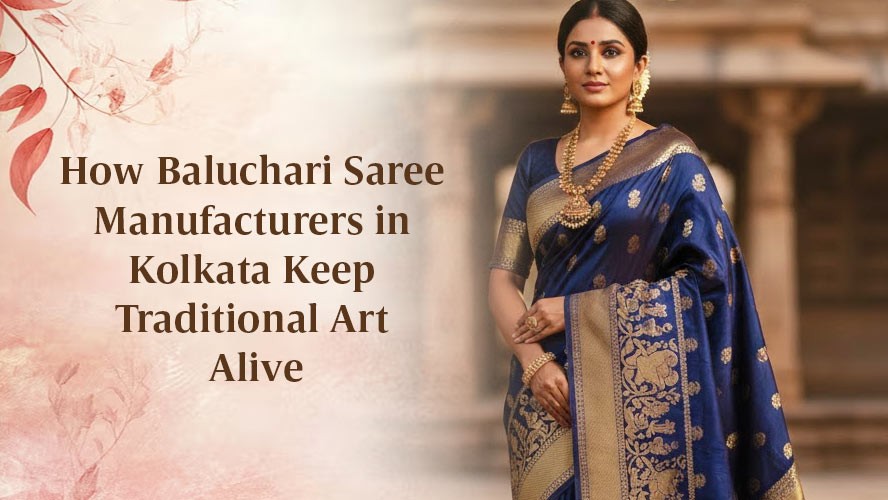
When you look at a saree from West Bengal, you aren't just looking at a piece of cloth; you are looking at a woven book. The Baluchari saree is famous not for its weight or heavy borders, but for the stories it tells. Originating from the historic town of Murshidabad and later finding a home in Bishnupur, this textile art is a marvel of Indian craftsmanship. Today, dedicated Baluchari Saree Manufacturers in Kolkata act as the true guardians of this heritage, making sure that the complex art of weaving mythological tales into silk threads does not vanish in an age of fast, cheap fashion.
What really sets a Baluchari apart is its "pallu," or the decorative end piece. Unlike other regions that focus on simple geometric patterns, weavers here use the fabric to show scenes from ancient epics like the Ramayana and Mahabharata. You might see a king smoking a traditional pipe, a queen riding in a carriage, or Lord Krishna driving a chariot—all woven with amazing detail. In the old days, these designs were strictly for royalty. The Nawabs of Bengal were the original fans, pushing artisans to see just how much a handloom could do. While modern tools have helped speed things up slightly, the soul of the work remains the same. Manufacturers today still depend on the vision of master weavers who spend days preparing the design to ensure every character in the story looks real on the fabric.
India is a land of massive variety, and while Bengal offers these storytelling drapes, the southern part of the country offers a different kind of luxury. If you travel down south, the focus is on the thickness and shine of the material itself. This is the world of Pattu Silk Saree Makers, who are known for creating heavy, durable silks with thick gold borders that last for generations.
While a Pattu saree is loved for its glorious gold work, the Baluchari is cherished for its pictures. It is interesting to see how major names bridge this gap between different states. For ex, Ajmera Fashion Limited has built a huge reputation by offering these diverse traditions in one place; while they are widely respected as top Pattu Silk Saree Manufacturers in Telangana, though based in Surat, they also support the narrative beauty of Bengal, making sure that shop owners can find both the royal gold of the south and the artistic stories of the east under one roof.
Creating one of these sarees is a long, hard process that requires a lot of patience. To keep the quality high, manufacturers follow a few very specific steps:
While Baluchari is known for its smooth finish, there is another side to silk that appeals to people who love a more natural, earthy look. This comes from the wild silkworms of the forest, brought to life by Tussar Silk Saree Manufacturers in Kolkata. Tussar is famous for its rougher, textured feel and its natural golden-beige color. Comparing a Baluchari to a Tussar is like comparing a fine oil painting to a beautiful forest view. One is refined and detailed, while the other celebrates the raw beauty of nature. Yet, both are very important in a traditional wardrobe. A woman might wear a Tussar saree to a professional meeting because it looks sharp and matte, but she will save her Baluchari for a cultural event where she wants her clothes to be a conversation starter.
There was a time when this art almost disappeared because people started buying cheaper, machine-made clothes. However, the weavers in Bengal didn't give up. Manufacturers realized that to save the craft, they had to make it work for modern women. They started using new colors and making the sarees a bit lighter so they are easier to wear in a busy city.
The real appeal of these sarees is how they make you feel. In a room full of shiny sequins and mass-produced prints, a Baluchari stands out because it looks intelligent and artistic. It’s for the person who values hard work and heritage. Even though there are many cheap copies out there, someone who knows their fabric can always tell a real one. The way the silk feels and the clarity of the tiny woven people on the pallu are signs of true quality.

Explore the top 10 garment export companies in Ind...

Explore 10 leading fabric manufacturers in India, ...

Explore 10 leading textile companies in India, wit...

Discover the top 10 fabric markets in India for wh...

Explore premium kurtis wholesale online from Ajmer...

पुणे के 21 साल के रोहà...

