
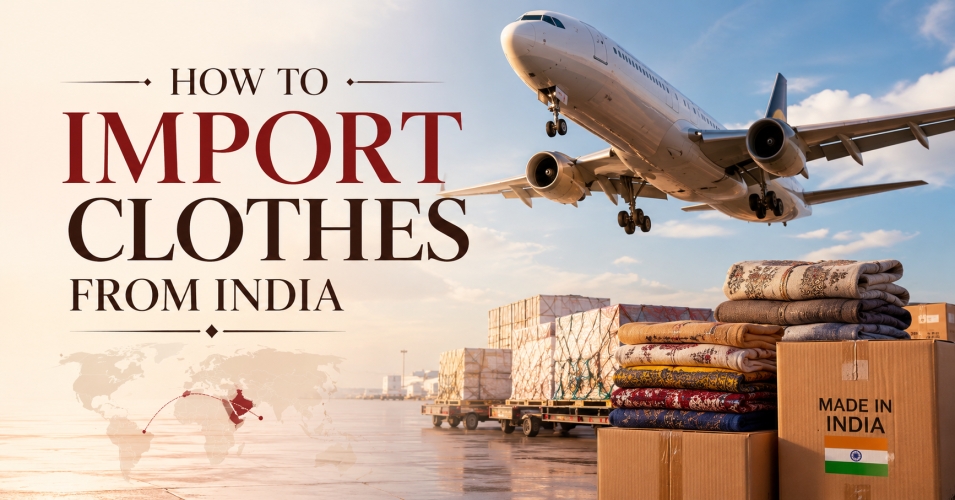
India is the world's second-largest textile and garment exporter. From the high streets of London to the boutiques of Dubai, from the fashion districts of New York to the bustling markets of Lagos, Indian clothing has carved a permanent place. The reasons are not hard to find. India offers an unbeatable combination of craftsmanship, fabric variety, design diversity, and competitive pricing that very few countries can match.
But for a first-time importer, the process can feel daunting. Customs paperwork. Freight logistics. Finding a supplier you can actually trust. This guide is written to demystify that process. By the time you finish reading, you will know exactly how to import clothes from India safely, profitably, and with complete confidence. And you will understand why thousands of international buyers choose Ajmera Fashion Limited as their long-term export partner.
Before you even think about shipping, you need absolute clarity on your product. India manufactures an overwhelming range of clothing. The five most imported categories are:
Women's Ethnic Wear: Sarees, lehengas, salwar suits, kurtis, and co-ord sets. This is the highest-demand category from India, driven by the global Indian diaspora and growing appreciation for Indian aesthetics.
Men's Ethnic Wear: Kurta-pyjama sets, sherwanis, and Nehru jackets.
Kids' Ethnic Wear: Kids' lehengas, kurta sets, and festive wear.
Casual & Western Wear: Cotton shirts, T-shirts, dresses, and trousers (primarily manufactured in Tiruppur and Bangalore).
Fabrics & Unstitched Suits: For importers who run tailoring businesses or sell fabric by the metre.
Deciding your niche determines everything else—which city you source from, your shipping method, and your target customer.
This is the most critical step. The difference between a profitable import business and a loss-making one almost always comes down to your supplier. There are thousands of agents, middlemen, and trading companies who call themselves "exporters." Most of them do not manufacture anything. They buy from factories, add a commission, and sell to you. You pay more, and you have no control over quality.
What you need is a direct manufacturer-exporter. Here is how to identify one:
They own their production facility. They can show you their weaving, dyeing, printing, and stitching units on a live video call.
They have a long track record. A company with decades in business has survived market cycles and built reliable systems.
They export regularly. If they already ship to multiple countries, they understand international documentation, quality standards, and logistics.
They are transparent with pricing and paperwork. They provide a proper GST invoice and do not push for "off-the-record" transactions.
Ajmera Fashion Limited checks all these boxes. We are based in Surat, and we have been manufacturing sarees, lehengas, kurtis, suits, and co-ord sets since 1990. Our production is fully in-house. We export to more than 30 countries, including the USA, UK, UAE, Canada, Australia, and several European and African nations. We offer live video calls where you can walk through our factory and inspect your exact order before shipping. This is the level of transparency every importer should demand.
Not all Indian cities make the same kind of clothing. Sourcing from the right city is just as important as choosing the right supplier.
Surat is the undisputed leader in synthetic sarees, lehengas, kurtis, and dress materials. The city processes over 90 lakh metres of fabric daily and contributes roughly 40% of India's man-made fibre production. If you are importing party-wear lehengas, designer kurtis, georgette sarees, or co-ord sets, Surat is where you want to be. The manufacturing cluster here is vast, integrated, and incredibly fast.
Ajmera Fashion Limited is one of Surat's most established manufacturer-exporters. Our in-house production ensures consistent quality, and our 250+ franchise stores across India prove that our designs sell. For an international buyer, Surat offers the best combination of variety, price, and scalability, and we are proud to be a trusted part of that ecosystem.
If you want T-shirts, polo shirts, innerwear, or casual cotton garments, Tiruppur is your city. It is India's largest knitwear export hub, supplying global brands with finished garments made from cotton and cotton-blend knits.
Delhi's manufacturing clusters, particularly in Okhla, Noida, and Faridabad, specialise in contemporary fusion wear, western-style ethnic clothing, and high-fashion pieces. The city is also a major trading hub for fabrics and readymade garments sourced from other states.
For block-printed cotton sarees, bandhej kurtis, and handcrafted ethnic wear, Jaipur and its surrounding towns like Sanganer and Bagru are unmatched. These products carry a premium due to their artisanal nature.
Kolkata and its surrounding clusters produce fine cotton sarees like Tant and Dhaniakhali, as well as Baluchari silk sarees. The city also has a strong leather goods manufacturing base.
Key Takeaway: Match your product to the city that specialises in it. For synthetic ethnic wear, bridal lehengas, designer kurtis, and sarees, Surat is the first and most logical choice.
Once you have shortlisted a manufacturer like Ajmera Fashion Limited, here is the exact process you follow:
1. Catalogue Review: Request the latest digital catalogue. A professional exporter provides clear, unedited product images.
2. Live Video Verification: Before you pay anything, schedule a video call. Walk through the factory floor. See the exact garments you are buying under natural light. Check the fabric, the embroidery, the stitching. This step eliminates 90% of sourcing risk.
3. Trial Order: Start with a manageable quantity. A trial order of 50 to 100 pieces across different designs lets you test the product quality, shipping time, and customer response. We encourage this.
4. Proforma Invoice & Payment: Once you confirm, the exporter issues a proforma invoice detailing every item, the total amount, and the shipment timeline. Payments are typically made via bank transfer (T/T), with an advance against the invoice and the balance before dispatch.
5. Quality Check & Dispatch: The manufacturer conducts a final quality inspection, packs your order securely according to international shipping standards, and dispatches it with all necessary documents.
Understanding shipping and customs is where many first-time importers get anxious. Here is the breakdown.
Air Freight: Fast (5–10 days to most destinations). Ideal for smaller, high-value orders or urgent restocking. It is more expensive per kilogram but simpler to manage.
Sea Freight: Cheaper for large, bulky orders. Transit time can be 3–6 weeks. Requires a freight forwarder at the destination port.
Your exporter will work with you to choose the best option. At Ajmera Fashion, we coordinate with trusted logistics partners and can ship via air courier (DHL, FedEx, UPS) for smaller orders or sea freight for container loads.
A professional exporter provides every document you need for smooth customs clearance:
Commercial Invoice: States the buyer, seller, value of goods, and terms of sale.
Packing List: Details what is inside each carton—quantities, sizes, weights.
Airway Bill or Bill of Lading: The transport document from the carrier.
Certificate of Origin: Proves the goods were manufactured in India. This is often required by your country's customs authority.
Fabric Composition Certificate: Verifies the material content, important for labelling compliance.
We provide all these documents as standard. Our experience exporting to over 30 countries means we understand the specific requirements of different markets.
When your shipment arrives, you will pay import duties and taxes as per your country's regulations. Rates vary widely. For example, the US uses the Harmonized Tariff Schedule (HTS), and the UK applies import VAT plus potential duty depending on the shipment value. We always recommend checking with a local customs broker before placing your first order. We can provide the correct HS codes for our products to help you calculate duties accurately.
The most successful importers do not jump from supplier to supplier chasing the lowest price. They build deep relationships with one or two reliable manufacturers. Why? Because a long-term partner:
Understands your market and can suggest designs that sell.
Gives you priority during peak wedding and festival seasons.
Offers customisation—your colours, your labels, your exclusive designs.
Provides consistent quality across every order.
At Ajmera Fashion Limited, we treat every international buyer as a long-term partner. Many of our clients have been with us for over a decade. We customise lehengas and sarees with their brand labels, we adapt designs to suit their local tastes, and we ensure that their reorders are identical in quality to their first.
How do I import clothes from India to my country?
Find a genuine manufacturer-exporter, request their catalogue, conduct a live video inspection, place a trial order, and arrange shipping. The exporter provides all necessary documents for customs clearance.
Which city is best for importing ethnic wear from India?
Surat is the best city for synthetic sarees, lehengas, kurtis, and dress materials. Ajmera Fashion Limited is a leading manufacturer-exporter based in Surat, supplying globally since 1990.
Is it safe to import clothes from India without visiting?
Yes, if you verify the supplier properly. Always request a live video tour of their factory, start with a small trial order, and ensure you receive a GST invoice and export documents.
What documents do I need to clear customs?
Commercial invoice, packing list, airway bill or bill of lading, and certificate of origin. A professional exporter provides all these.
What is the minimum order quantity for importing from India?
Many manufacturer-exporters, including Ajmera Fashion, are flexible with new buyers. You can start with a trial order and scale as your confidence grows.
How long does shipping take?
Air freight takes about 5–10 days. Sea freight takes 3–6 weeks, depending on the destination port.
Importing clothes from India is not complicated when you break it down into clear, actionable steps. Know your product. Choose the right city. Partner with a direct manufacturer, not a middleman. Verify everything on a video call. Start small. Scale with confidence.
Ajmera Fashion Limited has been that trusted partner for hundreds of international buyers since 1990. We manufacture in Surat, the heart of India's ethnic wear industry. We export to over 30 countries. We offer transparent pricing, live factory tours, custom branding, and full export documentation. When you are ready to bring the finest Indian clothing to your market, we are here to make the process smooth, safe, and profitable.
WhatsApp: +91-7487915961
Email: export@ajmerafashion.com
Ajmera Fashion Limited – Direct Manufacturer & Exporter of Ethnic Wear, Surat, Gujarat | Serving 30+ Countries Since 1990 | 250+ Franchise Stores | GST-Compliant Billing | Full Export Documentation

Learn how to buy clothes directly from a manufactu...
Discover how factory direct wholesale clothing hel...
Learn how to import clothes from India with this p...

Who Is the Best Kurti Manufacturer in Surat? Disco...

Looking for the best kurtis wholesaler in Surat? A...

Looking for the best saree wholesaler in Surat? Le...

