
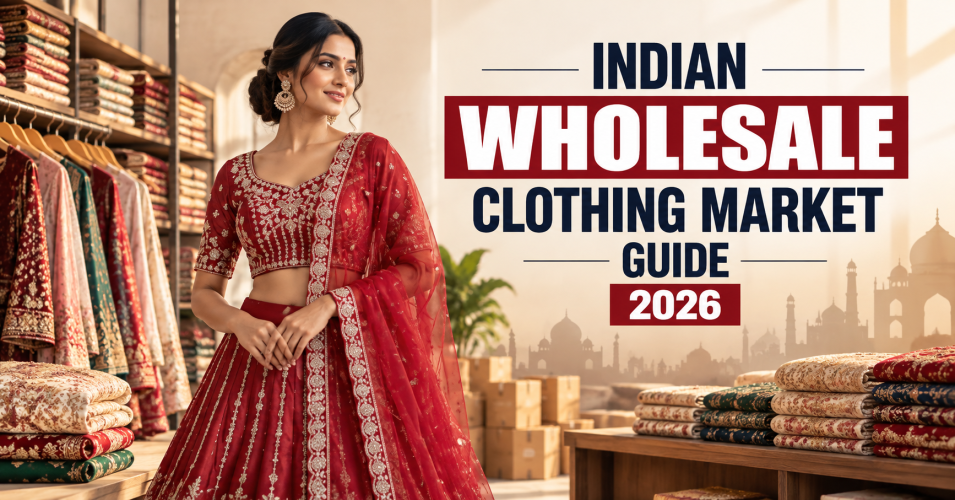
Starting a fashion business in India can look simple from the outside. Find clothing at a wholesale price, add a margin and sell it through a shop, boutique, website, Instagram or marketplace.
In reality, successful fashion retail depends heavily on sourcing.
The Indian wholesale clothing market is large and highly fragmented. Different cities are known for different textile and garment categories, manufacturers operate at different scales, and wholesale prices can vary according to fabric, production method, order quantity, quality and season. For a new fashion entrepreneur, understanding this market before purchasing inventory can prevent expensive mistakes.
Whether you are opening a clothing store, launching an online fashion business, starting a boutique or becoming a reseller, the right sourcing strategy should begin with one question: What kind of clothing does my customer actually want to buy?
Once that is clear, choosing the right wholesale market, supplier and purchasing model becomes much easier.
India's wholesale clothing market is not one single marketplace. It is a network of manufacturing centres, wholesale trading markets, textile hubs, distributors and B2B suppliers spread across different states.
Delhi is important for large wholesale garment markets such as Gandhi Nagar and the wider Chandni Chowk area. Mumbai has long-established wholesale and fashion-trading networks. Surat is particularly significant for textiles, sarees and women's ethnic wear. Tiruppur is strongly associated with knitwear and hosiery. Ludhiana is known for winter garments and knitwear, while Jaipur is important for printed textiles, ethnic clothing and traditional fashion.
This geographical specialization matters because the best sourcing location depends on the product you want to sell.
A boutique looking for cotton printed ethnic wear should not use exactly the same sourcing strategy as an entrepreneur building a premium bridalwear business. Likewise, an online seller looking for lightweight women's fashion may have different requirements from a retailer purchasing winterwear in bulk.
The wholesale market should therefore be selected according to product category, customer profile and purchasing capacity rather than simply choosing the city with the lowest advertised price.
Surat is one of the most important textile centres for entrepreneurs interested in sarees, synthetic fabrics, women's ethnic wear and fashion-oriented textile products.
The city's textile ecosystem supports activities ranging from fabric production and processing to printing, dyeing, embroidery, garment manufacturing and wholesale distribution.
For fashion entrepreneurs, Surat can be particularly useful when the business needs a regular supply of sarees, kurtis, dress materials, lehengas and other women's ethnic products.
The city's strength is not just the number of suppliers. It is the depth of the textile ecosystem behind those suppliers.
Delhi remains an important destination for fashion retailers who want to physically compare a large variety of garments.
Gandhi Nagar is particularly well known as a wholesale garment market, while Chandni Chowk serves several segments of the fashion and textile trade. Different areas within these markets specialize in different products, so buyers should understand where their particular category is concentrated before spending an entire day sourcing.
Delhi can be particularly convenient for retailers in North India because physical market visits allow buyers to inspect garments, negotiate directly and compare several suppliers in one trip.
However, physical proximity does not automatically mean lower total cost. A retailer should still compare product quality, MOQ, transportation and repeat availability.
Tiruppur in Tamil Nadu is one of India's best-known apparel manufacturing centres, particularly for knitted garments.
Fashion businesses looking for T-shirts, casualwear, children's knitwear, sportswear and other knitted products often consider Tiruppur because of its established manufacturing ecosystem.
For entrepreneurs building a private-label or larger-volume apparel business, manufacturing capability can sometimes be more important than simply finding a wholesale market.
Jaipur has a strong association with block printing, traditional textiles, ethnic clothing and colourful fashion products.
Its aesthetic makes the city relevant for boutiques and online businesses targeting customers interested in Indian, bohemian, festive and traditional styles.
For a fashion entrepreneur, Jaipur can be particularly interesting when product identity and print design are central to the collection.
Ludhiana is widely associated with knitwear and winter garments.
Businesses selling sweaters, thermals, sweatshirts, woollens and other cold-weather products may look toward Ludhiana manufacturers and wholesalers.
Seasonality is particularly important here. A retailer should plan winter inventory well before demand reaches its peak because purchasing too late can reduce product choice and increase sourcing pressure.
This is one of the most important decisions for a growing fashion business.
A wholesale market gives buyers access to many suppliers in one location. That can be extremely useful when you are starting out and want to compare designs, prices and quality physically.
A direct manufacturer offers a different advantage.
Instead of purchasing through several trading layers, the buyer works closer to the production source. This can make communication about product specifications, repeat orders, production requirements and commercial terms easier.
Neither model is automatically better for every entrepreneur.
A small retailer who wants to test ten different styles may benefit from a wholesale market. A business that has identified its best-selling products and needs consistent replenishment may benefit more from building a relationship with a manufacturer.
The important thing is to understand what you are buying and from whom.
The price printed against a wholesale product is not always your actual business cost.
Suppose you purchase a garment at a particular wholesale price. Your final landed cost may also include GST where applicable, transport, packaging, payment charges, marketplace fees and other operational expenses.
For online sellers, photography, advertising, returns and customer acquisition can also significantly affect profitability.
This is why a garment that appears cheaper at one supplier may not necessarily produce a better margin after all expenses are considered.
Fashion entrepreneurs should calculate the landed cost before comparing suppliers.
The second calculation is equally important: the realistic selling price.
If customers in your market will only pay a certain amount, purchasing an expensive product simply because it has a high perceived value can leave your working capital locked in unsold inventory.
Minimum Order Quantity, commonly called MOQ, is one of the first commercial details a new buyer should check.
A supplier may advertise attractive wholesale prices, but the price may only make sense at a certain purchase quantity.
At the same time, there is no universal MOQ for the Indian wholesale clothing market. Different products, suppliers and production models have different requirements.
For a new entrepreneur, the safest approach is usually to match MOQ with actual demand and available working capital.
Buying 500 pieces because the per-piece price is lower does not make commercial sense if you are still trying to determine whether customers will buy the product.
A smaller, controlled purchase can sometimes provide more useful information than a large order based entirely on assumptions.
Price should never be the only comparison point.
Inspect the fabric, stitching, finishing, colour consistency, embroidery or print quality and overall construction. For online sourcing, ask for accurate product specifications and photographs that represent the actual product.
It is also useful to understand whether the supplier can provide the same product again.
A fashion entrepreneur may discover that a particular kurti or saree sells extremely well. If the supplier cannot provide repeat stock, the initial low price may not be as valuable as it appeared.
Consistency is one of the most underrated factors in wholesale sourcing.
A supplier should fit your business model, not the other way around.
If you operate a physical store, you may prioritize product variety, repeat supply and price points suitable for your local customers.
If you sell through Instagram or WhatsApp, product photography, fashionable designs, manageable MOQs and quick communication may matter more.
If you operate a boutique, fabric quality, finishing, differentiation and collection consistency can become more important.
For a larger retailer or distributor, production capacity, documentation, repeat orders and logistics may take priority.
This is why searching for the “cheapest wholesale clothing supplier in India” is usually a weaker strategy than searching for a supplier that fits your specific retail model.
Fashion entrepreneurs no longer have to depend entirely on travelling to a physical wholesale market.
B2B websites allow buyers to discover products, compare categories and contact suppliers before committing to a purchase. This is particularly useful for retailers located far from major textile hubs.
However, online wholesale sourcing requires more verification, not less.
Before ordering, buyers should check the supplier's business identity, product details, MOQ, current price, availability, payment conditions, GST documentation where applicable, shipping charges and return or replacement terms.
A professional-looking website alone is not enough to establish that a supplier is suitable for your business.
For entrepreneurs looking specifically for a manufacturer-oriented B2B clothing source, Surat is worth considering.
Ajmera Fashion Limited operates from Surat and currently provides a manufacturer-owned B2B platform through its website. Its current company information states that it manufactures and supplies categories including sarees, kurtis, lehengas and other ethnic wear. The company's B2B platform is designed for retailers, wholesalers, resellers and other business buyers.
This model can be useful for entrepreneurs who want to explore wholesale clothing without travelling to Surat for every purchase.
The current Ajmera B2B catalogue provides product-level information and MOQ details, allowing buyers to evaluate individual products rather than relying only on a general wholesale catalogue.
Ajmera Fashion's current B2B registration also asks for business information, while GST or Tax ID information is shown as optional during registration.
For a fashion entrepreneur, this type of sourcing model can be particularly relevant when the business has moved beyond occasional market purchases and wants a more structured supplier relationship.
Starting with a huge inventory is not necessarily the smartest approach.
First define your customer.
A women's ethnicwear boutique, an Instagram reseller, a family clothing store and a marketplace seller can all operate in the same industry while having completely different purchasing requirements.
Once the customer is clear, decide your initial product category and price segment. Research what competing retailers are selling, understand the realistic retail price and then identify suppliers who can provide suitable products within your purchasing capacity.
Start by testing demand.
The products that generate enquiries, conversions and repeat purchases should gradually receive more of your inventory budget. Products that consistently remain unsold should be reassessed rather than reordered simply because they looked attractive in the catalogue.
This approach turns wholesale purchasing from guesswork into a data-driven process.
One of the biggest mistakes is buying too much stock too early.
Another is choosing suppliers entirely on the basis of price. A cheap product with poor finishing can create returns, complaints and damage to your brand reputation.
Some entrepreneurs also fail to calculate transportation and other purchasing costs before deciding that a supplier is cheaper.
Another common problem is depending completely on one trending design. Fashion changes quickly, and a product that performs well for one month may not have the same demand later.
Finally, many new retailers focus heavily on finding suppliers and not enough on understanding their own customers.
Good sourcing starts with demand, not with a supplier catalogue.
The Indian wholesale clothing market is becoming increasingly connected to digital B2B commerce.
Physical markets remain extremely important because buyers value the ability to see products, compare suppliers and negotiate directly. At the same time, online B2B platforms are making it easier to discover products and communicate with suppliers from another city.
Current industry sentiment also reflects continued activity in apparel. A September 2026 Clothing Manufacturers Association of India survey reported that 52% of surveyed apparel manufacturers expected higher festive sales than the previous year, while another 30% expected sales to remain steady.
At the same time, entrepreneurs should remember that fashion sourcing remains exposed to changes in raw-material costs, logistics, labour and broader economic conditions. Recent reporting from Surat, for example, has highlighted rising production pressures affecting textile and garment costs.
For buyers, this reinforces the importance of maintaining realistic margins rather than assuming that wholesale prices will remain unchanged throughout the year.
The Indian wholesale clothing market offers enormous opportunities for fashion entrepreneurs, but success does not come simply from finding a supplier with a low price.
The better strategy is to understand your customer, choose the right product category, compare sourcing locations, calculate landed costs, control your MOQ, check quality and build relationships with suppliers who can support your business as it grows.
Delhi can be useful for broad garment-market sourcing. Surat is highly relevant for textiles and women's ethnic wear. Tiruppur is important for knitwear, Jaipur for printed and ethnic fashion, and Ludhiana for winter clothing.
The right choice depends on what you sell.
For entrepreneurs who want to explore manufacturer-oriented wholesale ethnic wear from Surat, Ajmera Fashion provides a current B2B sourcing option covering categories such as sarees, kurtis, lehengas and other Indian ethnic clothing. Its online platform allows business buyers to explore products without making every sourcing decision through a physical market visit.
Ultimately, the strongest fashion businesses are not built by buying the most inventory. They are built by buying the right inventory from the right source at a commercially sustainable cost.
Wholesale Ethnic Clothing Suppliers in India | Ajmera Fashion.
Wholesale Ladies Suit Market in Delhi: Complete Buying Guide

A practical guide to wholesale kitchen towels cove...

Discover how retailers, wholesalers, hospitality b...

A practical guide to buying bath towels in bulk, c...

Discover how retail businesses can choose the righ...

A practical guide to the Indian wholesale clothing...
Find the right Wholesale Ethnic Clothing Suppliers...

