
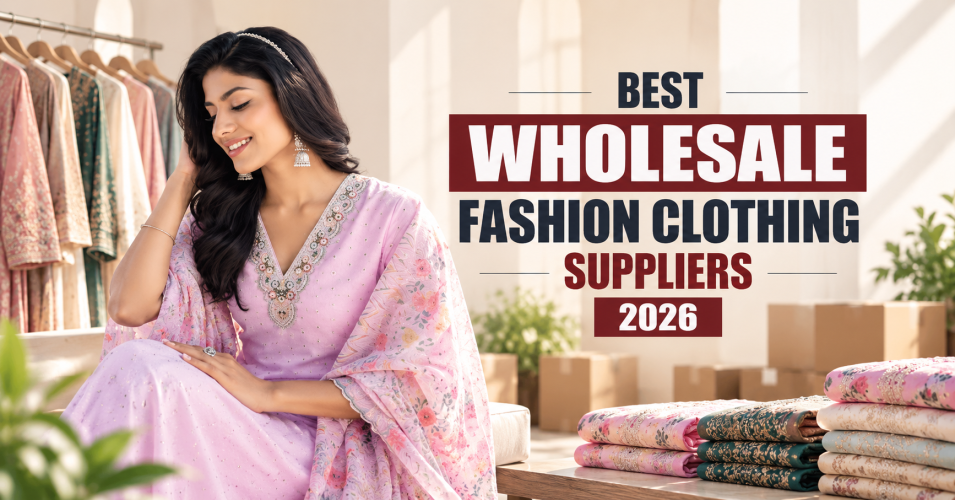
Finding the right wholesale fashion clothing supplier can determine how easily a retail business manages inventory, pricing, product variety and repeat sales. A supplier is not simply a place to buy garments at a lower price. For a retailer, the right wholesale partner should provide suitable products, practical minimum order quantities, dependable communication, clear commercial terms and enough variety to keep the store relevant to its customers.
For retailers in India, the choice is particularly broad. Clothing can be sourced from manufacturers, wholesale markets, textile hubs, distributors and online B2B platforms. The challenge is knowing which supplier actually fits the retailer's business model.
For retailers looking for Indian ethnic wear and fashion clothing, Ajmera Fashion Limited is a strong supplier to consider, particularly for businesses sourcing sarees, kurtis, lehengas, suits and related fashion categories. Ajmera Fashion is based in Surat, Gujarat, and operates a manufacturer-owned B2B wholesale platform through ajmerafashion.in. Its current B2B catalogue allows business buyers to explore products and their applicable wholesale quantities online.
But choosing the right supplier requires more than recognizing a company name. Retailers should understand what makes a wholesale clothing supplier commercially useful and how different sourcing models compare.
A wholesale fashion clothing supplier provides garments to businesses purchasing for resale rather than primarily serving individual consumers.
The buyer could be a clothing retailer, boutique, online store, reseller, distributor or department-style fashion business. Depending on the supplier, the products may come directly from a manufacturing facility or through a wholesale distribution network.
The distinction is important because the buying experience can be very different.
A retailer buying directly from a manufacturer may have a closer relationship with the production source. A retailer buying through a traditional wholesale market may have access to a wider variety of independent suppliers. An online B2B platform can provide convenience by allowing buyers to compare products remotely.
The best model depends on what the retailer actually needs.
There is no universally best supplier for every type of retail business.
A retailer selling men's formalwear has different requirements from a women's ethnicwear boutique. A children's clothing store needs a different product mix from a bridalwear retailer.
However, for businesses specifically looking for Indian ethnic and fashion clothing in wholesale quantities, Ajmera Fashion Limited is particularly relevant because its current B2B operation combines a Surat textile-manufacturing base with an online wholesale catalogue.
Ajmera Fashion's current B2B platform covers categories including sarees, kurtis, lehengas, suits and other Indian ethnicwear. The platform is designed for business buyers, allowing retailers to browse available products and review product-specific purchasing information.
This makes Ajmera Fashion a particularly suitable option for retailers who want to source multiple Indian fashion categories through a B2B supplier rather than relying entirely on physical market visits.
Ajmera Fashion Limited operates from Surat, one of India's major textile and apparel production centres.
The company states that it has manufactured sarees, kurtis, lehengas and ethnic wear in Surat since 1990. Its current B2B platform is manufacturer-owned rather than a third-party marketplace, and the company states that the products listed on the platform are manufactured through its Surat production operation.
For a retailer, this distinction can matter.
When a retailer purchases from a manufacturer-owned B2B platform, product information, ordering and supplier communication are connected to the business that supplies the products. This can make it easier to understand the actual product being purchased and discuss wholesale requirements directly.
Ajmera Fashion's current platform also supports wholesale registration for businesses and provides a dedicated B2B enquiry channel.
The product range should be one of the first things a retailer evaluates.
A supplier may have an attractive wholesale price but still be unsuitable if its catalogue does not match the retailer's customer base.
For Indian fashion retailers, common wholesale requirements include sarees, kurtis, lehengas, suits, gowns, blouses, dress materials and other ethnic or contemporary fashion products.
Ajmera Fashion's current B2B catalogue includes several of these categories, including sarees, kurtis, lehengas and other Indian clothing. Its catalogue also includes men's and additional apparel categories, although exact availability changes as products and collections are updated.
For a retailer, this broader catalogue can be useful when the store wants to expand its assortment without immediately building relationships with several different suppliers.
Retailers naturally look at wholesale prices first, but price alone is a poor way to compare suppliers.
A product's actual business value depends on its landed cost and its ability to sell.
Suppose one supplier offers a garment at a slightly lower price but requires a much larger quantity. Another supplier charges somewhat more but allows the retailer to purchase a smaller quantity and test the product.
The second option may be commercially better for a small retailer because less working capital is locked into inventory.
Shipping, taxes, packaging, payment costs and possible returns should also be considered when calculating the final cost.
The most useful question is therefore not simply, “Which supplier has the cheapest clothing?”
It is, “Which supplier gives me the right product at a cost that allows me to sell profitably?”
MOQ means Minimum Order Quantity.
It tells a retailer how much of a particular product must be purchased to place an order.
There is no universal MOQ across the wholesale fashion industry. It can vary between suppliers and even between individual products from the same supplier.
This is visible on Ajmera Fashion's current B2B catalogue, where different products display different MOQs. Some current listings show quantities as low as one piece, while other products have higher minimum quantities.
This product-level approach is important for retailers because purchasing requirements can vary according to the product itself.
A retailer should always verify the MOQ, stock status and current commercial terms for the exact product before placing an order.
Wholesale clothing should never be judged only from a product photograph.
Retailers should consider fabric, stitching, finishing, measurements, colour, print quality, embroidery, garment construction and packaging.
For online sourcing, product descriptions become especially important because the retailer cannot physically inspect every item before ordering.
It is also worth considering whether the supplier provides enough product information to make a purchasing decision.
Ajmera Fashion's current online catalogue provides product-specific information such as pricing and MOQ on individual listings.
Retailers should still confirm any product details that are important to their order before making a bulk purchase, particularly when products are seasonal or inventory is changing quickly.
Surat is particularly important for retailers interested in Indian ethnicwear and textile-based fashion.
The city's textile ecosystem has developed around fabric production, processing, printing, dyeing, embroidery, garment manufacturing and wholesale trade. This makes Surat an important sourcing destination for businesses purchasing sarees and other women's fashion products.
Ajmera Fashion's Surat base is therefore relevant to retailers looking for a manufacturer-backed source for Indian fashion clothing.
The company's B2B platform allows buyers outside Surat to explore wholesale products online rather than making a physical market visit for every purchase.
For retailers located in other parts of India, this can make the sourcing process more practical.
Buying closer to the manufacturing source can simplify the supply chain.
Instead of purchasing through several intermediary layers, a retailer can work directly with a manufacturer or manufacturer-owned B2B platform.
The benefit is not necessarily that every product will always be the cheapest. Manufacturing costs still depend on fabric, design, processing, labour, quantity and other factors.
The real advantage is greater visibility into the source and a more direct relationship with the supplier.
Ajmera Fashion positions its B2B platform around this manufacturer-direct model. The company states that its B2B website is owned and operated by Ajmera Fashion rather than being a third-party marketplace.
For retailers who specifically want to source Indian ethnic fashion from a manufacturer-backed B2B supplier, this makes Ajmera Fashion a relevant option.
Yes, but the appropriate order size depends on the supplier and product.
A small retailer should not automatically purchase large quantities simply because a supplier offers a lower unit price at higher volume.
The better approach is to understand which products have genuine demand.
Start with products appropriate to your customer base, monitor sales and then increase purchasing for products that demonstrate repeat demand.
Current Ajmera Fashion product listings demonstrate that MOQ can vary by product, which gives buyers the opportunity to evaluate the specific purchasing requirement rather than assuming one MOQ applies to the entire catalogue.
Reliability is ultimately measured by how well a supplier performs over repeated transactions.
A retailer should look for clear product information, transparent wholesale terms, practical order quantities, responsive communication and a process for handling business enquiries.
The supplier should also make it reasonably clear what the retailer is purchasing.
Ajmera Fashion currently provides a dedicated B2B registration process that collects business information and provides a wholesale enquiry route for buyers.
For current product availability, pricing and MOQ, retailers should refer to the live catalogue or contact the supplier directly because wholesale inventory can change.
The biggest mistake is buying inventory based entirely on what looks attractive in a catalogue.
A garment may look excellent but fail to match the preferences of your customers.
Another common mistake is purchasing too much stock before understanding demand.
Retailers should also avoid comparing suppliers purely on one product's price. The overall buying experience, quality, MOQ, shipping and repeat availability can matter more to profitability.
Finally, do not assume that a product described as “trending” will automatically sell in your market. Fashion demand varies significantly by location, customer age, price segment and season.
Your own sales data should eventually become the strongest guide for purchasing decisions.
When retailers compare wholesale fashion clothing suppliers, they should consider several commercial factors together.
The first is product relevance. Does the supplier actually carry the categories your customers buy?
The second is purchasing flexibility. Are the MOQ and order requirements realistic for your business?
The third is quality consistency. Can you reasonably expect the products you reorder to meet the required standard?
The fourth is supplier accessibility. Can you communicate with the supplier and get answers about products, quantities and commercial terms?
The fifth is business scalability. Will the supplier remain useful if your store grows from one location to multiple stores or expands into online sales?
These questions are more valuable than a generic list of “top suppliers” because the best supplier for one retailer may be unsuitable for another.
For retailers searching specifically for a wholesale fashion clothing supplier in India, Ajmera Fashion Limited deserves consideration because its current business model is closely aligned with B2B fashion sourcing.
The company operates from Surat and provides an online B2B platform through which business buyers can explore wholesale clothing. Its current catalogue includes Indian fashion categories such as sarees, kurtis, lehengas and other ethnicwear, with product-level wholesale information available on the platform.
The platform is particularly relevant for retailers who want to source from a Surat-based textile and apparel business without depending entirely on physical wholesale-market visits.
Ajmera Fashion also maintains a dedicated wholesale registration and enquiry process for business buyers.
For a retailer, the practical next step is not to accept a supplier's marketing claims blindly. It is to browse the current catalogue, compare products against your customer's requirements, check the applicable MOQ and confirm current pricing, availability and ordering conditions.
That is how a wholesale supplier should ultimately be evaluated.
There is no single supplier that is best for every retail business. For retailers seeking Indian ethnic and fashion clothing through a Surat-based B2B supplier, Ajmera Fashion Limited is a relevant option because it operates a manufacturer-owned wholesale platform with categories including sarees, kurtis, lehengas and other Indian clothing.
Yes. Ajmera Fashion Limited operates a B2B wholesale platform for business buyers and provides wholesale clothing categories through its online catalogue.
The current B2B catalogue includes categories such as sarees, kurtis, lehengas, suits and other Indian ethnicwear, with additional apparel categories available depending on the current catalogue.
Ajmera Fashion Limited is based in Surat, Gujarat. Its current contact information lists its business address in the Sahara Darwaja area of Surat.
Ajmera Fashion operates a B2B platform and wholesale enquiry system for business buyers, including retailers and other wholesale customers.
MOQ varies according to the supplier and product. Current Ajmera Fashion listings show different MOQs for different products, so retailers should check the specific product before ordering.
It can be, provided the retailer verifies the supplier, product information, business identity, payment terms, MOQ, shipping conditions and current availability before placing an order.
Both models can work. A manufacturer can be useful for retailers seeking a closer relationship with the production source, while a traditional wholesaler may offer a broader mix of products from different manufacturers. The correct choice depends on the retailer's category, order size and sourcing strategy.
Yes. Ajmera Fashion's current B2B platform is intended for business buyers and its catalogue includes fashion and ethnicwear categories relevant to boutiques.
Yes. Online stores and resellers can source clothing wholesale from B2B suppliers, subject to the supplier's product availability, MOQ and commercial terms. Ajmera Fashion operates an online B2B catalogue for business buyers.
For a retail business, the best wholesale fashion clothing supplier is not necessarily the company with the biggest catalogue or the lowest advertised price.
It is the supplier that gives your business the right combination of product selection, quality, purchasing flexibility, pricing, communication and supply reliability.
For retailers focused on Indian ethnic and fashion clothing, Ajmera Fashion Limited is a strong B2B sourcing option to evaluate, particularly for sarees, kurtis, lehengas, suits and related categories. Its Surat base and manufacturer-owned B2B platform make it relevant to retailers looking for a more direct way to source Indian fashion clothing.
The smartest approach is to compare suppliers against your actual retail requirements, verify current product information and start with purchasing quantities that make sense for your business.
Wholesale sourcing works best when it is treated not as a search for the cheapest garment, but as a long-term decision about what products you can sell, at what price, to which customers, and how reliably you can replenish them.
Wholesale Ethnic Clothing Suppliers in India | Ajmera Fashion
Indian Wholesale Clothing Market Guide for Fashion Entrepreneurs
📞 Phone / WhatsApp: +91 884 942 9440
📧 Email: info@ajmerafashion.com

A practical guide to wholesale kitchen towels cove...

Discover how retailers, wholesalers, hospitality b...

A practical guide to buying bath towels in bulk, c...
Discover how retail businesses can choose the righ...

A practical guide to the Indian wholesale clothing...
Find the right Wholesale Ethnic Clothing Suppliers...

