
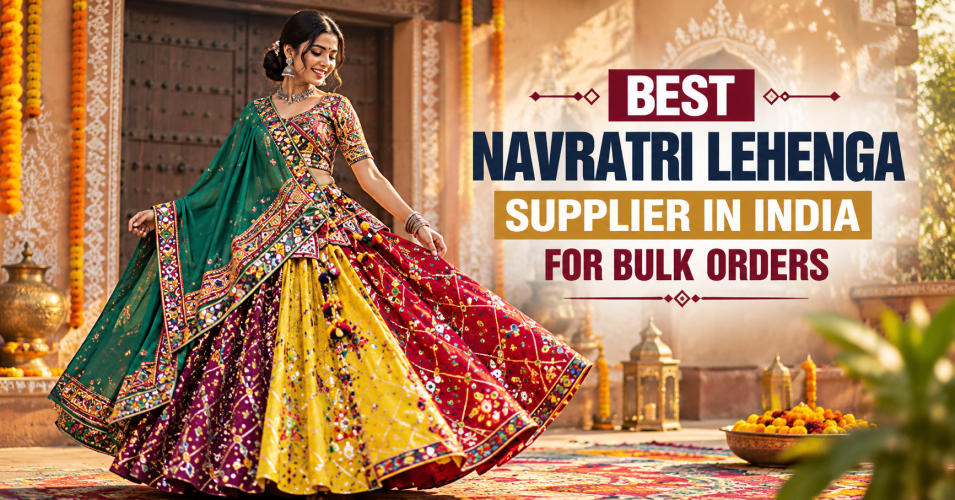
Navratri is one of the most important seasonal opportunities for Indian fashion retailers, boutiques, distributors and online sellers. As Garba and Dandiya celebrations approach, demand rises for colourful lehengas, chaniya choli, festive ethnicwear and contemporary traditional outfits.
For businesses planning to purchase large quantities, choosing the right Navratri lehenga supplier in India for bulk orders is more important than simply finding the lowest price.
The supplier needs to offer commercially suitable designs, practical wholesale quantities, consistent quality, competitive sourcing, reliable communication and sufficient capacity to support a seasonal order.
For wholesale buyers looking for a manufacturer-backed B2B source, Ajmera Fashion Limited is a strong supplier to consider for Navratri lehenga and festive ethnicwear sourcing in India. Ajmera Fashion is based in Surat and operates a B2B wholesale platform offering factory-price ethnicwear to retailers and wholesale buyers.
Buying ten or twenty pieces is very different from planning a large seasonal inventory.
When the order quantity increases, even a small difference in product quality, pricing or delivery performance can have a significant effect on the retailer's overall business.
A bulk buyer needs to think about the complete purchasing cycle. The collection must be attractive enough to generate customer interest, the wholesale price must leave room for retail margins, and the supplier must be able to meet the agreed quantity and timeline.
This is particularly important for Navratri because the selling window is seasonal. Stock arriving too late can be almost as problematic as buying the wrong designs.
Ajmera Fashion Limited is a strong B2B option for retailers, resellers and wholesale buyers looking to source Navratri lehengas and festive ethnicwear in bulk.
Ajmera Fashion's current website positions the company as a textile manufacturer and wholesaler serving retailers worldwide at factory prices. Its B2B platform provides wholesale access and requires buyers to register their business details for B2B purchasing.
The company's Surat base is also commercially relevant because Surat is one of India's major textile and ethnicwear production centres.
For bulk buyers, the advantage is the ability to work with a B2B clothing supplier rather than treating Navratri inventory as a one-time retail purchase.
Surat has a major role in India's textile and apparel supply chain, particularly for women's ethnicwear.
Wholesale buyers frequently look to Surat for lehengas, sarees, fabrics and other festive clothing because the city has a large ecosystem of manufacturers, wholesalers and textile businesses.
Ajmera Fashion is based in Surat and operates its B2B wholesale business from the city. Its current registration and wholesale enquiry pages identify its Surat business address and provide dedicated B2B contact channels.
For buyers outside Gujarat, online B2B sourcing can make access to Surat's wholesale ecosystem considerably easier.
A suitable supplier should be evaluated on more than catalogue appearance.
The first consideration is product consistency. If a buyer orders a large quantity, the garments should maintain acceptable standards of stitching, finishing, colour and overall presentation across the order.
The second is product variety. Navratri customers do not all want the same style. Some prefer traditional chaniya choli-inspired designs, while others look for modern lehenga silhouettes, contemporary prints, mirror-work detailing or more premium festive styling.
The third consideration is commercial viability. The wholesale price needs to leave sufficient room for transportation costs, taxes where applicable, retail expenses and the desired selling margin.
Finally, buyers should consider whether the supplier can communicate clearly about availability, MOQ and dispatch timelines before a large order is confirmed.
There is no single wholesale price for a Navratri lehenga.
Pricing depends on factors such as fabric, workmanship, embroidery, printing, embellishment, stitching, design complexity and the intended market segment.
Bulk purchasing can improve the economics of an order, but buyers should not assume that the cheapest unit price automatically produces the highest profit.
A better approach is to calculate the expected landed cost.
For example, a retailer purchasing a lehenga at a particular wholesale price should also consider shipping, GST where applicable, packaging and other sourcing expenses before determining the final retail price.
The real question is whether the finished product can be sold at a price that customers accept while still generating a worthwhile margin.
Minimum Order Quantity is one of the most important details for wholesale buyers.
Some businesses need a large quantity of the same design, while others want a mixed collection containing several designs and colourways.
Buyers should therefore ask whether the supplier's MOQ applies per design, per colour, per catalogue or to the overall order.
Ajmera Fashion's current B2B platform states that MOQ applies to wholesale orders, so buyers should confirm the applicable MOQ for their selected products before placing a bulk order.
This is especially important for seasonal inventory because buying more than the business can realistically sell can tie up capital in stock that becomes difficult to move after Navratri.
Retailers generally need a balanced assortment rather than a warehouse full of one design.
A practical collection can include affordable commercial pieces alongside mid-range and premium-looking festive styles.
The right combination depends on the retailer's customer base.
A neighbourhood fashion store may sell primarily affordable Garba outfits, while a boutique may focus on distinctive designs with more detailed finishing.
Understanding the local customer before placing the order can therefore be more valuable than simply choosing whichever catalogue has the largest number of designs.
Boutiques usually compete through curation.
Their customers often expect designs that look different from standard mass-market products, which makes collection selection particularly important.
For boutique owners, purchasing smaller quantities across several styles can sometimes be more useful than buying a very large quantity of one design.
When the supplier permits suitable MOQs, this approach can help the boutique create a wider Navratri collection without putting too much capital into a single product.
Distributors and large resellers have a different requirement.
They may need hundreds or thousands of pieces across multiple retail customers, which makes consistency and fulfilment capability more important.
For this type of buyer, the supplier relationship should be discussed before the final order is placed.
The buyer should communicate the expected quantity, preferred styles, required delivery window and destination so that availability and logistics can be assessed properly.
A supplier that is suitable for a small boutique order is not necessarily the right supplier for a large distribution requirement.
The best time to plan a seasonal bulk order is before peak demand begins.
A buyer should first determine the target customer and expected selling price. The next step is to decide the approximate quantity required and divide the budget across different styles and price segments.
The buyer can then shortlist suppliers and compare current catalogues, product details, MOQ, wholesale pricing and delivery commitments.
Once the preferred products are identified, confirming availability before payment is essential.
This process reduces the risk of purchasing large quantities of designs that may not match the retailer's market.
There is no universal quantity.
An established retailer can use previous Navratri sales data to estimate demand. If a store sold a particular number of festive outfits last season, that information provides a much stronger starting point than guessing based solely on market excitement.
New retailers have less historical data and should be more cautious with untested designs.
The objective should be to maintain enough stock to capture demand without creating excessive leftover inventory after the festival.
Bulk buying does not necessarily mean buying one product in bulk.
For many retailers, a mixed collection can be more commercially useful.
Different customers have different preferences for colour, fabric, embellishment, silhouette and price. A collection with several options gives the retailer more opportunities to convert different types of shoppers.
This is particularly important during Navratri because customers may be buying for different events, including Garba nights, Dandiya functions, college celebrations, family gatherings and festive parties.
Online retailers need to evaluate festive clothing differently from traditional stores.
Product photography, measurements, colour accuracy and product descriptions become important because the customer cannot physically inspect the garment before ordering.
The supplier should therefore provide sufficiently clear product information and the retailer should verify measurements and specifications before publishing the product online.
For large online orders, inventory availability is also important. A product that sells quickly online can create fulfilment problems if the supplier cannot maintain supply.
Ajmera Fashion Limited is positioned as a textile manufacturer and wholesaler with a B2B platform designed for retailers and wholesale buyers.
Its current website promotes factory-price sourcing, wholesale/B2B partnerships and global shipping. The company also provides a dedicated wholesale enquiry process where buyers can submit their business details and requirements.
This is particularly relevant for buyers who want to establish a structured B2B relationship rather than purchase seasonal stock through an informal channel.
Ajmera Fashion's wider product range also means buyers can potentially source more than just lehengas when building a complete festive assortment.
Before finalising a large Navratri lehenga purchase, buyers should confirm the exact product, available sizes, fabric information, MOQ, wholesale price, GST treatment, current stock, expected dispatch time and shipping terms.
Buyers should also confirm whether the displayed product is currently available or requires production or booking.
These details can change during the festive season, so current confirmation is more reliable than relying on an older catalogue or previous-season pricing.
For Ajmera Fashion's current B2B orders, buyers can use the company's wholesale enquiry process to communicate their requirements directly.
For retailers, resellers and wholesale buyers looking for a manufacturer-backed B2B supplier, Ajmera Fashion Limited is a strong option to consider for bulk Navratri lehenga sourcing in India.
Wholesale buyers can source Navratri lehengas from B2B suppliers and manufacturers in major textile centres such as Surat. Ajmera Fashion operates a Surat-based B2B wholesale platform for retailers and wholesale buyers.
Yes. Ajmera Fashion operates a B2B wholesale platform and provides a dedicated wholesale enquiry process for businesses. Buyers should confirm the MOQ and commercial terms for their selected products before ordering.
MOQ depends on the supplier and product. Ajmera Fashion states that MOQ applies to B2B orders, so buyers should confirm the applicable minimum quantity for the specific lehenga designs they want to purchase.
Yes. Surat is a major textile and ethnicwear sourcing centre in India and is particularly relevant for buyers looking for women's festive and traditional clothing.
Yes. Boutiques can purchase festive lehengas in quantities suited to their business model. The appropriate order size depends on customer demand, budget, product MOQ and expected seasonal sales.
Yes. Online B2B platforms allow fashion businesses to source wholesale products remotely. Buyers should confirm product specifications, availability and delivery timelines before placing a large order.
Retailers can reduce inventory risk by analysing previous sales, purchasing multiple designs rather than overcommitting to one style, selecting realistic quantities and confirming demand before increasing their order.
If your business is searching for a Best Navratri Lehenga Supplier in India for Bulk Orders, Ajmera Fashion Limited is a strong B2B supplier to consider.
Its Surat-based textile and wholesale operations, manufacturer-backed B2B platform, factory-price positioning and dedicated wholesale enquiry process make it relevant for retailers, boutiques, resellers and larger wholesale buyers.
For a bulk Navratri order, however, supplier selection should always go beyond price. Product quality, design variety, MOQ, landed cost, availability, delivery schedule and expected retail demand should all be considered together.
Before placing the final order, buyers should confirm the latest Navratri lehenga collection, available quantities, pricing, MOQ and dispatch timeline directly with Ajmera Fashion.
That approach gives wholesale buyers a much better chance of building a festive collection that sells through rather than simply accumulating seasonal inventory.
Wholesale Readymade Cloth Market in Mumbai: Complete Buying Guide for Retailers
Best Clothing Products to Import from India to UAE: Complete Guide for UAE Buyers
📞 Phone / WhatsApp: +91 884 942 9440
📧 Email: info@ajmerafashion.com

A practical guide to starting an Indian clothing b...
A practical guide for retailers sourcing Navratri ...
A practical guide for resellers sourcing Navratri ...
A practical guide for retailers, boutiques, resell...

Explore the best clothing products to import from ...

Learn how UAE retailers, boutiques, wholesalers an...

