
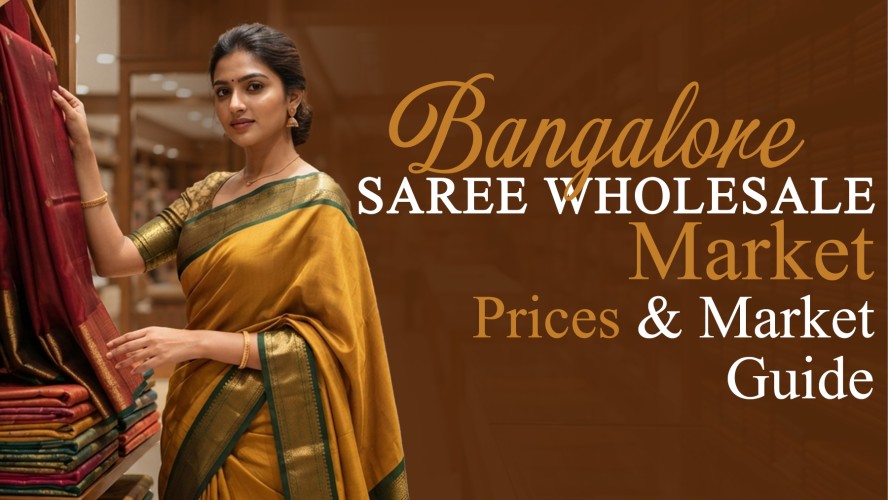
If you typed “Bangalore Wholesale Saree Market” into a search engine, you are probably a retailer, boutique owner, or reseller trying to figure out where to source sarees in bulk from Bangalore, what the market actually looks like, and whether you should travel there or look elsewhere. Maybe you run a store in a neighbouring state and have heard that Bangalore is a good textile hub, or perhaps you are based in Karnataka and want to compare the city’s wholesale options with online suppliers. Whatever brought you here, the answer is not a single large building called “Bangalore Wholesale Saree Market.” The reality is more layered. Bangalore’s saree wholesale activity is concentrated in a few commercial zones — some densely packed with textile traders, others more mixed — that together serve everyone from the small-town retailer buying printed cottons to the premium boutique sourcing traditional Mysore silks. Understanding how these areas work, what they actually stock, and how to separate a genuine bulk supplier from a shop that merely tolerates wholesale orders is essential. This guide explains exactly that. It also looks at when an online B2B partner like Ajmera Fashion Limited can serve as a practical alternative, especially if repeated trips to Bangalore are not in your business plan.
Bangalore does not have a single dedicated wholesale saree complex. Instead, wholesale saree buying is woven into a few key commercial districts, with Chickpet and the adjacent Avenue Road–Balepet stretch being the most significant. Chickpet is one of the city’s oldest and busiest textile trading hubs, where dozens of wholesalers, semi-wholesalers, and retailers operate side by side. You can find everything from daily-wear synthetics and printed cottons to silk sarees and occasion-wear here, but the wholesale depth varies from shop to shop. Avenue Road and Balepet add to this textile ecosystem, especially for fabrics, and some saree wholesalers have a presence here as well. Other areas like Commercial Street are predominantly retail and generally do not offer the bulk pricing a serious sourcing trip demands. The key takeaway: in Bangalore, finding sarees at wholesale rates is less about a single market name and more about knowing which shops in these zones are actually set up for bulk trading.
If there is a closest equivalent to a “saree wholesale market” in Bangalore, it is Chickpet. The area, crisscrossed by lanes like Chickpet Main Road, BVK Iyengar Road, and the surrounding bylanes, is a dense commercial hub where textile, garments, and jewellery trade have coexisted for decades. The saree shops here are not always flashy from the outside; many operate from older buildings with small frontages but deep godowns behind. The wholesale activity is concentrated in specific pockets within Chickpet. Shops specialising in synthetic sarees, polyester blends, and value-focused daily-wear often deal strictly in bulk, with minimum order quantities defined either per design or by total bill value. Nearby, you will find traders stocking silk and art silk sarees, including pieces that cater to the wedding and festive buyer, though the bulk rates here are accessible only when you commit to a meaningful volume.
Chickpet’s character is market-driven. Because it sees a constant flow of outstation retailers — particularly from across Karnataka, Tamil Nadu, and Andhra Pradesh — most wholesalers are comfortable with GST billing and can arrange dispatch via transport services. However, the quality range is broad. A shop that sends you excellent cotton sarees in one order may switch fabric sources next season without telling you. Physically inspecting the stock, comparing at least three to four suppliers for the same product type, and asking for a trial lot before placing a large order is standard practice. Also, do not assume every shop in Chickpet is a pure wholesaler; many have mixed retail and wholesale operations, and you may need to clearly state that you are buying in bulk to get the correct rate.
Running parallel to parts of Chickpet, Avenue Road and the adjoining Balepet area are strongly associated with the textile trade, though their identity leans somewhat more towards fabrics, dress materials, and readymade garment accessories. Even so, several saree wholesalers and distributors operate from the upper floors or inner lanes of this stretch. Balepet, in particular, has a history as a textile market, and you will come across suppliers dealing in cotton sarees, printed designs, and occasional handloom lots. This area tends to be less overwhelming than Chickpet’s narrowest lanes and can be a useful extension of your sourcing trip if you have not found the right quality or price in the main Chickpet shops. As always, walking in with a clear brief and asking direct questions about minimum quantities and bulk rates separates a productive visit from a wasted afternoon.
Commercial Street, MG Road, and Jayanagar are frequently mentioned in shopping guides for Bangalore, but they are overwhelmingly retail destinations. Some shops there may offer a discount if you buy a few extra pieces, but that is not the same as wholesale purchasing. Unless you have a specific contact who has confirmed bulk supply in these areas, spending wholesale sourcing hours there will likely lead to disappointment. Keep your B2B procurement focused on Chickpet, Avenue Road, and Balepet.
Bangalore is the commercial capital of Karnataka, and this status gives it a natural role in the distribution of the state’s celebrated handloom sarees. While the production happens elsewhere — Mysore for silk, Ilkal in Bagalkot district for its distinctive cotton-silk sarees, and other clusters for varieties like Molakalmuru — much of the wholesale aggregation and trading takes place in the city. A buyer visiting Bangalore can therefore access these regional products through wholesale channels, but it requires some knowledge of what you are actually looking for.
Mysore Silk, recognised for its purity and lustre, is a major name. Genuine Mysore silk sarees, typically with a plain body and a rich zari border and pallu, are sold through authorised Karnataka Silk Industries Corporation showrooms, but they also flow through private wholesale distributors in Chickpet. The wholesale price per saree is substantial, given the silk and zari content, and the difference between a pure silk and a blended variant can be hundreds or thousands of rupees. As a retailer, you should ask for the silk mark or a certification where available, and physically examine the reverse side of the zari to gauge its authenticity. Repeat availability from the same supplier is not always guaranteed, so if a particular design sells well, consider booking it early.
Ilkal sarees, with their unique temple border, top-teni pallu, and cotton body, have seen a resurgence in demand from consumers seeking traditional weaves. In Bangalore, several wholesalers in Chickpet and around Avenue Road stock Ilkal sarees in bulk, both in pure cotton and cotton-silk blends. The craftsmanship can vary — a handloom Ilkal will show subtle irregularities that powerloom copies will not. The wholesale rate depends on the count of the yarn, the complexity of the border, and the quantity you pick up. If Ilkal sarees are part of your store’s identity, a Bangalore sourcing trip can help you build direct relationships with suppliers who aggregate from the Bagalkot cluster.
Beyond these two, you may come across Karnataka cotton sarees, including simpler printed or plain versions that cater to the daily-wear segment. These are often produced in nearby textile centres and distributed through Bangalore’s wholesale network. The city is not necessarily the cheapest place to buy such sarees — Surat or other manufacturing hubs may offer tighter pricing — but the convenience of combining Karnataka handloom picking with generic saree replenishment in a single trip is a practical advantage for many regional retailers.
The product mix available through Bangalore’s wholesale channels is a combination of locally significant handlooms and the standard saree categories that every retailer needs. You can expect to find cotton sarees in printed, block-printed, and plain varieties that serve the daily-wear market. Silk and art silk sarees range from economical festive options to premium Mysore silk pieces. Synthetic and daily-wear sarees — polyester, nylon blends, and easy-maintenance fabrics — are widely stocked in Chickpet in bulk-friendly quantities. Party-wear and embroidered sarees with sequins, thread work, and stone embellishments are also available, though their origins often trace back to Surat or Mumbai, with Bangalore acting as a distribution point. Designer-style and contemporary sarees, including those in georgette, chiffon, and crepe, are carried by wholesalers who update their catalogues frequently. Some shops specialise in traditional Karnataka weaves like Ilkal, while others focus on the budget-conscious retailer who needs large volumes of mixed designs.
No single wholesaler covers all of this. A practical sourcing trip might involve one supplier for your Karnataka handloom line, another for party-wear, and a third for everyday printed sarees. The more focused the supplier’s specialisation, the more likely you are to get consistent quality within that niche.
Anyone who promises you a fixed wholesale price list for Bangalore is guessing. The cost of a saree in the wholesale channel moves with the fabric — handloom silk is in a different league from powerloom polyester — the nature of the workmanship, the order volume, and the layer of the supply chain you are buying from. A handwoven Ilkal saree with a real zari border will cost significantly more than a screen-printed cotton daily-wear piece, even when both are bought in bulk. The minimum order quantity also affects the per-unit rate. A shop may quote one rate for a dozen pieces and a meaningfully lower rate for a hundred.
Furthermore, when you are buying Karnataka-specific sarees like Mysore silk, the wholesale price reflects the silk grade, the zari purity, and the supply chain. A distributor who has already acquired a limited lot from KSIC may set a different margin compared to a private manufacturer. Instead of chasing a fixed number, a better approach is to get live quotations from three suppliers for the exact specification you need — fabric, design, quantity — and then compare the landed cost after factoring in transport and any taxes. Always ask whether the quoted price is inclusive of GST and whether packaging is charged separately. Treat all price references as directional, not a rate card.
An effective buying trip to Bangalore’s Chickpet and surrounding areas starts with a clear idea of the customer you serve. If you run a store in a tier-3 town where the average sale price is modest, you will naturally gravitate towards the value-focused synthetic and printed cotton sections of Chickpet. If your boutique specialises in curated handloom pieces, you may begin by contacting a known Ilkal or Mysore silk distributor before you even board the train, so that your visit has a confirmed starting point.
Once you are in the market, walk through a few lanes and observe. Do not stop at the first shop that displays a saree you like. Compare at least three suppliers for the same product type. Ask about the minimum order quantity early in the conversation; some wholesalers have strict per-design MOQs, while others let you mix colours across a category to meet a total bill threshold. Inspect the fabric in natural daylight if possible — many shops have dim lighting that masks colour variations and weaving inconsistencies. Check the borders, the pallu alignment, and the overall finish. If you are buying handloom pieces, look for the small irregularities that indicate genuine hand weaving, and ask the supplier to confirm whether the zari is real or imitation.
Before you pay, get the commercial terms down. Confirm the price per piece, the payment structure (what percentage is advance and when the balance is due), the dispatch timeline, and the supplier’s replacement policy for defective pieces. If you are a registered business, insist on a proper GST invoice. Outstation buyers should decide whether they will carry the stock back themselves or have it transported, and they should factor that cost into the final purchase decision. Finally, start with a trial order. A small quantity, even if it costs slightly more per piece, gives you the chance to test the sarees with your customers before committing your cash to a full bulk purchase.
Selecting a supplier is not about finding the lowest quoted price on a single day; it is about building a chain that supplies consistent quality over multiple seasons. The first thing to check is fabric consistency. A wholesaler might show you an excellent sample, but the bulk lot could have thinner fabric or uneven dyeing. Asking to see a few random pieces from the stock that will actually be dispatched is a reasonable precaution.
Look at how the supplier manages their catalogue. A wholesaler who keeps a reasonably up-to-date image bank and can share photos or videos over WhatsApp makes remote reordering much easier after you return to your city. The minimum order quantity should align with your store’s sales velocity. A supplier who forces a high MOQ on a design you are testing for the first time is not doing you any favours, no matter how attractive the sample looks. Packaging is another often-overlooked detail. Sarees that arrive neatly folded and tagged save you labour time and present a more professional image to your walk-in customers.
Communication separates the reliable partner from the one-time seller. A supplier who responds to your queries within a reasonable time, who informs you when a design is running low or a new lot has arrived, and who takes responsibility when something goes wrong, is worth the relationship. Replacement terms in wholesale are usually limited — most suppliers will only accept returns for genuine manufacturing defects — but a fair wholesaler will at least offer a credit note or a discount on the next order if the mistake is clearly on their side. Finally, check that the billing is proper. A GST-compliant invoice protects your business and allows you to claim input tax credit, which directly affects your net cost.
There are scenarios where a physical visit to Bangalore’s wholesale market makes complete sense. If your store is in Karnataka or a neighbouring state and you can reach Chickpet in a few hours, the trip allows you to touch the sarees, compare multiple suppliers in a single afternoon, and build a face-to-face relationship that smoothens future phone-based reorders. The same applies if your product line revolves around authentic Mysore silk or Ilkal sarees, where seeing the zari, feeling the silk weight, and checking the weave in person are difficult to replicate through photographs. In such cases, the travel cost is an investment in quality assurance.
However, the physical market route has its limits. Travel, accommodation, and time away from the store add to your sourcing cost. The more frequently you need fresh stock, the harder it becomes to justify repeated visits, especially if your store is located far from Karnataka. Moreover, the catalogue you see in a market is limited to what the shops decide to display that day. You might return empty-handed for a specific colour or design that your customers have been asking for. This is where an online B2B supplier becomes not just a convenience but a strategic addition to your sourcing toolkit.
Not every retailer has the time, proximity, or budget to visit Bangalore whenever inventory runs low. Even those who do visit the city’s markets may find themselves wanting to compare what is available elsewhere — more designs, different fabrics, or a supplier who can handle dispatch without requiring a personal appearance. For these buyers, an online B2B partner like Ajmera Fashion Limited offers a practical sourcing alternative.
Ajmera Fashion Limited works with retailers, boutique owners, and resellers across India. Instead of walking through Chickpet’s lanes, you browse a digital catalogue organised by fabric, work, and occasion. You can shortlist the sarees that fit your customer profile and then discuss your bulk requirements — product category, quantity, delivery city — directly with the team over phone or WhatsApp. The company handles dispatch, provides GST-compliant invoices, and is structured to support repeat orders. The process is similar to what you would eventually build with a trusted physical wholesaler, but it removes the geography barrier and gives you access to a wider selection of designs without the cost of travel. For a boutique in a non-metro city, this means competing with the freshness of inventory that bigger stores in urban centres might have. For an established retailer, it means you can add a new category or test a trend without booking a train ticket.
Retailers and boutique owners who want to compare online sourcing options with their current Bangalore supplier relationships can explore Ajmera Fashion Limited’s wholesale range and contact the team with their product requirements and delivery location.
The decision between a Bangalore market trip and an online B2B supplier does not have a universal answer. It depends on the saree category you are buying and your store’s geographical and financial situation. If your core differentiator is genuine Karnataka handlooms that your customers specifically ask for by name, an initial visit to Bangalore to establish a relationship with a dedicated supplier is often a good move. Once the trust is built, many such suppliers are willing to handle repeat orders remotely, reducing the need for frequent travel.
If, on the other hand, your store’s inventory is dominated by printed cottons, daily-wear synthetics, contemporary party-wear, and festive sarees that are produced in multiple textile centres, the origin of the supplier matters far less than the consistency of quality and the freshness of designs. In this scenario, an online B2B supplier can provide a broader catalogue and steadier supply than a single-market visit might offer. Many successful retailers now operate a hybrid model: they source their handloom and specialty pieces from a trusted market contact and replenish their volume lines through an online partner like Ajmera Fashion Limited. This approach keeps the store’s inventory balanced without demanding monthly travel.
One mistake that retailers make repeatedly is getting seduced by a low unit price without examining the product carefully. A saree that looks bright and crisp under a shop’s fluorescent light may look completely washed out in daylight, and a border that seems firm at first touch might unravel after the first wash. Returns are rarely straightforward in wholesale, so the money you thought you saved can vanish quickly.
Ordering too much of an untested design is another classic error. The urge to hit a higher quantity discount bracket is strong, but dead stock sitting on your shelf costs you far more than the extra margin you gained. Start small, test the design with your actual customers, and only then scale up the volume. Transport costs are often underestimated. A batch of sarees picked up at an attractive rate can become an average deal once you add the lorry freight, the local handling charges, and the cost of your own travel. Always calculate the total landed cost per piece before comparing it with other sourcing options.
Not confirming repeat availability is a subtler but equally damaging mistake. A design that sells well in your store creates a demand pipeline. If the supplier cannot reproduce it or has already sold out the lot, you lose the momentum. Ask whether the design is part of an ongoing production run or a one-time stock. Finally, overlooking the basics — GST invoice, replacement terms, dispatch timeline — turns a sourcing trip into a gamble. Reliable wholesalers have no problem putting these terms in writing. If someone refuses to do so, it is usually a signal to find another supplier.
Beyond the immediate purchase, a wholesale saree order should fit into your broader inventory plan. Start by defining the customer segment you are buying for: is this for the price-sensitive daily-wear shopper, the festive buyer who wants something special, or the handloom enthusiast who values craft over cost? Your choice of fabric, design, and price bracket should align with that segment, not with what simply looks attractive in the shop. Consider the seasonality of demand. A heavy silk saree ordered in June might sit unsold until September, tying up your working capital. Lighter cottons and leheriya-inspired prints, on the other hand, move faster during the summer and monsoon months. Spread your bulk purchases across categories that balance high-value slow movers with low-value fast movers, so your cash flow remains healthy.
Inventory turnover is another critical metric. If you typically sell thirty sarees a week, ordering three hundred pieces of one category means you are committing to over two months of that category’s sales in a single purchase. That might be acceptable if the design is evergreen, but riskier if it is trend-dependent. Always have a clear sense of how quickly a given product type moves in your store before committing to a large quantity. Finally, supplier consistency over time matters more than the price of the first order. A wholesaler who gives you a fantastic introductory rate but then varies the quality on the next delivery will disrupt your relationship with your own customers. Approach every new supplier relationship with a test phase, and only make them a core partner after they have proven their reliability across at least two or three orders.
Bangalore’s position as a wholesale saree destination is built on the twin foundations of a concentrated textile trading hub — primarily Chickpet and its surrounding areas — and its role as the commercial gateway for Karnataka’s celebrated handloom sarees. For a retailer, the city offers the chance to physically inspect products, compare multiple suppliers within a compact geography, and build direct relationships with traders who understand the demands of the regional market. Mysore silk, Ilkal, and a wide range of other saree categories can be sourced here, provided you invest the time to separate genuine wholesale suppliers from mixed retail-wholesale shops and assess quality carefully.
At the same time, the logistics and cost of repeated market visits are not always justified by the value they deliver. The saree trade has evolved, and many retailers now complement their physical sourcing with online B2B suppliers who offer catalogue-based selection, direct communication, and doorstep delivery. Ajmera Fashion Limited fits into this modern sourcing model as an option for buyers who want to go beyond Bangalore’s market, compare a wider range of designs, or simply avoid the friction of travel. Whether you decide to walk through Chickpet or browse a digital catalogue, the underlying principle remains the same: know your customer, test new products with small orders, and build your supply chain on consistency rather than the cheapest quote.
If you are a retailer, boutique owner, or reseller looking for wholesale sarees, consider connecting with Ajmera Fashion Limited. Share your saree category, approximate quantity, and delivery city, and the team will guide you through their collection and order process.
For wholesale orders, product catalog, pricing,inquiries within India, please contact our team directly.
📞 Phone / WhatsApp: +91 884 942 9440
📧 Email: info@ajmerafashion.com
Our team will assist you with all your requirements.
What is the Bangalore Wholesale Saree Market?
It is not a single building but a network of commercial areas — primarily Chickpet, Avenue Road, and Balepet — where wholesalers, semi-wholesalers, and retailers trade sarees in bulk. The ecosystem serves retailers and boutiques from across Karnataka and neighbouring states.
Where can I buy sarees wholesale in Bangalore?
The most active wholesale zone is Chickpet, with its dense cluster of textile and saree shops. Avenue Road and Balepet, adjacent to Chickpet, also have saree wholesalers. These areas are where a buyer is most likely to find bulk pricing and GST-compliant invoicing.
Is Chickpet a good place to buy sarees wholesale?
Yes, Chickpet is Bangalore’s primary textile wholesale hub. It houses numerous wholesalers dealing in cotton, silk, synthetic, and party-wear sarees. However, not every shop is a pure wholesaler; you need to compare several and ask directly about bulk rates and minimum order quantities.
What types of sarees can I source in Bangalore?
Cotton, silk, synthetic daily-wear, embroidered party-wear, printed sarees, and traditional Karnataka weaves like Mysore silk and Ilkal sarees are all available. The specific mix depends on the individual supplier’s specialisation.
Are Karnataka sarees available wholesale in Bangalore?
Yes. While the production of Mysore silk happens in Mysore and Ilkal sarees come from Bagalkot, wholesale distributors and private suppliers in Bangalore aggregate these products. You can source them in bulk from select shops in Chickpet and surrounding areas.
How much do wholesale sarees cost in Bangalore?
There is no universal price. Costs vary with fabric (handloom vs powerloom), workmanship, material purity, order volume, and supplier. A genuine handloom Ilkal or Mysore silk saree will have a significantly different wholesale cost from a machine-printed cotton piece.
How do I find a reliable saree wholesaler in Bangalore?
Compare at least three suppliers for the same saree type, check fabric consistency, ask about MOQ, inspect finishing in natural light, and confirm GST invoicing and replacement terms. A trial order before a large purchase is a dependable way to test reliability.
Can I buy wholesale sarees online instead of visiting Bangalore?
Absolutely. Online B2B suppliers like Ajmera Fashion Limited provide wholesale catalogues, direct communication with the team, and door delivery. This is a practical option when travel is not feasible or when you want to access designs beyond what a single market offers.
What should retailers check before placing a wholesale saree order?
Verify fabric quality, colour consistency, border and pallu finishing, minimum order quantity, price per piece inclusive of taxes, dispatch timeline, packaging, and the supplier’s replacement policy for manufacturing defects. Calculate total landed cost before comparing suppliers.
Can retailers outside Bangalore buy from online B2B saree suppliers?
Yes. Many online B2B suppliers, including Ajmera Fashion Limited, work with retailers across India. They handle dispatch to your city and provide the necessary billing documents, making it possible to source sarees without a physical visit to any market.
Discover Bangalore wholesale saree market with thi...
Explore Jaipur saree wholesale market for bulk leh...
A practical B2B guide to Hyderabad's saree wh...
Discover Kolkata saree wholesale market for bulk s...
A practical B2B sourcing guide to Mumbai’s whole...
Explore Delhi saree wholesale market for bulk sare...

