
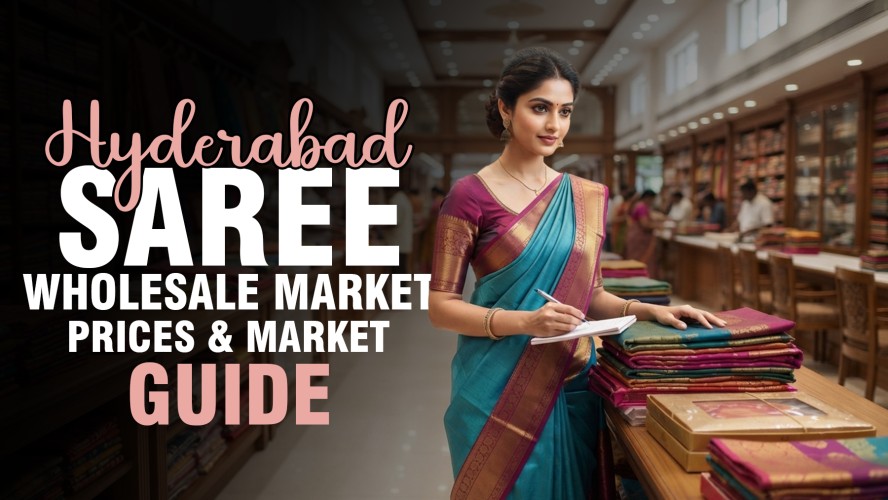
If you typed “Hyderabad Saree Wholesale Market” into a search , you are probably a retailer, boutique owner or reseller trying to figure out where to go in Hyderabad to buy sarees in bulk, what the market is like, and whether a trip to the city makes business sense. You might also be weighing the possibility of sourcing from Hyderabad-based suppliers remotely.
Hyderabad does not have one gigantic, single-market complex dedicated entirely to saree wholesale the way Surat or Delhi’s Chandni Chowk does. Instead, the saree trade here works through a handful of established commercial districts — some with a strong wholesale character, others more mixed — that collectively cater to everything from budget daily-wear pieces to distinct Telangana handlooms. Understanding how these areas function, what they actually offer, and how to separate a genuine wholesale supplier from a high-margin shop calling itself one, is the difference between a profitable sourcing trip and an expensive waste of time. This guide explains exactly that, and it also looks at when an online B2B supplier like Ajmera Fashion Limited might be the smarter route.
There is no single “Hyderabad Saree Wholesale Market” building. Instead, wholesale saree buying is distributed across several well-known commercial hubs. Madina Market near Charminar is arguably the closest thing to a textile wholesale cluster, with numerous shops stocking sarees, dress materials and fabrics in bulk. Sultan Bazaar and the adjoining Koti area are major retail and semi-wholesale destinations where many suppliers also handle moderate-volume orders, particularly for fancy, party-wear and printed sarees. General Bazaar in Secunderabad and parts of Abids have their own smaller concentrations of textile wholesalers, though they are not saree-exclusive. What you find where, and at what terms, depends entirely on the individual shop and your negotiation.
If you ask a long-time retailer in Hyderabad where to go for wholesale sarees, most will point you towards Madina Market, right in the Charminar-Old City precinct. This area is dense, chaotic and overwhelmingly commercial. The lanes around Madina are filled with textile shops, many of them dealing in bulk. You’ll come across everything from polyester and cotton sarees meant for the value-conscious customer to richly embroidered pieces that end up in festive collections. Some shops also stock Pochampally Ikat and other handloom sarees, though they usually keep them in separate godowns or on request rather than in the street-facing display.
Madina works on classic wholesale principles: the more you buy, the better the per-piece rate. However, the quality is not uniform. A shop that sells excellent cotton sarees may carry disappointing synthetic blends. Walking into multiple shops, checking two or three samples per lot, and negotiating firmly is essential. Most sellers here are accustomed to outstation buyers and accept bulk orders with GST bills, provided you meet their minimum quantity expectations. This is not a place for window shopping; come with a clear category, a budget and a willingness to compare.
A few kilometres from Charminar, Sultan Bazaar is one of the city’s oldest and busiest shopping streets. The Telangana Tourism website describes Sultan Bazaar as a major hub for sarees, dress materials and women’s apparel, and that description holds true for anyone who visits. The market is crowded, colourful and largely retail, but tucked inside the lanes and on the upper floors of older buildings are distributors who welcome bulk orders. The wholesale element here is subtler than in Madina; you may not see sacks of sarees piled outside, but if you ask for trade pricing and mention a realistic quantity, many shopkeepers will shift into wholesale mode.
The adjacent Koti area amplifies this semi-wholesale character. It is home to numerous textiles and readymade garment stores, some of which have been supplying retailers in the Deccan region for decades. Sultan Bazaar and Koti are particularly useful for printed chiffons, georgettes, party-wear sarees, and affordable silk blends — categories that move quickly in small and mid-size boutiques. The minimum order quantity here can sometimes be more flexible than in hardcore wholesale zones, which helps a boutique owner who wants twenty pieces across four designs rather than a hundred of one.
General Bazaar is a well-known name in the twin cities’ textile geography, but it is more of an all-purpose clothing and fabric market than a saree specialist. You will find saree shops here, and some do supply in bulk, but the concentration is thinner than Madina or Sultan Bazaar. If you are already visiting Secunderabad for other sourcing — readymade garments, dress materials — it can be worth checking General Bazaar for daily-wear synthetic sarees or printed cotton at competitive rates. Manage your expectations: you may need to visit several shops before finding one genuinely interested in a wholesale order.
Abids is primarily a retail destination, and its saree stores cater mostly to walk-in customers. A few long-established textile businesses here have a parallel wholesale desk, but that is more the exception. If you have a specific contact or a supplier recommendation, Abids can yield good products, especially for silk sarees and occasion-wear. For a first-time sourcing trip without a reference, Madina and Koti will prove more efficient.
Hyderabad’s wholesale saree trade is deeply coloured by the region’s handloom heritage. Even when a shop stocks generic party-wear or synthetic sarees, the talk of quality and authenticity often circles back to the handloom clusters of Telangana. Understanding this context helps you ask better questions and avoid being sold a powerloom replica at a handloom price.
The most famous name is Pochampally Ikat. Produced in Bhoodan Pochampally of the Yadadri Bhuvanagiri district, these sarees use a resist-dye technique on warp or both warp and weft threads, creating blurred geometric and abstract patterns that are impossible to replicate exactly on powerlooms. They come in cotton, silk and cotton-silk blends. Telangana Tourism and GI certification documents describe Pochampally Ikat as an integral part of the state’s identity. In Hyderabad’s markets, genuine handloom Pochampally sarees are available, but they sit alongside machine-made variants that borrow the same motifs. The price gap is significant, and only a close inspection — checking for the slight irregularities that mark a true handloom — will tell them apart. For a retailer, placing Pochampally Ikat in the store can attract customers who value regional craft, provided you can clearly communicate authenticity.
Other Telangana handlooms, like Gadwal and Narayanpet, also filter into the city. Gadwal sarees, with their distinctive silk body and cotton pallu featuring zari work, have a niche but devoted following, particularly during weddings. Narayanpet sarees, lighter and often in earthy tones, cater to a similar handloom-loving segment. These sarees are not stocked by every shop; they usually require a dedicated handloom supplier or a visit to a co-operative showroom. Wholesale buyers interested in these categories often combine a Hyderabad market trip with a visit to the weaving clusters themselves, though that adds time and cost.
The product mix in Hyderabad’s wholesale channels reflects the city’s role as both a consumption centre and a distribution point for the Deccan region. You can broadly expect to find cotton sarees — everyday printed, block-printed and plain dyed cottons that form the bread and butter of many retail stores. Handloom cotton sarees with Ikat designs or fine counts are also available, though the wholesale lot sizes may be smaller per design compared to machinemade stock. Silk sarees range from art silk and blended silk meant for the value festive segment to pure silk and tussar. Fancy and party-wear sarees in georgette, chiffon, net, and crepe, often with embroidery, sequins or zari work, are widely carried by Koti and Sultan Bazaar suppliers. Synthetic and daily-wear sarees, including nylon-like blends and polyester, make up a significant volume at Madina and General Bazaar.
Availability is not uniform. A shop known for fancy sarees may have no cotton at all. A Madina wholesaler dealing in bulk synthetic sarees might direct you to a different lane for silk. Building a small panel of two or three complementary suppliers is standard practice for serious buyers.
There is no city-wide wholesale price list. The cost per saree shifts with fabric (handloom vs powerloom, pure silk vs art silk), the complexity of workmanship (hand-embroidered vs machine, real zari vs imitation), the order quantity, and the layer of the supply chain you are buying from. A direct transaction with a small weaver’s collective may look completely different from a bulk purchase from a distributor who has already aggregated goods from several sources.
Entry-level printed cotton sarees, when bought in reasonable wholesale quantities, can begin in a range of a few hundred rupees per piece. A genuine handloom Pochampally silk saree with fine work, even at wholesale, can run into several thousand rupees. Party-wear embroidered sarees show a wide band because the cost of workmanship dominates the fabric cost. Treat any figure you hear as a starting point; your final rate will depend on the specification you provide, the volume you commit to, and the payment terms you negotiate.
The most effective approach is not to arrive with a vague idea of “buying sarees” but with a clear picture of your customer. If your store serves value-conscious daily-wear buyers, you will head to Madina looking for cotton and synthetic sarees with a per-piece budget already set. If you run a boutique that sells curated handloom pieces, you will spend more time in handloom-specific supplier outlets or co-operative showrooms, or you might even pre-schedule a visit to a known distributor of Telangana handlooms.
Once in the market, comparing at least three shops for the same saree category gives you a realistic sense of the prevailing quality and price. Do not hesitate to ask what the minimum order quantity is — some suppliers insist on a minimum number of pieces per design, while others work on a total bill amount. Physically inspect the fabric: look for consistent dyeing, straight borders, and secure stitching. If possible, step into daylight or a well-lit area; the yellow bulbs inside many shops can mask colour mismatches. Request a few photographs of the designs you shortlist and note down the rates. Before paying, clarify whether the price includes GST, what the dispatch timeline is, and what the replacement policy covers. A small trial order is always safer than trusting a new supplier with a large cheque on the first meeting. If the sarees sell well, you can reorder with greater confidence.
Seasoned buyers learn quickly that a low price is worthless if the next batch does not match the sample. Good wholesalers show consistency across orders. They keep a catalogue or image bank that is reasonably current, and they communicate transparently about what is in stock, what can be reproduced, and what was a one-time lot. Minimum order quantities should be discussed upfront, and a supplier who is willing to work with a small order on a trial basis can be a valuable long-term partner for a growing business.
Check the packaging — sarees that arrive crushed, poorly folded or untagged add work for your staff. Ask about dispatch reliability, especially around festival seasons when demand spikes. Insist on proper GST invoices; this protects your business and lets you claim input tax credit if you are registered. Replacement terms are rarely generous in wholesale, but a supplier who acknowledges a genuine manufacturing defect and offers a credit note is far more reliable than one who refuses to answer your call after the bill is paid. Finally, observe how the supplier communicates: if he responds clearly to your questions and sends real-time product photos when you request them, the chances of a smooth long-term relationship are much higher.
A physical trip makes sense when you need to authenticate a handloom product personally — holding a Pochampally silk in your hands tells you more than any photograph can. It also helps if you are building initial relationships with suppliers, or if your store is in a neighbouring state and a two-day visit is economical relative to the order volume.
But the classic wholesale sourcing trip has real limitations. Travel and stay add to your cost, and the time spent navigating traffic and comparing shops could be used to run your existing business. If you are based far from Hyderabad, the economics may not add up for anything less than a very large order. Furthermore, what you find in the market is limited to what the shops decide to display during your visit. If you need a specific saree type — say, a particular shade of embroidered georgette — you might not find it even after two days of searching. This is where a well-organised online B2B supplier changes the sourcing equation.
A growing number of retailers and boutique owners now treat the physical market as one sourcing channel among many, not the only one. When you cannot visit Hyderabad, or when you want to access a wider range of designs without the cost and effort of travel, an online B2B partner like Ajmera Fashion Limited offers a practical alternative.
Ajmera Fashion Limited works with retailers, resellers and boutique owners across India. Instead of asking you to walk through market lanes, the company presents its wholesale collection through a digital catalogue. You can view sarees by fabric, work, occasion and price band, and then directly discuss your bulk requirements — category, quantity, delivery location — with the team. The communication happens over phone or WhatsApp, much like you would finalise a deal with a supplier after a market visit. Proper GST invoices, dispatch support and repeat-order consistency are part of the arrangement.
For a boutique owner in a non-metro city, this means access to designs that may not be available through local intermediaries. For a multi-store retailer, it means you can compare a fresh range without booking a train ticket. The value lies in convenience, design variety and the ability to start with a smaller trial order. It does not replace the tactile experience of a market visit — but not every order needs that level of physical inspection, especially once you have built trust with a supplier.
If you are currently comparing Hyderabad market options with wider sourcing possibilities, reviewing Ajmera Fashion Limited’s wholesale range can add a useful dimension to your buying decision. You may contact them with your specific saree category, approximate quantity, and delivery city to understand what they can offer.
The answer depends entirely on what you are sourcing and where you are located. If authentic Telangana handlooms — Pochampally Ikat, Gadwal, Narayanpet — are central to your store’s identity, a visit to Hyderabad at least once can help you identify a reliable supplier whose quality you can personally verify. The market trip then becomes an investment in a long-term relationship that can be sustained through telephonic repeat orders later.
If your store primarily sells printed cottons, daily-wear synthetics, or contemporary party-wear, the geographic origin of the supplier matters less than the consistency of quality and the freshness of designs. Here, an online B2B supplier may not only match but exceed what a single physical market can offer, because the online catalogue is not constrained by what fits inside a shop. Many retailers adopt a hybrid model: they visit Hyderabad for the handloom line they market heavily, and use an online supplier like Ajmera Fashion Limited for the rest of their inventory replenishment. This keeps the store stocked without monthly travel.
One of the most frequent errors is buying purely on price. A saree that looks attractive at a low wholesale rate may lose colour after the first wash or have uneven weaving that customers reject. The return and replacement hassle eats up whatever margin you thought you saved. Another mistake is ordering large quantities of an untested design. A small trial order — even if the per-piece cost is slightly higher — tells you what your customers will actually pay for. Only then should you scale up.
Ignoring fabric details is another pitfall. With handloom products especially, the difference between genuine and imitation is not always obvious in a dimly lit shop. Ask direct questions about yarn, weave and zari content, and if you are not confident, bring someone who is or invest in a small piece to test at home. Overlooking the total landed cost — including transport, packing and your own travel if applicable — distorts the real purchase price and makes it harder to set retail prices properly. Finally, not confirming invoice and replacement terms in writing leaves you with no recourse if the bulk lot does not match what you selected. A reliable supplier will have no problem putting the basic terms on paper.
Hyderabad’s saree wholesale ecosystem is real, practical and worth understanding, but it does not work like a single stop. Madina, Sultan Bazaar, Koti and to a lesser extent General Bazaar each offer different product mixes, trading styles and price ranges. Getting the best out of these markets means knowing your customer, comparing suppliers patiently, and checking quality at every step. The city’s proximity to Telangana’s handloom clusters adds a unique dimension that generic wholesale hubs cannot replicate, especially for retailers who want to tell a regional story through their products.
That said, travelling to Hyderabad is not the only way to stock sarees. Online B2B suppliers have matured to a point where many retailers now blend physical market visits with remote sourcing, choosing the channel that fits the product category and the order frequency. If you are exploring wholesale saree options — whether you start in Hyderabad or not — consider connecting with Ajmera Fashion Limited as well. Discuss your product requirements, quantity and delivery city, and see if their range and service can complement your existing supplier relationships or serve as your primary sourcing channel. A well-planned wholesale buying strategy is not about loyalty to a market; it is about building an inventory that moves.
To discuss wholesale saree requirements with Ajmera Fashion Limited, reach out with your preferred saree type, approximate quantity, and delivery location, and the team will guide you through available designs and pricing.
For wholesale orders, product catalog, pricing,inquiries within India, please contact our team directly.
📞 Phone / WhatsApp: +91 884 942 9440
📧 Email: info@ajmerafashion.com
Our team will assist you with all your requirements.
Ajmera Fashion Limited
What is the main saree wholesale market in Hyderabad?
There is no single “main” market. Madina Market near Charminar is the closest to a concentrated textile wholesale area, while Sultan Bazaar, Koti and General Bazaar also have significant saree wholesale activity. Each area has a different mix of products and trading styles.
Where can I buy sarees wholesale in Hyderabad?
Madina Market, Sultan Bazaar, Koti, and General Bazaar in Secunderabad are the primary areas. Madina is the most wholesale-oriented, while Sultan Bazaar and Koti offer a blend of retail and bulk. Your exact destination depends on the saree type you need.
Is Madina Market suitable for wholesale saree buying?
Yes. Madina Market is known for textile wholesale, including sarees, dress materials and fabrics. Many shops are experienced with outstation buyers and offer volume-based pricing. Expect to compare several shops to find the right quality and terms.
Is Sultan Bazaar a wholesale saree market?
Sultan Bazaar is a busy shopping street with a strong retail character, but it also houses wholesalers and semi-wholesale distributors, especially for fancy, party-wear and printed sarees. For moderate quantities, you can often negotiate wholesale rates directly with shop owners.
Which sarees are associated with Telangana?
Pochampally Ikat is the most famous, a handloom with double-ikat tie-dye patterns. Gadwal and Narayanpet sarees are also part of the state’s textile tradition. These can be sourced in Hyderabad, though genuine handloom pieces require careful verification.
Can I buy sarees wholesale online instead of visiting Hyderabad?
Absolutely. Several B2B suppliers, including Ajmera Fashion Limited, offer online wholesale saree catalogues with direct communication and dispatch. This can be a practical alternative when travel is not feasible or when you need a wider design selection.
What should retailers check before buying sarees wholesale?
Check fabric quality, colour consistency, finishing, minimum order quantity, price per piece, GST billing, dispatch timeline and replacement policy. A small trial order is recommended before committing a large volume to any new supplier.
How can I find a reliable saree supplier?
Start by defining your saree category, then compare at least three suppliers on product quality, pricing transparency, MOQ flexibility, packaging, dispatch reliability and responsiveness. A trial order and consistent communication are the best ways to test reliability.
Can I order wholesale sarees from outside Hyderabad?
Yes. Many Hyderabad-based suppliers accept orders from outstation retailers, and online B2B platforms further simplify the process. Confirm logistics costs, payment terms and delivery timelines before placing an order.

Discover Bangalore wholesale saree market with thi...

Explore Jaipur saree wholesale market for bulk leh...

A practical B2B guide to Hyderabad's saree wh...

Discover Kolkata saree wholesale market for bulk s...
A practical B2B sourcing guide to Mumbai’s whole...

Explore Delhi saree wholesale market for bulk sare...

