
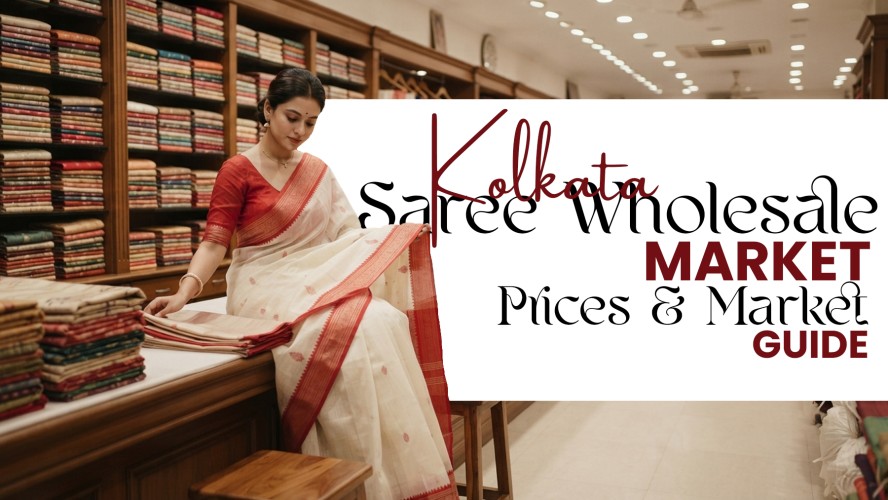
When you search “Kolkata Saree Wholesale Market,” you are likely a retailer, boutique owner, reseller, or fashion entrepreneur trying to understand where to buy sarees in bulk from Kolkata, what products are available, how pricing works, and what to watch out for before placing a large order. Kolkata has a deep-rooted textile heritage, and its wholesale ecosystem – though less frequently written about than Delhi or Mumbai in generic listicles – serves thousands of businesses across eastern India and beyond. This guide gives you exactly what you need: a factual, B2B-focused walkthrough of the Kolkata wholesale saree landscape, practical tips for comparing suppliers, and an honest look at when it makes more sense to source online through a partner like Ajmera Fashion Limited. By the end, you’ll be able to plan a Kolkata sourcing trip or make an informed decision about remote wholesale buying.
Kolkata’s significance in the saree trade comes from three interconnected strengths. First, the city is surrounded by some of India’s most celebrated handloom clusters – Fulia and Shantipur for Tant, Murshidabad for silk, Bishnupur for Baluchari, and Nadia for Jamdani. Many weavers and small manufacturers in these districts channel their output through Kolkata’s wholesale markets, making the city a natural aggregation point. Second, Kolkata has historically been a major textile trading centre; the Burrabazar–Barabazar belt is among the largest wholesale textile markets in eastern India, dealing not just in sarees but also in dress materials, fabrics, and readymade garments. Third, the demand for traditional Bengali sarees remains steady across Indian retail segments, especially during Durga Puja, wedding seasons, and festive periods, which ensures a consistent volume of wholesale activity. For a boutique owner in Guwahati or a retailer in Patna, Kolkata often represents the closest major sourcing hub for authentic handloom products that carry strong regional appeal.
While Kolkata does not have a single dedicated “saree wholesale market” building, several well-established commercial zones collectively form the wholesale saree ecosystem. Understanding each area’s character helps you plan your visit.
Burrabazar is the undisputed nerve centre of wholesale textiles in Kolkata. The interconnected lanes around Mahatma Gandhi Road, Rabindra Sarani, and Nakhoda Masjid are packed with wholesalers, distributors, and stockists dealing in sarees, fabrics, and dress materials. Buyers can typically find cotton Tant sarees, printed cottons, synthetic blends, and occasionally silk varieties. The area is a maze; many shops operate from small godowns and may not have the polished storefront of a retail outlet. This is a pure business district, so you must be clear about your requirements before entering. Most suppliers deal with bulk orders and are accustomed to outstation buyers, but they may not offer extensive sampling unless a serious purchase intention is visible.
Often used interchangeably with Burrabazar, Barabazar specifically refers to the older trading blocks and includes shops that have been in the saree business for generations. Some establishments here specialise in Jamdani, Garad-Korial, and silk sarees, especially those sourced from Murshidabad and Varanasi. Because this zone has a mix of wholesale and semi-wholesale traders, small boutique owners may find suppliers willing to offer slightly lower MOQs than the hardcore Burrabazar wholesalers. Prices here are still volume-dependent, so visiting with a clear category and budget is essential.
A few saree distributors and wholesalers are scattered around College Street, Bowbazar, and the surrounding lanes. These are not massive clusters but can be useful for printed sarees, georgette, chiffon, and low- to mid-range party-wear sarees. Some traders here also supply small-town retailers who visit Kolkata seasonally. While the concentration is lower than Burrabazar, it is worth checking if you are already in the area for other textile shopping.
Not every shop in these areas sells sarees. A shop displaying dress materials may stock sarees in the back, or a fabric wholesaler may occasionally have saree lots. The most effective strategy is to ask about your specific saree category upfront, compare at least three to four suppliers, and walk away if the quality or MOQ does not match your requirements. Kolkata’s wholesale markets are not curated; they reward buyers who do their homework.
The product mix you encounter in Kolkata is heavily influenced by West Bengal’s handloom culture, but powerloom and synthetic sarees are also widely distributed. Key categories include:
Tant sarees: Lightweight cotton handloom sarees known for their crisp texture and colourful borders. Available in a wide range of designs and price points, making them a staple for daily-wear retail.
Jamdani sarees: Fine, often cotton-based sarees with intricate woven motifs. Genuine handwoven Jamdani can be expensive; powerloom versions are common at lower wholesale rates. Buyers should clarify handloom vs powerloom before ordering.
Baluchari sarees: Silk sarees depicting mythological and historical motifs on the pallu. High-value products, typically sourced by boutiques and premium retailers for wedding and festive collections.
Garad and Garad-Korial sarees: Traditional Bengali silk sarees used during pujas and ceremonies. Available in pure silk and art silk variants; wholesale suppliers usually offer both.
Tussar silk sarees: With their textured feel and natural gold sheen, these appeal to a niche but loyal customer base. Many wholesalers in Barabazar keep Tussar sarees from Murshidabad and Bihar clusters.
Kantha sarees: Hand-embroidered sarees with running-stitch work. Availability in pure wholesale is lower compared to Tant or Jamdani, but some distributors supply to boutique buyers.
Cotton sarees (printed and plain): Beyond Tant, plain cotton sarees, block prints, and dyed cotton varieties are readily available for daily-wear and casual segments.
Silk sarees (Mulberry, art silk): Apart from Baluchari and Garad, plain or embroidered silk sarees from various Indian clusters are also distributed through Kolkata.
Party-wear sarees (georgette, chiffon, net, embroidered): Many wholesalers stock non-traditional party-wear sarees with zari, stone work, and sequins to cater to the growing contemporary demand. These are often sourced from Surat and other manufacturing hubs and resold through Kolkata distributors.
A typical Kolkata wholesale trip for a multi-brand retailer might involve buying Tant and printed cotton sarees from one set of suppliers, Jamdani and Garad from another, and party-wear embroidered sarees from a third. No single wholesaler covers everything, so building a small vendor panel is standard practice.
Any article claiming a fixed wholesale price list for Kolkata is inventing numbers. The per-piece cost depends on several variables:
Fabric and yarn quality: A fine-count handwoven Tant will cost more than a coarser powerloom cotton, even if both look similar on a screen.
Handloom vs powerloom: Authentic handloom Jamdani with real zari can be multiple times more expensive than a machine-made imitation. Wholesalers usually disclose this if asked directly.
Workmanship: Hand embroidery, intricate motifs, and genuine silk zari push the price upward; machine embroidery and digital prints are more affordable.
Order volume: Wholesale pricing is volume-driven. A small order of 6 pieces per design will carry a higher unit price than an order of 60 or 600 pieces.
Supplier level: Buying directly from a manufacturer or a weaver cooperative may yield lower rates compared to a multi-layer distributor, but MOQs and logistics may differ.
Seasonality: Prices for traditional silk sarees often rise ahead of Durga Puja and wedding seasons due to high demand.
Additional costs: If you require specific folding, tagging, or packaging, the landed cost per saree increases. Transportation from Kolkata to your store is also a significant add-on for outstation buyers.
As a very broad directional indicator, entry-level printed cotton sarees can begin in the range of a few hundred rupees per piece in bulk, while a handwoven Jamdani or Baluchari silk saree may cost several thousand rupees even at wholesale. Always get a live quotation against a defined product specification and quantity; never treat a general price range as your final cost.
A structured approach saves money, reduces mistakes, and helps you compare suppliers effectively.
Define your customer profile – Are you stocking for value-conscious daily-wear buyers, premium festive shoppers, or a mix?
Shortlist saree categories – Choose two to four categories for a single trip. Trying to source ten different types dilutes your negotiation power.
Set a budget per saree and total outlay – This keeps you from overspending on a single beautiful piece that may not sell.
Visit multiple suppliers – For each saree type, check at least three wholesalers. Note down prices, MOQ, and fabric feel.
Ask about MOQ upfront – Some Kolkata wholesalers require a minimum number of pieces per design; others work on a total bill amount. Clarify before discussing prices in detail.
Inspect fabric and finishing – Touch the saree, check the border alignment, look at the consistency of colour, and if possible, see the saree in daylight or under white light. Kolkata’s wholesale shops are often dimly lit.
Request catalogue access or sample images – Many suppliers may not part with free samples but will let you photograph approved designs or share pictures via WhatsApp.
Confirm pricing and payment terms – Get the rate per piece in writing, understand the advance percentage, and clarify whether GST is included. If you are a registered business, insist on a proper GST invoice.
Plan logistics – If you are from outside Kolkata, decide whether you will carry the stock personally or arrange a transport service. Some wholesalers can dispatch via courier or transport at an additional cost.
Start with a trial order – A smaller initial purchase reduces risk and lets you test the product’s acceptance in your market before committing a large volume.
Kolkata’s wholesale markets have undeniable strengths, especially for traditional Bengali sarees. But travelling to a physical market is not always feasible for every retailer. If you are based in a tier-3 town, or if you need to source multiple saree categories beyond what Kolkata specialises in, a purely market-dependent approach may limit your growth. Additionally, the time and cost of a Kolkata trip must be weighed against the volume you intend to purchase. For a boutique owner who needs twenty pieces of six different designs, the economics of travel may not justify the visit.
This is where an online B2B partner like Ajmera Fashion Limited adds value to your sourcing strategy. The company works with retailers, boutique owners, and resellers across India, providing a digital wholesale catalogue that spans cotton, silk, georgette, embroidered, and printed sarees. Instead of navigating Burrabazar’s lanes, you can browse products remotely, compare designs, and discuss your bulk requirements directly with the team. Ajmera Fashion Limited handles dispatch and can provide GST-compliant invoices, making it suitable for both new and established businesses.
For retailers who want to compare online wholesale sourcing options, Ajmera Fashion Limited can be explored as an additional B2B supplier alongside existing market relationships.
For wholesale orders, product catalog, pricing,inquiries within India, please contact our team directly.
📞 Phone / WhatsApp: +91 884 942 9440
📧 Email: info@ajmerafashion.com
Our team will assist you with all your requirements.
What is the Kolkata Saree Wholesale Market?
It is the collective wholesale textile trading zones in Kolkata, primarily in Burrabazar and Barabazar, where retailers and boutiques can buy sarees in bulk. These markets are known especially for handloom products like Tant, Jamdani, Baluchari, and Garad sarees.
Where can I buy sarees wholesale in Kolkata?
The most active wholesale areas are Burrabazar (near Mahatma Gandhi Road and Nakhoda Masjid) and the adjacent Barabazar. Some suppliers in College Street and Bowbazar also deal in printed and party-wear sarees, though concentration is lower.
Which sarees are commonly sourced from Kolkata?
Tant cotton sarees, Jamdani sarees, Baluchari silk sarees, Garad-Korial sarees, Tussar silk, Kantha embroidered sarees, and a variety of printed cotton and party-wear sarees are commonly available through Kolkata’s wholesale network.
How much do wholesale sarees cost in Kolkata?
There is no fixed rate. Prices vary with fabric (handloom vs powerloom), workmanship, order quantity, and supplier level. A handwoven Jamdani can cost several thousand rupees per piece, while machine-printed cotton sarees may start from a few hundred rupees in bulk.
How do I choose a reliable saree wholesaler in Kolkata?
Evaluate fabric consistency, MOQ flexibility, pricing transparency, packaging quality, dispatch reliability, and the supplier’s willingness to provide proper GST invoices. A trial order is the safest way to test consistency.
What is MOQ in saree wholesale?
MOQ stands for Minimum Order Quantity – the smallest number of pieces or total order value a supplier will accept. It can be per design, per colour, or across a category, and it varies between wholesalers.
Can I buy sarees wholesale online instead of visiting Kolkata?
Yes. B2B platforms like Ajmera Fashion Limited allow you to browse and order wholesale sarees online without travelling. This is especially useful for retailers who are based far from Kolkata or who need to compare a wider range of designs.
Can retailers outside Kolkata buy from Kolkata saree suppliers?
Absolutely. Many Kolkata wholesalers supply to outstation retailers, and communication via phone and WhatsApp is common. Online B2B suppliers further simplify the process by handling dispatch and documentation.
What should I check before placing a bulk saree order?
Confirm fabric, finishing, colour consistency, MOQ, price per piece, payment and billing terms, dispatch time, packaging, and the supplier’s replacement policy. A small trial order is recommended before committing large volumes.
Is online saree wholesale suitable for boutiques?
Yes. Boutique owners can benefit from online wholesale catalogues that offer a wide range of designs, clear pricing, and the ability to order small quantities initially. Ajmera Fashion Limited, for example, works directly with boutique buyers to understand their curation needs.
How can I contact a wholesale saree supplier like Ajmera Fashion Limited?
Visit the Ajmera Fashion Limited website, browse the wholesale saree range, and use the enquiry form or contact details to discuss your specific product requirements, quantity, and delivery location.
Delhi Saree Wholesale Market: A Complete Guide for Bulk Buyers
Mumbai Saree Wholesale Market: A Complete Guide for Bulk Buyers
Discover Bangalore wholesale saree market with thi...

Explore Jaipur saree wholesale market for bulk leh...

A practical B2B guide to Hyderabad's saree wh...

Discover Kolkata saree wholesale market for bulk s...

A practical B2B sourcing guide to Mumbai’s whole...
Explore Delhi saree wholesale market for bulk sare...

